
René Descartes1596–1650
Curvature relation between tangent circles
Mathematician and philosopher whose circle theorem relates the curvatures of four mutually tangent circles, enabling recursive circle packing.
Three circles that touch, and the one circle that fits between them, and then the three new gaps, without end.
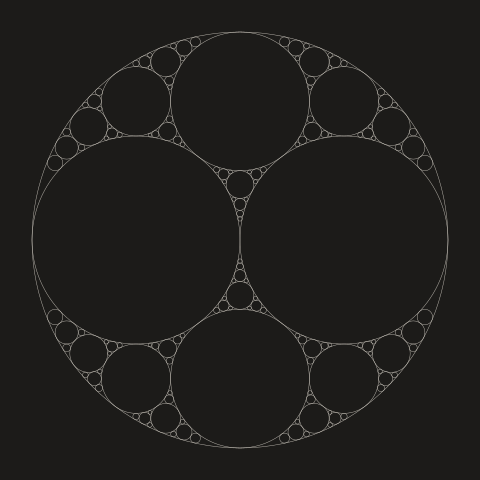
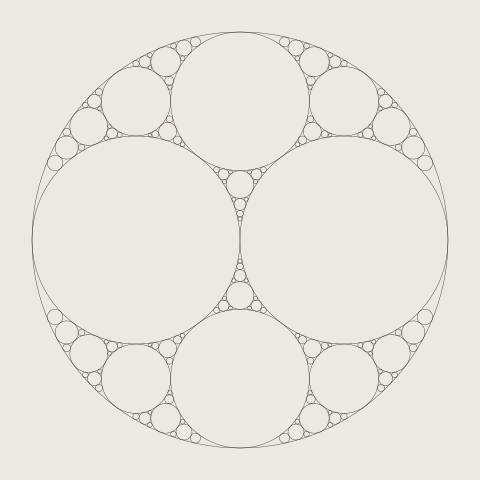
Apollonius of Perga · Descartes' circle theorem, 1643
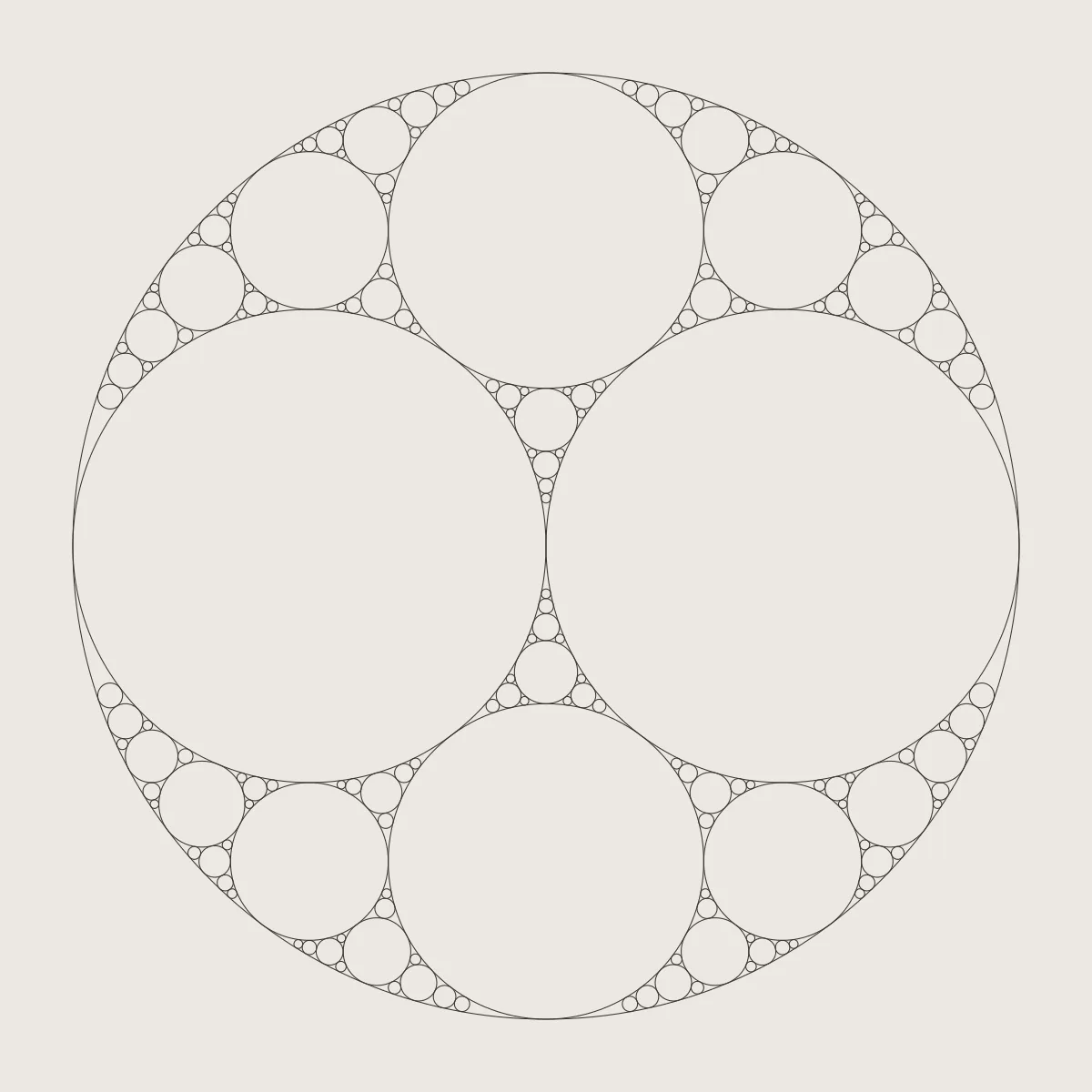
Every gap between three mutually tangent circles admits exactly one more circle, and Descartes' theorem gives its size straight from the other three: the curvatures satisfy a quadratic, so the new one is found rather than fitted. Applied to the gaps it makes, and then to theirs, it fills the disc completely while the circles themselves cover no area at all, and what is left has dimension about 1.3, which is neither a curve nor a surface.
Behind the mathematics
Curvature relation between tangent circles
Mathematician and philosopher whose circle theorem relates the curvatures of four mutually tangent circles, enabling recursive circle packing.