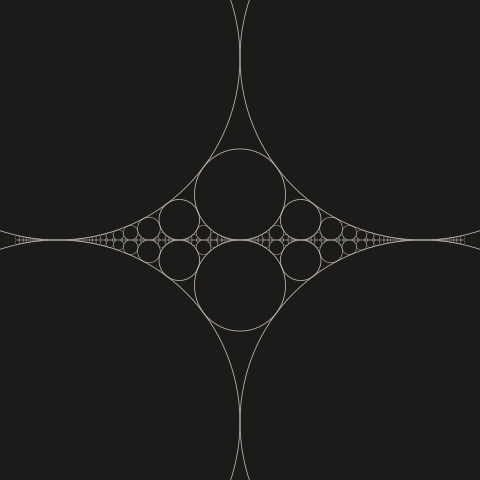
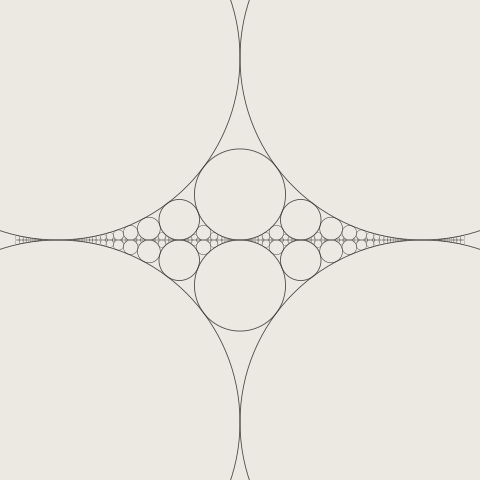
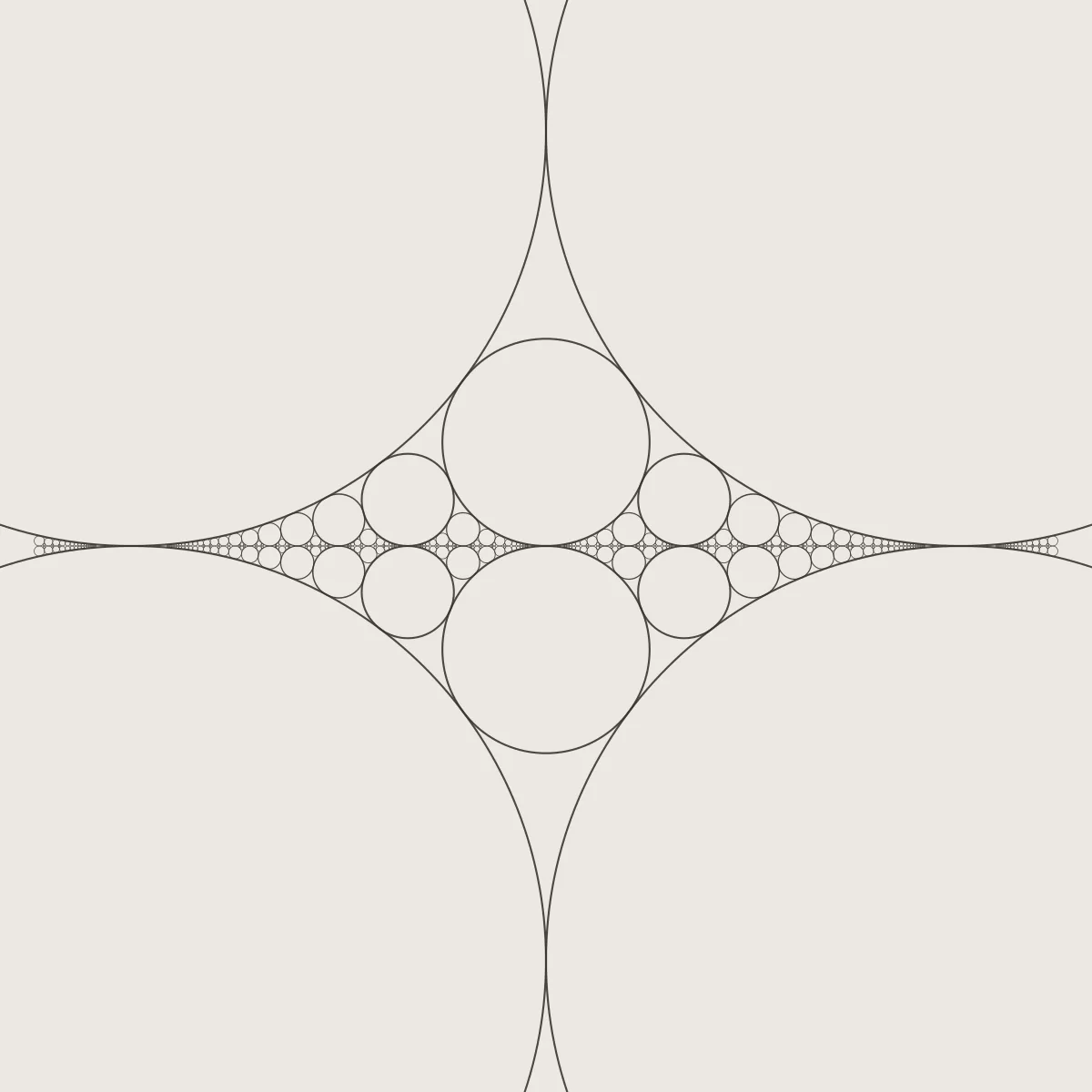
Above every fraction sits a circle, the smaller the bigger its denominator. Neighbouring fractions' circles touch, and no two ever overlap, so the rationals become a lace that never ends.
Over each fraction p/q in lowest terms, stand a circle of diameter 1/q² on the number line. Lester Ford described them in 1938 in a paper called simply "Fractions": two circles touch exactly when the fractions are neighbours, p/q and r/s with ps − qr equal to one or minus one, and otherwise they never meet.
Between any two that touch, the next to arrive is their mediant, (p + r)/(q + s), which is how fractions enter the Farey sequence. The circles over the stretch from 0 to 1 cover about 87% of the square they sit in: the area is 45ζ(3)/2π³, which brings in the Riemann zeta function.
Drawn with Farey arcs, every pair of neighbours is joined by a half circle that passes through the point where their circles kiss; in the disc those arcs become the Farey tessellation of the hyperbolic plane.
Choose the disc to see the half plane carried into a circle by the Cayley map, which keeps circles round and keeps every touch a touch.
In motion the circles slide one whole unit along the line, which brings back exactly the same picture.
American mathematician who described the circles over the fractions in his 1938 paper "Fractions", edited The American Mathematical Monthly from 1942 to 1946 and was president of the Mathematical Association of America in 1947 and 1948.