Openness · Balance · Tonal depth
Shapes that repeat themselves at every scale. Julia and Mandelbrot sets, L-system plants, space-filling curves and circle packings, each grown from a short rule applied again and again.
Openness · Balance · Tonal depth
Balance · Rotation · Tonal depth
Curl · Branching · Contour bands
Spread · Branching · Tonal depth
Recursion · Strand width · Tonal depth
Order · Rotation
Depth
Zoom · Detail
Points
Order · Weight · Rotation
Contact angle · Scale · Weight
Sides · Meeting at a corner · Rings
Rule · Cells across · First row
Columns · Depth · Split chance
Folds · Weight · Corner
Depth · Weight · Face contrast
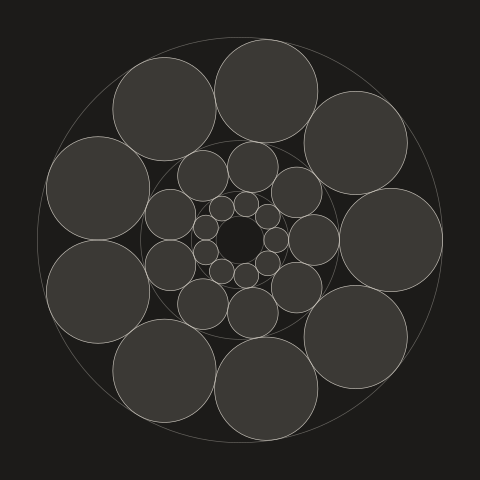
Circles · Nested chains · Weight
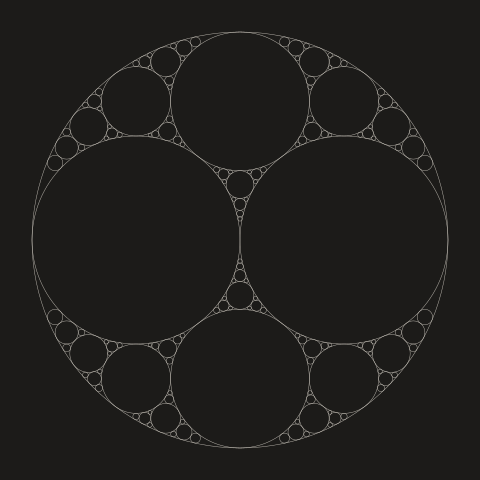
Depth · Weight · Smallest
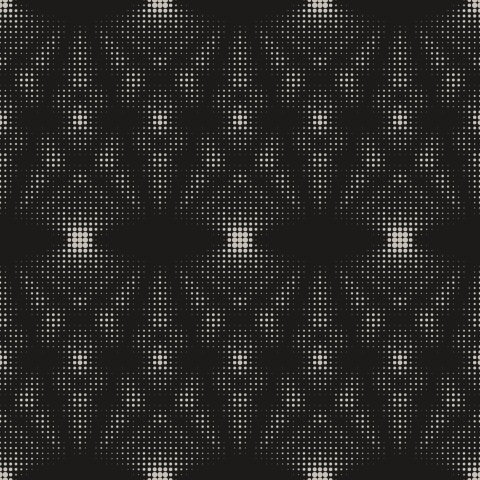
Slits across · Depth · Slit width

Grains · Grains poured · Grid size
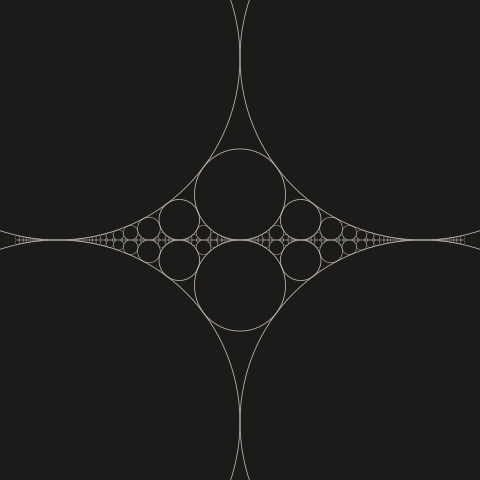
Denominators up to · Laid out · Farey arcs
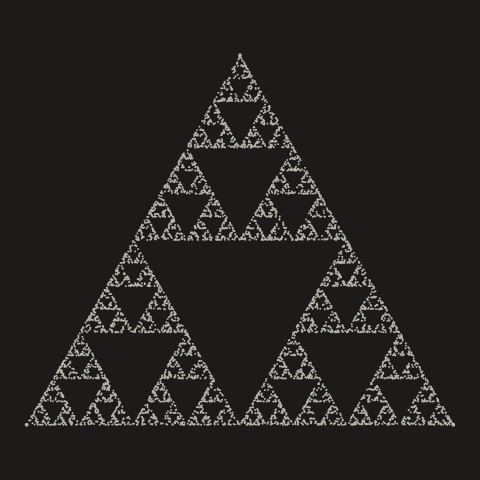
Played on · Corners · Jump towards the corner
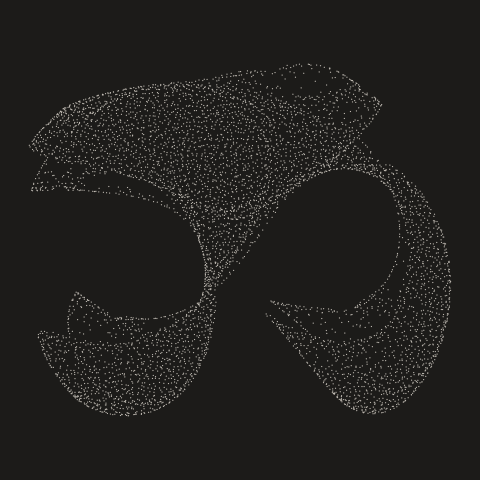
Formula · Shape · a
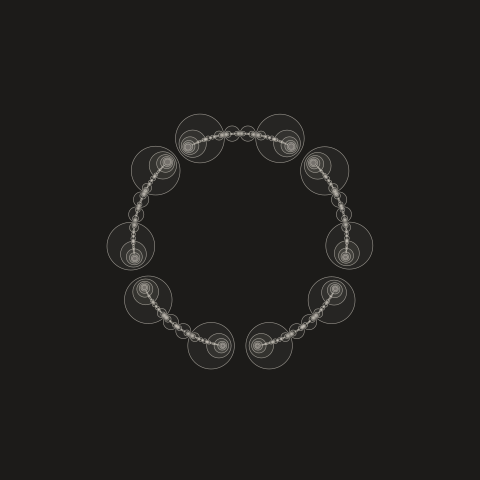
Circles reflected through circles become intricate necklaces. Quiet openings hold the composition while tiny pearls collect around their edges.
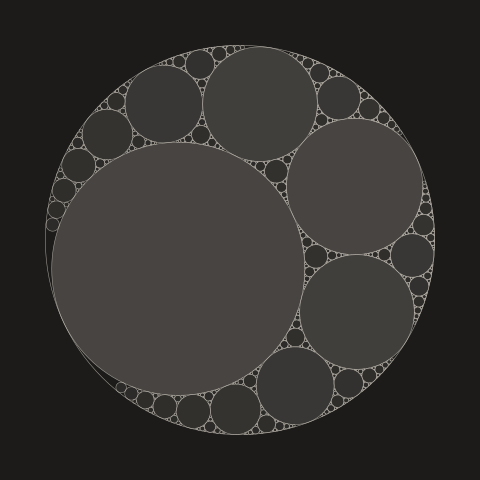
A few generous circles give way to constellations of smaller ones. Tangency creates a continuous rhythm, with soft neutral discs adding weight and depth.
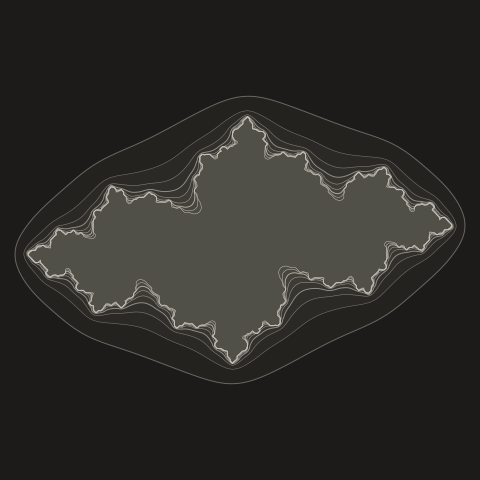
Twin curls, branching islands and finely engraved edges emerge from a single complex number. Nested contours trace their changing silhouette.
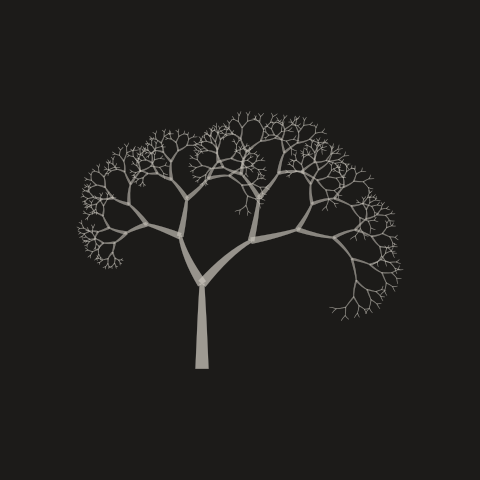
A sculptural fan grows from a single stem. Tapered branches overlap like layers of cut paper, opening into a delicate crown.
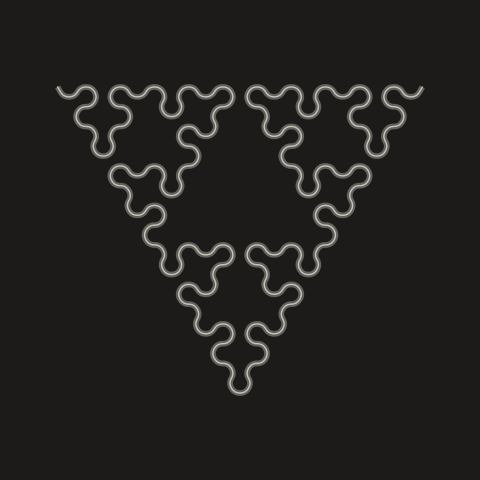
One continuous path folds into a triangular labyrinth. Soft corners and a tonal underlay give the recursive weave a tactile, carved quality.
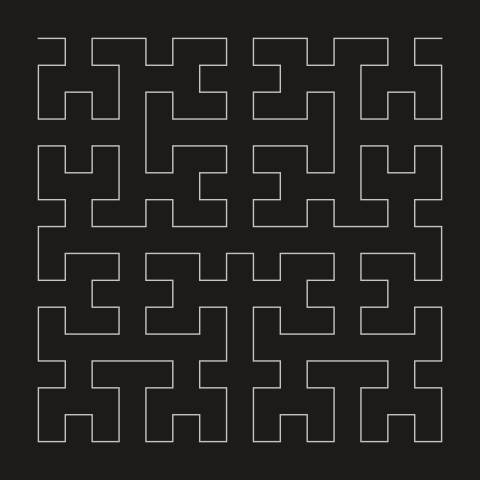
A space-filling curve of the given order. Rotation turns the square; the path always visits every cell once.
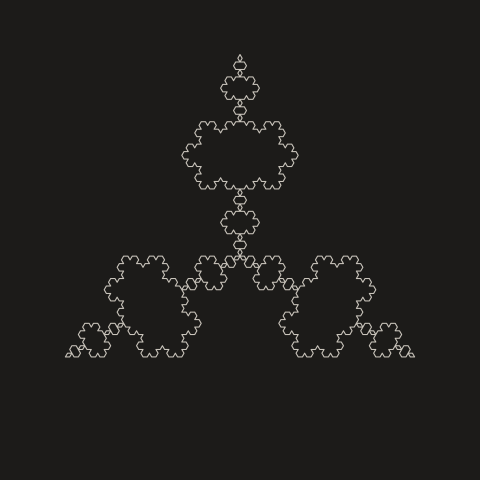
Each side of an equilateral triangle is replaced by a four-segment bump. Iterate and the perimeter grows without bound inside a finite area.
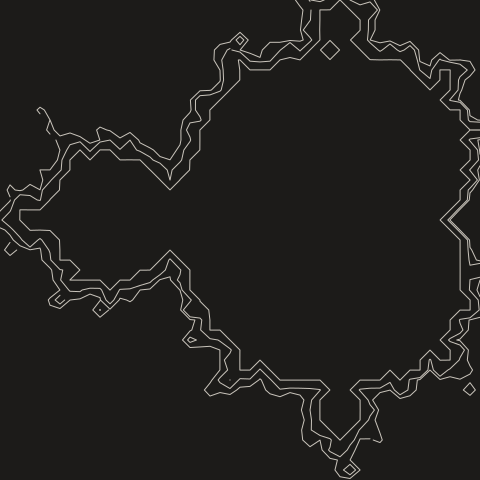
Iterate z → z² + c in the complex plane. The boundary is infinitely crumpled; zoom is a window onto that edge, drawn as contour lines.
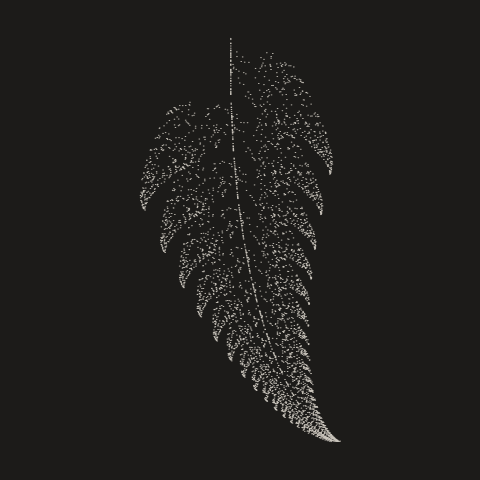
Four affine maps, chosen at random, iterate a point. The attractor is a fern: self-similar fronds from a handful of matrices.
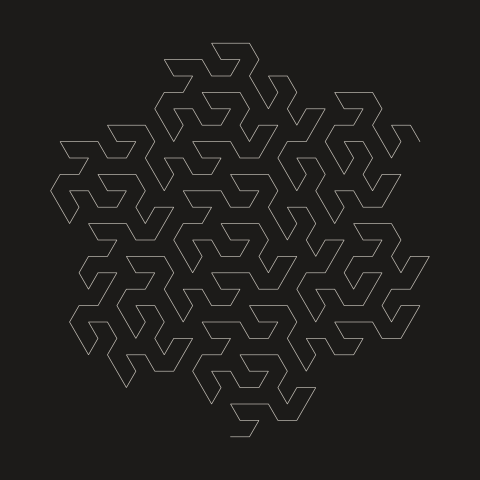
A single line that fills a hexagon and never crosses itself. Far away it is a texture; up close it is one continuous path you can follow end to end.
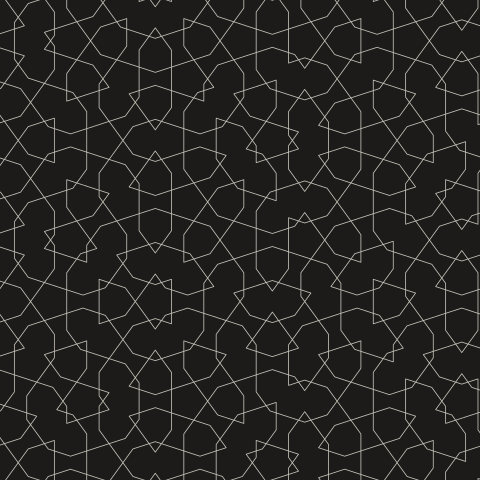
Ten-fold star patterns on a tiling that never repeats. Two rhombus shapes carry the same strapwork rule as the periodic panels, but nothing about the arrangement comes back around.
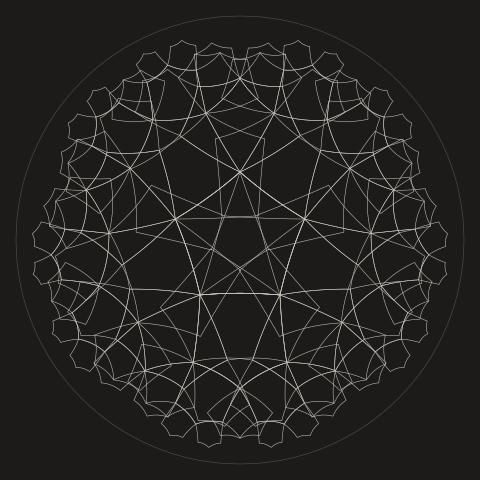
Every tile here is the same size. The whole infinite hyperbolic plane is drawn inside one circle, and the rim is infinitely far away, so the tiles appear to shrink as they approach it.
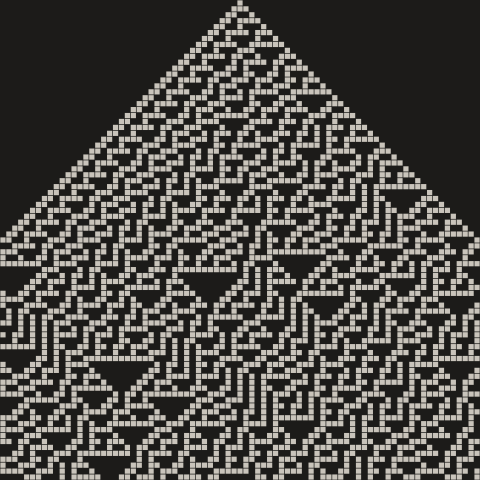
One row of cells, one rule, and the row below follows from the three cells above it. Eight bits of instruction are enough to produce order, chaos or something that does both at once.
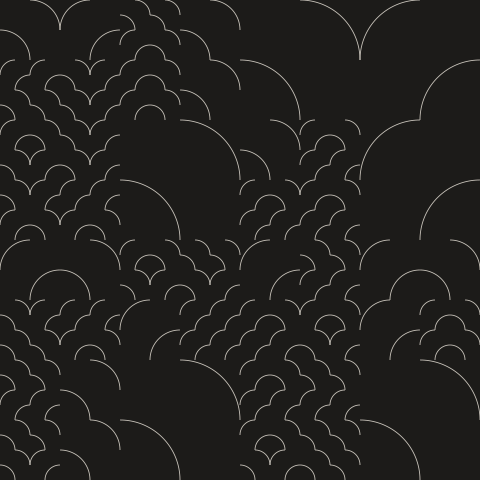
Truchet's tiles, but each square may break into four smaller ones before it decides which way to turn. Arcs still meet at every edge midpoint, so coarse and fine areas join without a break.
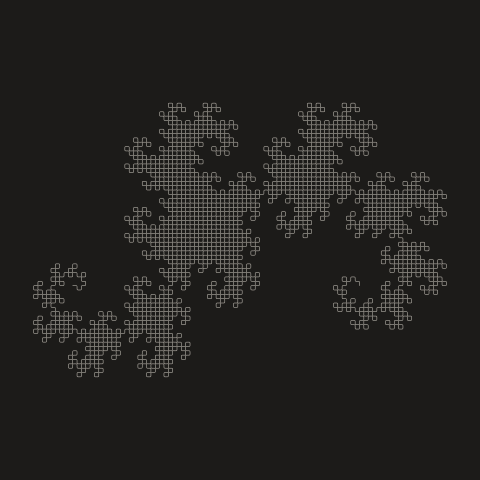
One strip of paper folded in half the same way over and over, then opened out to right angles. It never crosses itself.
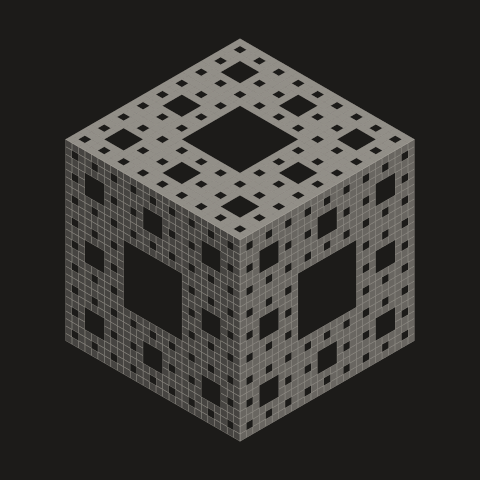
A cube whose three visible faces have had their middles removed, and the middles of what is left, and so on.
A ring of circles, each touching its neighbours and both of the circles it lies between. Either it closes exactly or it never does.
Three circles that touch, and the one circle that fits between them, and then the three new gaps, without end.
Light passing through a row of slits rebuilds the row further on, and in between splits into finer and finer copies of it. Followed downstream, the field weaves a fractal lace.
Grains poured on one square of a grid, where any square holding four topples and gives one to each neighbour. They settle into a fractal mandala, the same whatever order the squares topple in.
Above every fraction sits a circle, the smaller the bigger its denominator. Neighbouring fractions' circles touch, and no two ever overlap, so the rationals become a lace that never ends.
Pick a corner at random and jump half way towards it, again and again. The dots never land anywhere near randomly: they draw the Sierpiński triangle.
Two lines of sines and cosines, applied to a point a few hundred thousand times. It never repeats, yet it keeps to one folded, smoky shape, and four numbers choose which.