
Edward Lorenz1917–2008
Lorenz system
American mathematician and meteorologist whose simplified atmospheric equations revealed deterministic chaos and the butterfly-shaped Lorenz attractor.
The butterfly of chaos: one trajectory turns between two lobes without repeating. A selected stretch of its path and a little depth fading reveal an airy, folded structure.

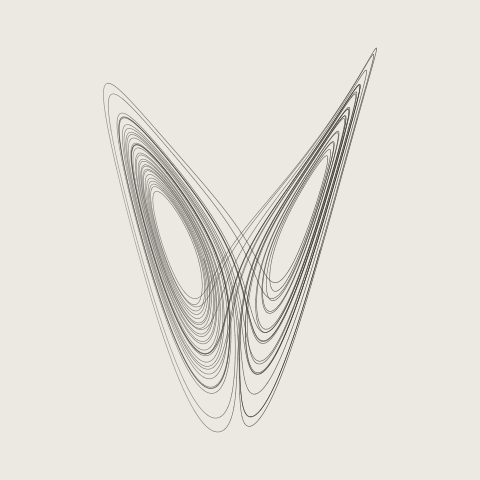
Edward Lorenz, 1963
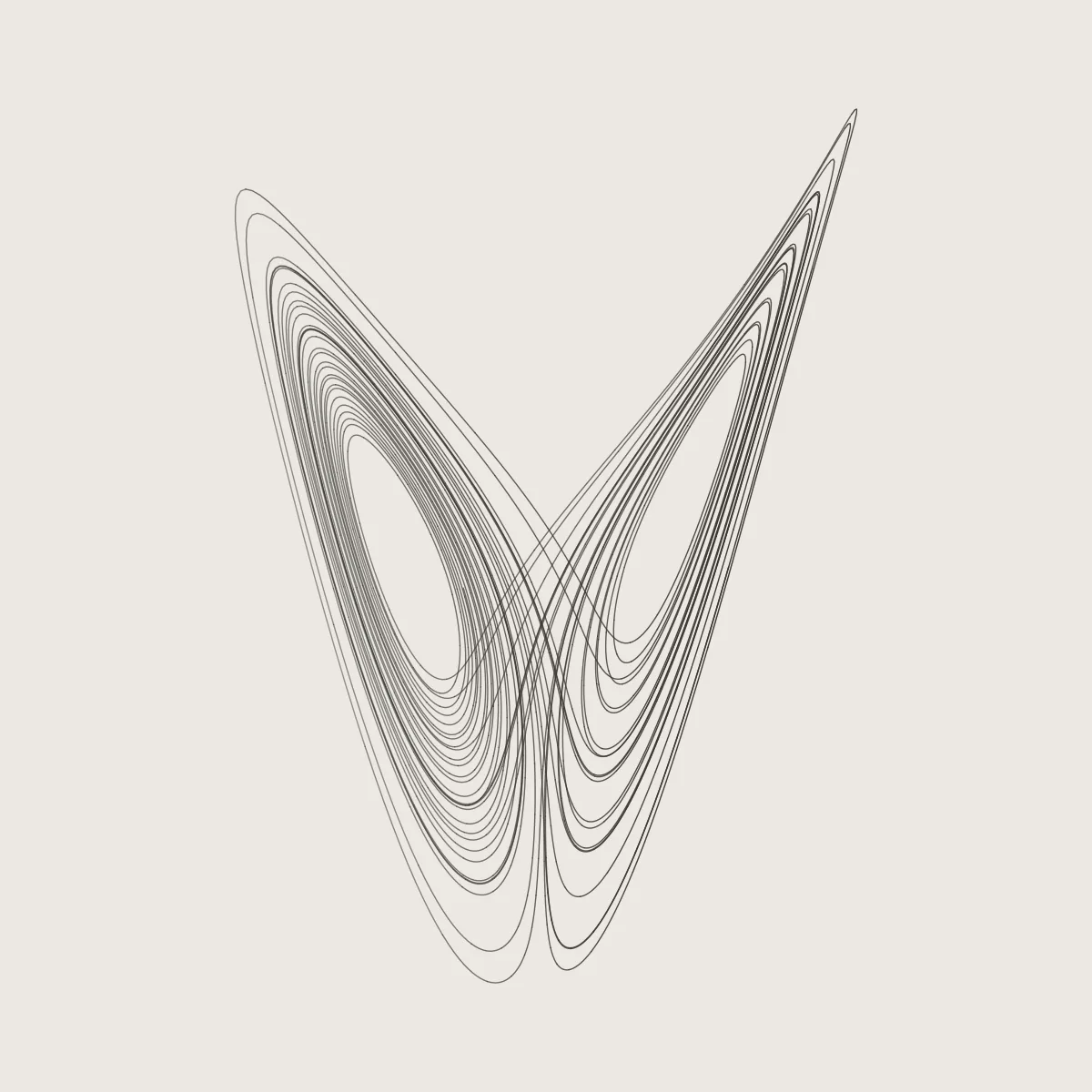
The classic Lorenz equations are integrated with fourth-order Runge–Kutta, starting from a fixed point and discarding an initial transient. Start selects a later stretch of that same trajectory. Rotation changes the projection; it does not change the dynamical system. The default uses σ = 10, ρ = 28, β = 8/3.
Behind the mathematics
Lorenz system
American mathematician and meteorologist whose simplified atmospheric equations revealed deterministic chaos and the butterfly-shaped Lorenz attractor.