
Clifford A. Pickoverborn 1957
The Clifford attractor is attributed to him
American author and columnist on science, mathematics and creativity, and for many years a researcher at IBM. Paul Bourke's catalogue attributes the Clifford attractor to him.
Two lines of sines and cosines, applied to a point a few hundred thousand times. It never repeats, yet it keeps to one folded, smoky shape, and four numbers choose which.
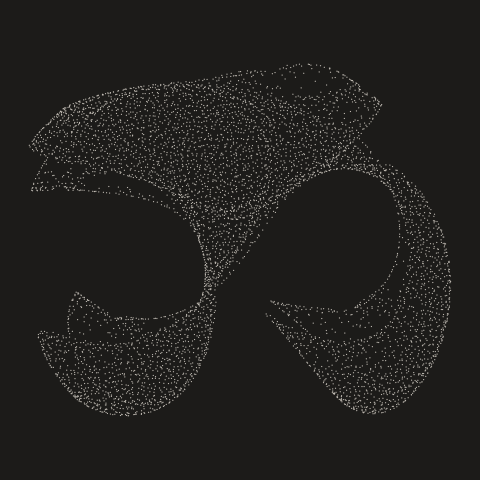
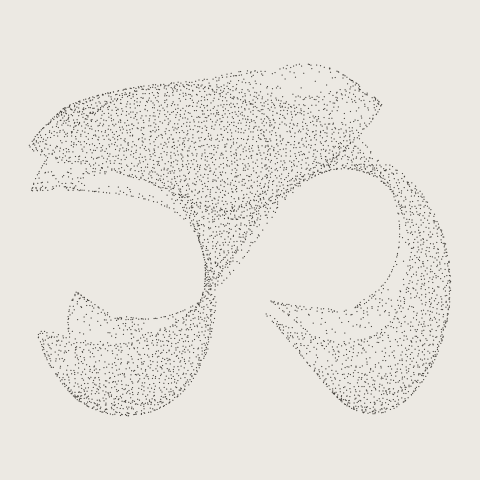
Clifford Pickover · Peter de Jong, 1987 · catalogued by Paul Bourke
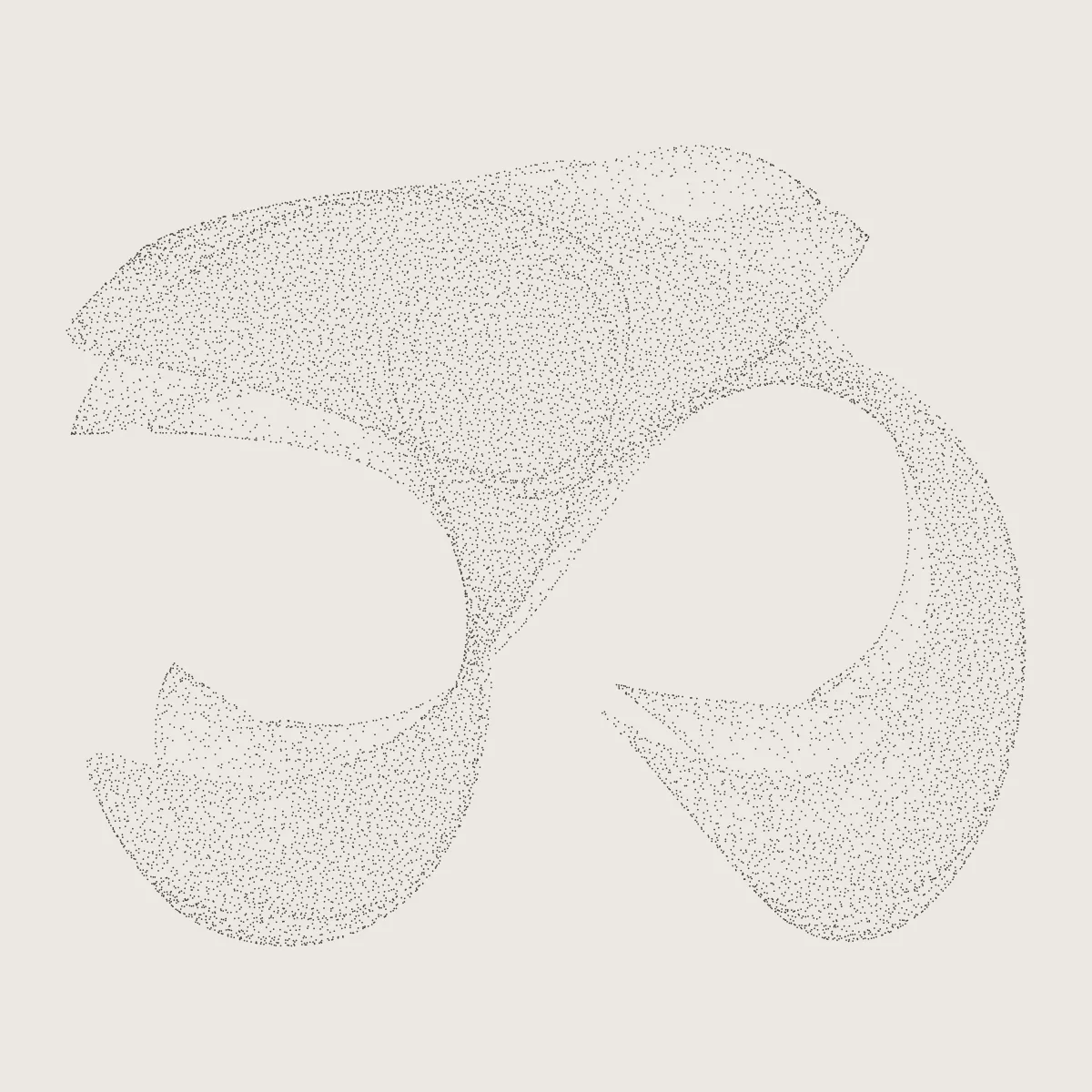
Take a point, put its x and y into two short formulas made of sines and cosines, and you get a new point. Do it again with the new one, and again, hundreds of thousands of times, and mark everywhere it lands. The point never settles down and never comes back to where it was, but it never wanders off either: it keeps to a shape, folded over itself like smoke caught mid-turn, with dense creases and empty pockets.
A shape like that, which a restless point is drawn to but never fills in a simple way, is called a strange attractor. Four numbers, a, b, c and d, decide which shape you get, and a tiny change to any of them can fold it into something new. Two families are drawn here. The de Jong attractor was first published in the Computer Recreations column of Scientific American in July 1987, and the Clifford attractor is attributed to Clifford Pickover; Paul Bourke's online catalogue of both, with the values used for the presets, is where most people meet them.
The shading is built from the number of dots in each little square rather than from transparency, so the drawing keeps its tone on a pen plotter.
Drawn as contours, the same density becomes lines, like a map of the smoke's height. Most values of the four numbers, picked at random, give nothing much: the point settles into a few spots or a single loop.
Choose Found from the seed and each seed tries random values until it finds four that spread the point over a wide, folded shape, so every seed is a new attractor that may never have been drawn before. In motion the first number drifts a little to each side and back, and the shape breathes.
Behind the mathematics
The Clifford attractor is attributed to him
American author and columnist on science, mathematics and creativity, and for many years a researcher at IBM. Paul Bourke's catalogue attributes the Clifford attractor to him.
The de Jong attractor, Scientific American, 1987
Author of the attractor, two lines of sines and cosines, that appeared in the Computer Recreations column of Scientific American in July 1987.