Vortex Wake

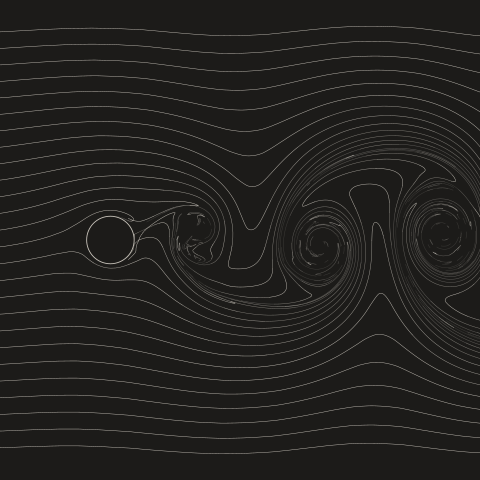
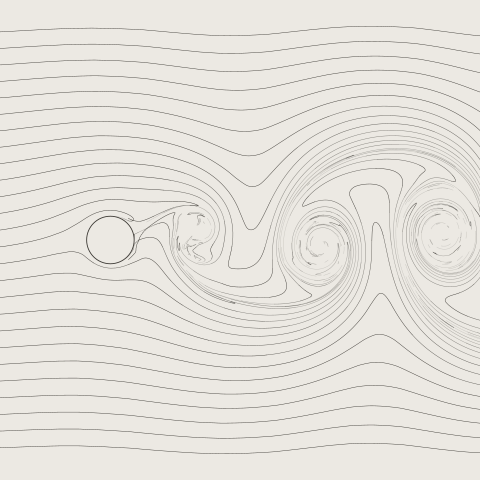
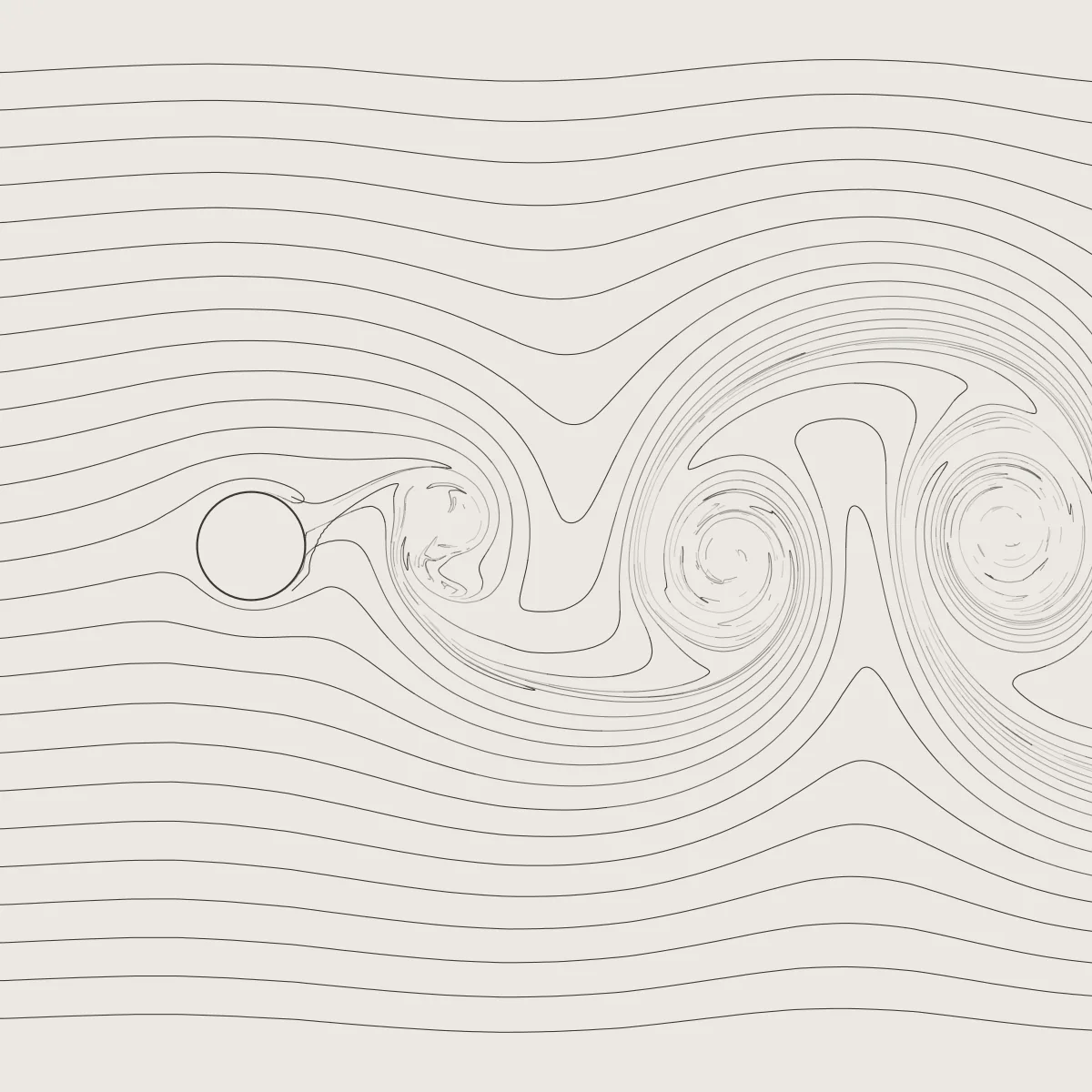
A current flows past a cylinder and sheds a Kármán vortex street, simulated with vortex particles. Dye rolls up into the spirals of a smoke tunnel; drag the cylinder to move the wake.

Vortex Wake: A current flows past a cylinder and sheds a Kármán vortex street, simulated with vortex particles. Dye rolls up into the spirals of a smoke tunnel; drag the cylinder to move the wake.Vortex Wake: A current flows past a cylinder and sheds a Kármán vortex street, simulated with vortex particles. Dye rolls up into the spirals of a smoke tunnel; drag the cylinder to move the wake.

About this pattern

Theodore von Kármán, 1911 · Vincenc Strouhal, 1878 · Henri Bénard, 1908

Vortex Wake, kármán vortex street, drawn by GART: A current flows past a cylinder and sheds a Kármán vortex street, simulated with vortex particles. Dye rolls up into the spirals of a smoke tunnel; drag the cylinder to move the wake.
Vortex Wake · CC BY 4.0

Behind a cylinder in a steady current, the flow peels away from the top and bottom in turn and rolls into vortices that drift downstream in two staggered rows, the street that Theodore von Kármán explained in 1911 (Henri Bénard had photographed it a few years before). Here it is simulated. The current flows round a cylinder kept solid by the circle theorem: every vortex has a mirror image inside the cylinder that cancels any flow through its surface.

Behind the mathematics

Theodore von Kármán1881–1963

The vortex street, 1911

Hungarian-American engineer and physicist who in 1911 explained the double row of alternating vortices behind a bluff body, the Kármán vortex street, and went on to found modern aerodynamics and the Jet Propulsion Laboratory.

Vincenc Strouhal1850–1922

The shedding frequency, 1878

Czech physicist who in 1878 measured the tone of a wire singing in the wind and found its frequency set by wind speed over wire thickness, the ratio now called the Strouhal number.