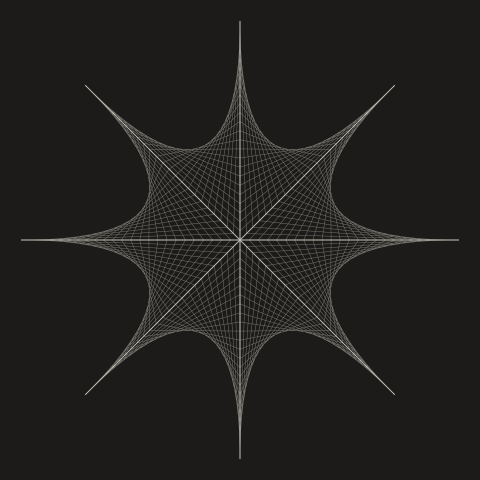
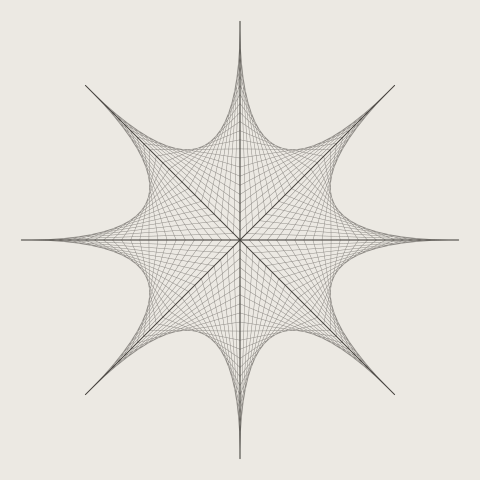
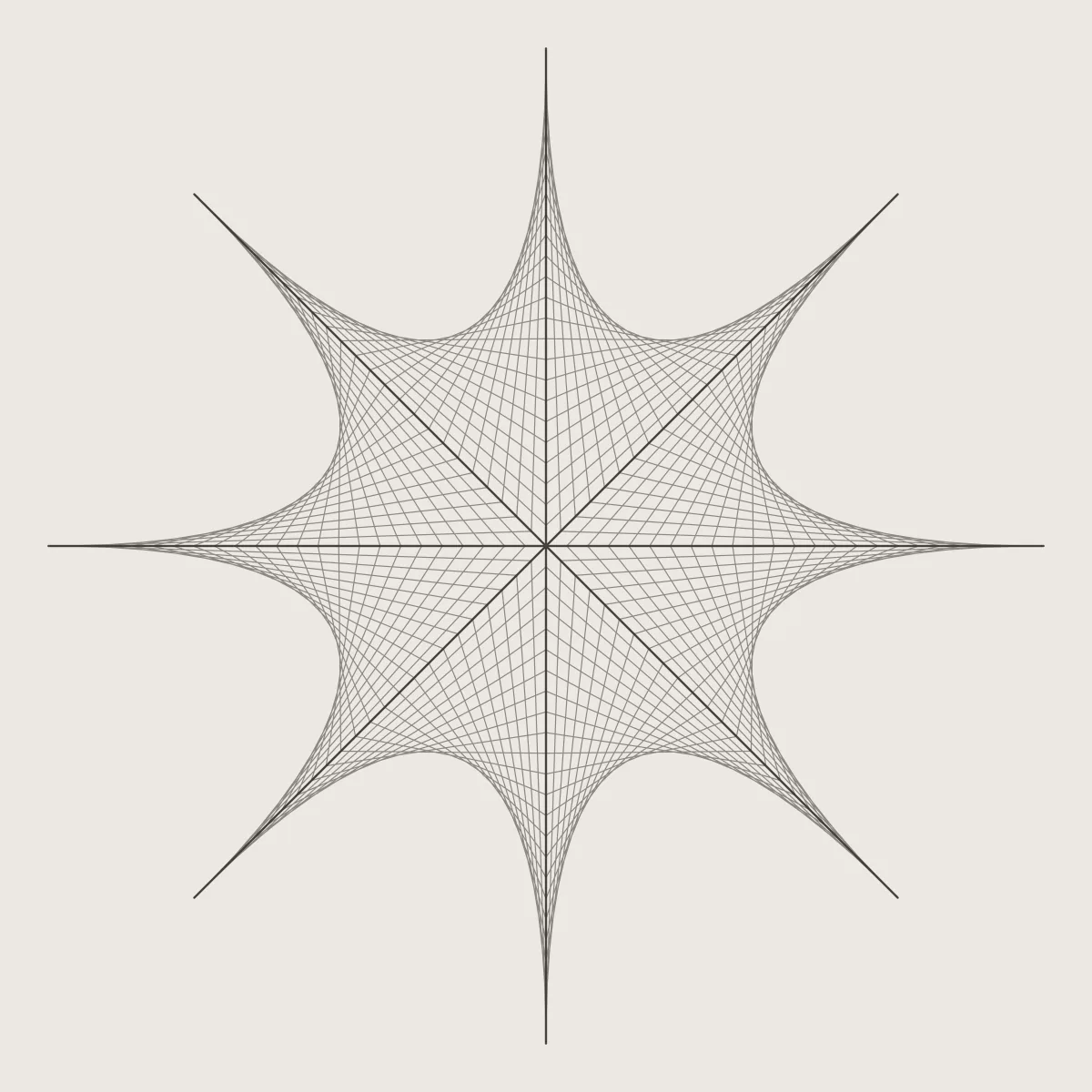
Take a corner made of two arms, and mark ten evenly spaced points along each. Join the first point on one arm to the last point on the other, the second to the last but one, and carry on until the threads run out. Not one of the lines is curved, and yet a curve appears, swelling out from the corner: a parabola, which every thread touches once and none of them crosses.
The curve is the envelope of the lines, the shape their edges make together, and it touches each arm just where that arm ends. Mary Everest Boole, a teacher and writer on how children learn mathematics, gave children cards with holes punched along two lines and coloured thread to sew between them, so that they would feel the curve emerge rather than be told about it; she called it curve stitching.
In the 1960s and 70s it came back as string art, nails and wool on a board, and it is still one of the most popular lessons in schools. Open the corner wider and the curve flattens; close it and the curve tightens into the point. A star is a corner repeated round a centre, and a polygon has a corner at every vertex, its two sides as the arms.
More stitches make a smoother curve, though the threads can never quite reach it. In motion a thread is drawn tighter as if being pulled through, and runs round from the first stitch to the last. Stitch between two edges that do not lie in one plane and the threads curve in space instead: across a skew four-sided loop they make a saddle, a hyperbolic paraboloid, curved two ways at once yet made only of straight lines.
Stitch all three pairs of opposite edges of a tetrahedron and three saddles pass through each other, the classic string sculpture. Drag to turn them, nearer threads drawn heavier; in motion they turn once round.