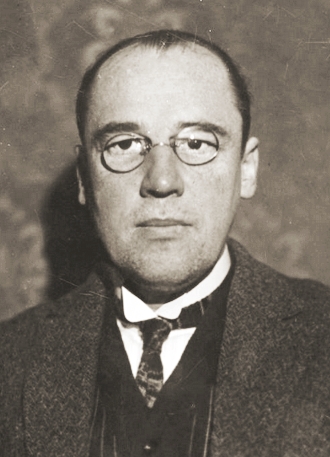
Michael Barnsleyborn 1946
Named and studied the chaos game, Fractals Everywhere, 1988
British mathematician known for iterated function systems and the Barnsley fern, where a few affine transformations grow a lifelike leaf.
Pick a corner at random and jump half way towards it, again and again. The dots never land anywhere near randomly: they draw the Sierpiński triangle.
Michael Barnsley, 1988 · Wacław Sierpiński, 1915
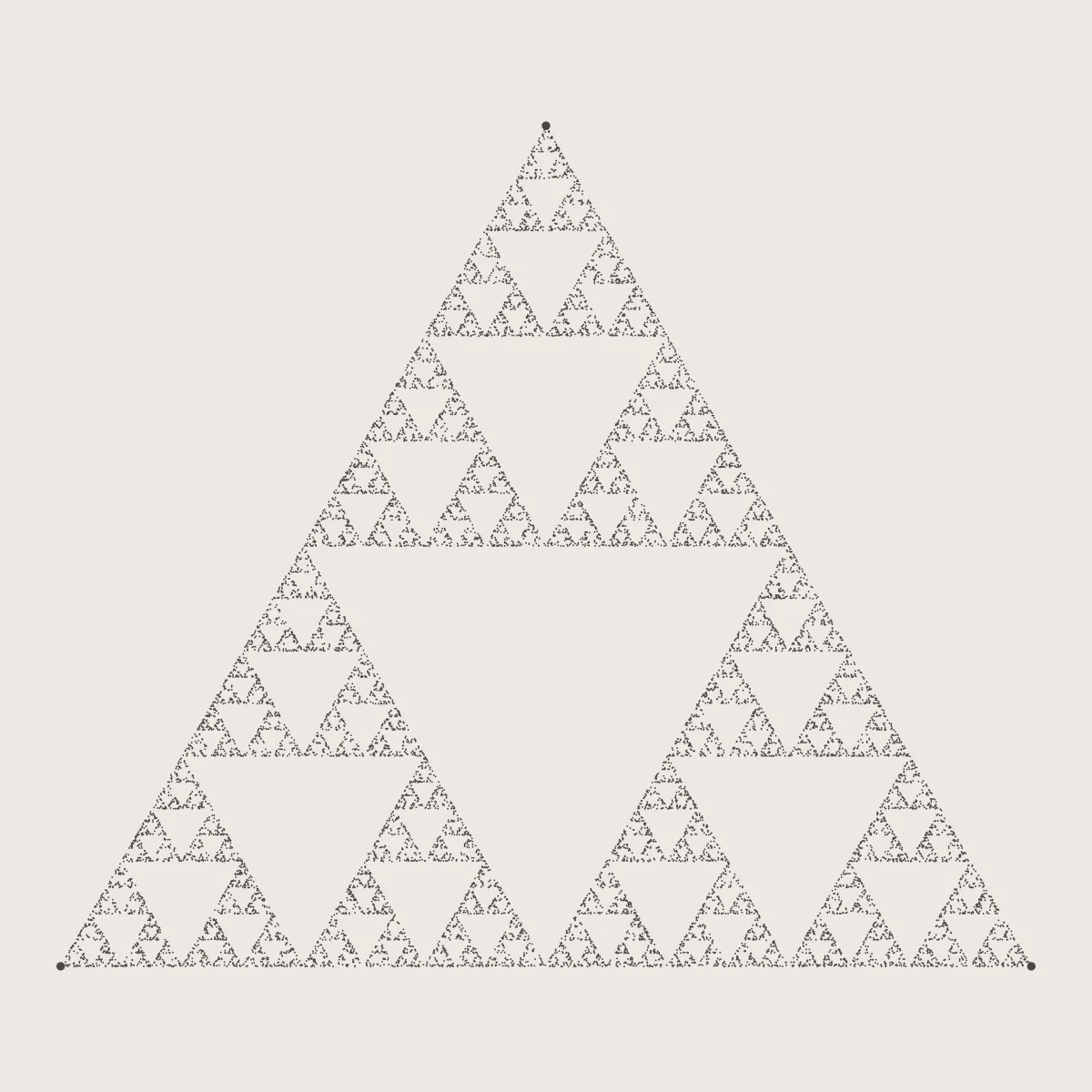
The rules fit on a sticky note. Draw a triangle. Put a dot anywhere inside it. Now roll a die to choose one of the three corners, and draw a new dot half way between the last dot and that corner. Repeat. You might expect a random fog, but after a few hundred rolls a shape appears, and it is always the same one: the Sierpiński triangle, the triangle with a triangle cut from its middle, and from the middle of each of the three left, and so on for ever.
The Polish mathematician Wacław Sierpiński described the shape in 1915. Michael Barnsley gave the game its name in Fractals Everywhere in 1988, and showed why it works: each corner is a rule that shrinks the whole picture by half towards itself, the triangle is the one shape that the three shrunken copies rebuild exactly, and every jump brings the dot closer to it, whatever the roll.
It is a favourite in classrooms because it can be played with a pencil and a die. Change the rules and the shape changes. A square with half-way jumps fills in solid, but forbid the same corner twice in a row and a fractal appears again. Add the middles of the sides and jump two thirds of the way, and you get the Sierpiński carpet; a pentagon with jumps of about 0.62, the golden ratio, gives a ring of pentagons that only just touch.
Show the first moves to see the dot hop from corner to corner before the shape takes over. In motion the length of the jump breathes, and the dust gathers and spreads. The game works in three dimensions too. Jump half way towards the four corners of a tetrahedron and the dots build a Sierpiński tetrahedron, a pyramid of pyramids with holes all the way down; the six corners of an octahedron give its own version.
Use the eight corners of a cube and the middles of its twelve edges, jump two thirds of the way, and the dust becomes the Menger sponge, the cube that Karl Menger described in 1926, drilled through and through. Nearer dots are drawn bigger, drag to turn the solid, and in motion it turns once round.
Behind the mathematics
Named and studied the chaos game, Fractals Everywhere, 1988
British mathematician known for iterated function systems and the Barnsley fern, where a few affine transformations grow a lifelike leaf.
The Sierpiński triangle, 1915
Polish mathematician who worked across set theory, number theory and topology, and whose triangle, carpet and curves became standard examples of self-similar sets.