
Boris Delaunay1890–1980
The triangulation
Russian mathematician whose triangulation joins nearby sites so that no point falls inside another triangle’s circumcircle.
A crumpled sheet drawn only in parallel lines. Each facet is hatched as a fan from its peak, the lines packed tighter the further it turns from the light, so the folds appear with no shading at all.
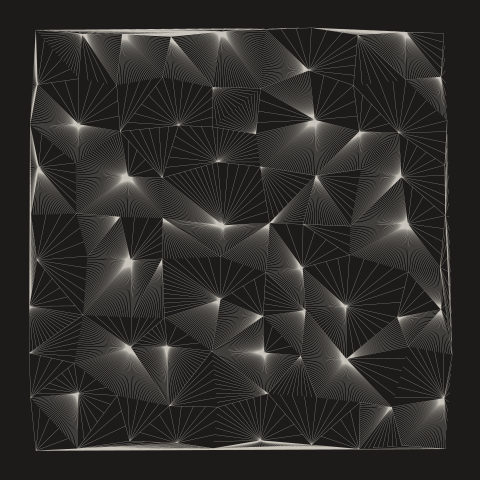
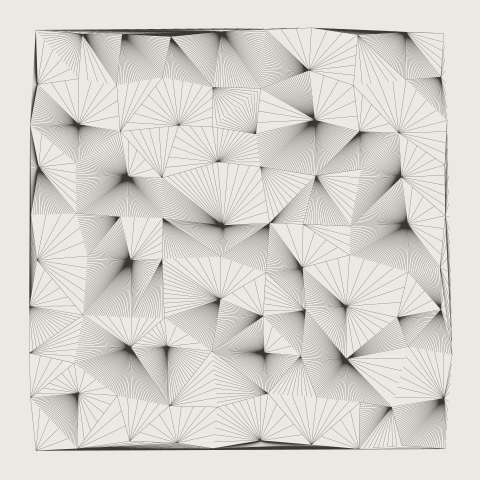
Delaunay facets, hatched by their light
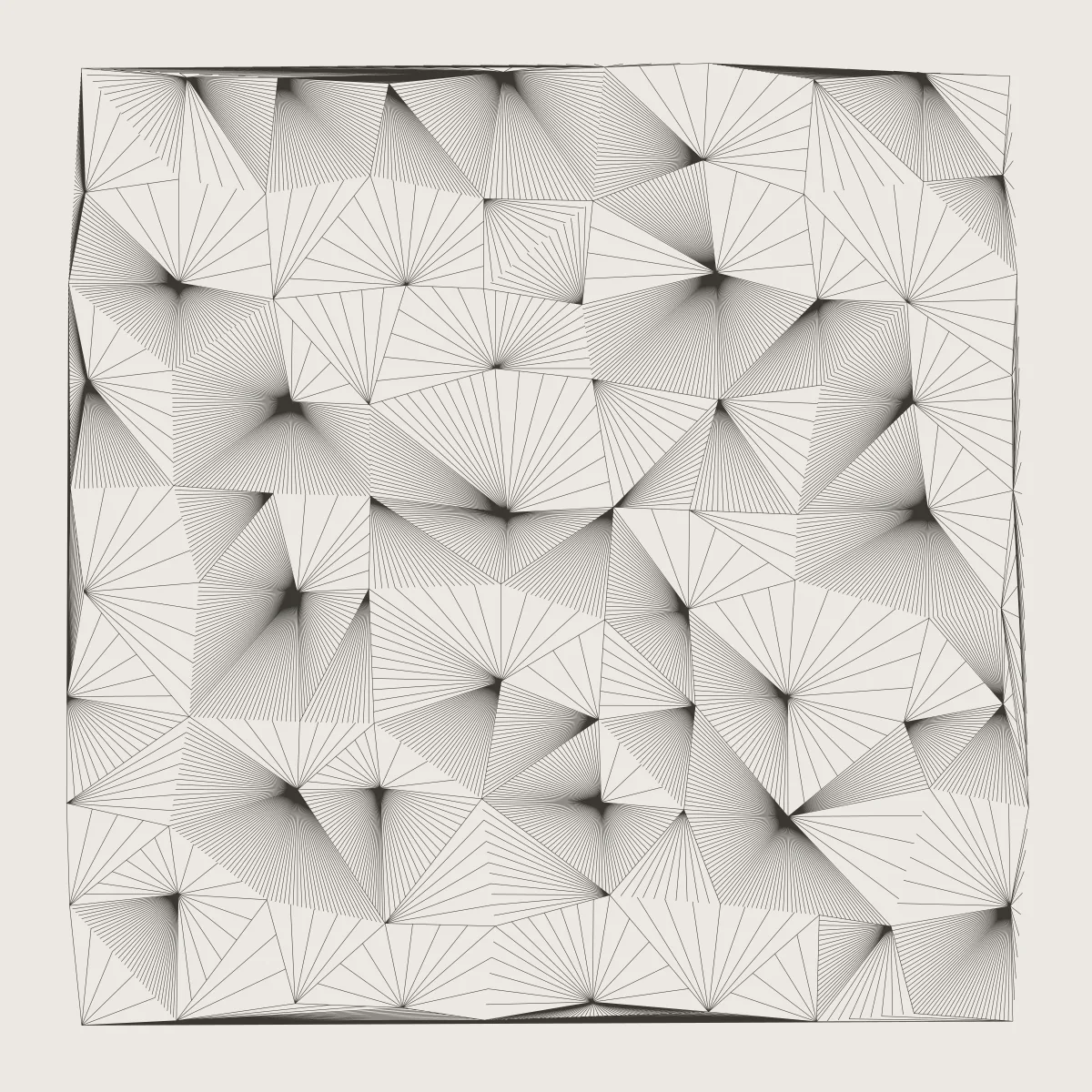
Scatter points over a sheet, lift each to a random height, and join them into Delaunay triangles: a crumpled surface of flat facets. Light it from one side, and each facet is as bright as it faces the light. Then draw no tone at all, only lines. Every facet is hatched with a fan of strokes from its highest corner, or with parallel strokes down its slope or along its contours, and the gap between strokes widens as the facet brightens.
The fans of neighbouring facets meet at the same peaks and change direction at every fold, and the eye reads the change in direction and density as a relief. It is the way an engraver or a pen plotter makes shade. In motion the light circles the sheet and the folds turn over.
Behind the mathematics
The triangulation
Russian mathematician whose triangulation joins nearby sites so that no point falls inside another triangle’s circumcircle.