
Georgy Voronoy1868–1908
The quarters
Ukrainian mathematician whose nearest-point decomposition now appears across geometry, crystallography, ecology and computational design.
A sheet split into quarters, each on its own grid at its own angle and filled with one maze. Drawn as its paths, every maze branches like the streets of an old town.
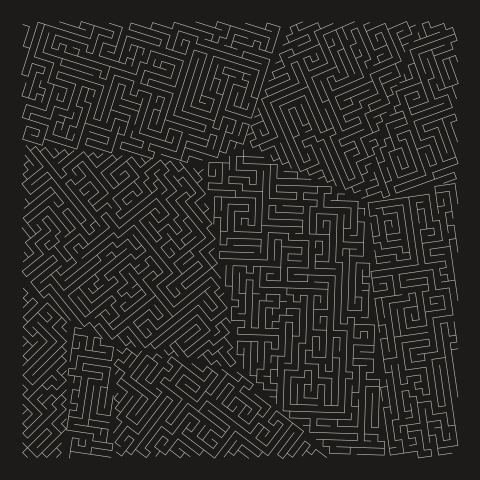
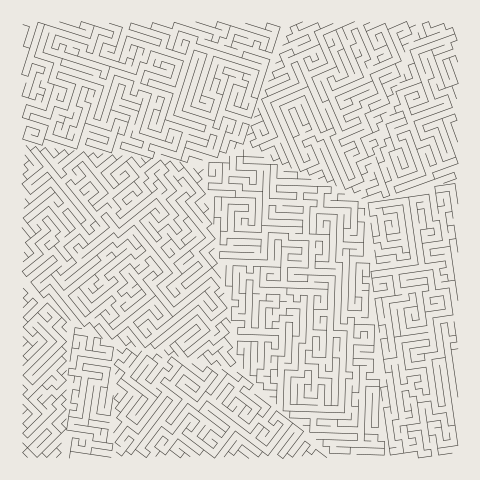
Voronoi quarters, each a depth-first maze
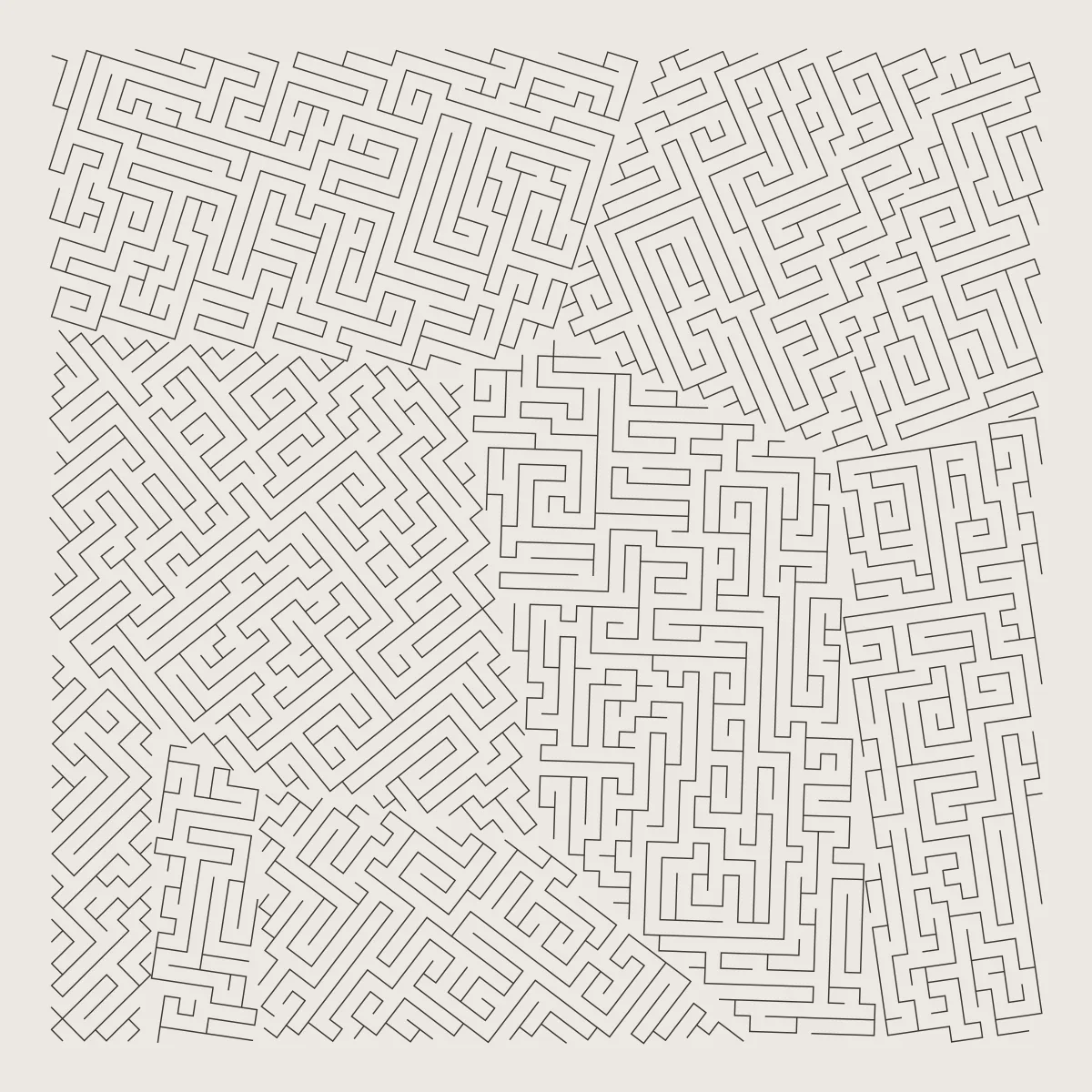
The sheet is first divided into Voronoi quarters, each the ground nearest one site, and each quarter is given a grid turned to its own angle. Inside it a maze is dug in the classic way, a depth-first search of the grid as a graph: start at one cell, step to a neighbour not yet visited, and when every way is blocked go back until one opens.
The result is a spanning tree, in the language of graph theory: it reaches every cell exactly once, with no loops. Drawn as the paths rather than the walls, it branches into combs, long avenues and dead ends, and where two quarters meet their grids cross at an angle, like old districts of a city that grew separately.
Straightness makes the digger keep heading the same way, for longer streets. In motion each maze is dug out from its start.
Behind the mathematics
The quarters
Ukrainian mathematician whose nearest-point decomposition now appears across geometry, crystallography, ecology and computational design.