Hajime Ouchi
Japanese Optical and Geometrical Art, 1977
Japanese graphic designer whose 1977 book of 746 copyright-free op art designs, Japanese Optical and Geometrical Art, included the figure now known as the Ouchi illusion.
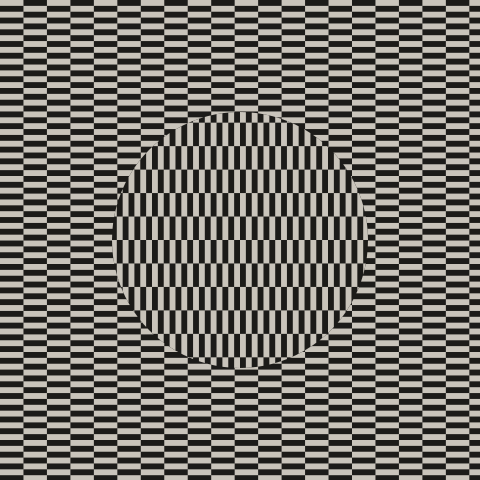
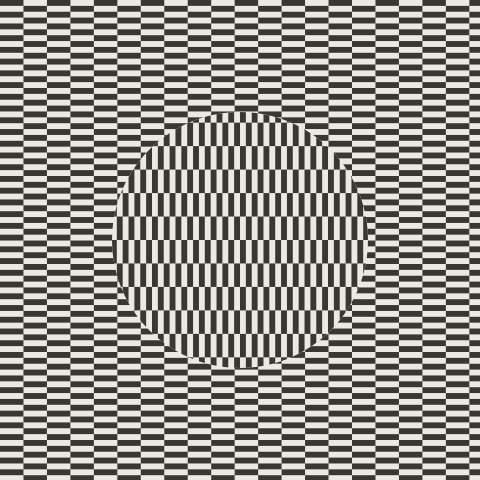
A disc of upright bricks on a field of bricks lying flat. Let your eyes wander and the disc seems to float and slide on its own, though nothing on the page moves.
Hajime Ouchi, 1977 · Lothar Spillmann, 1986
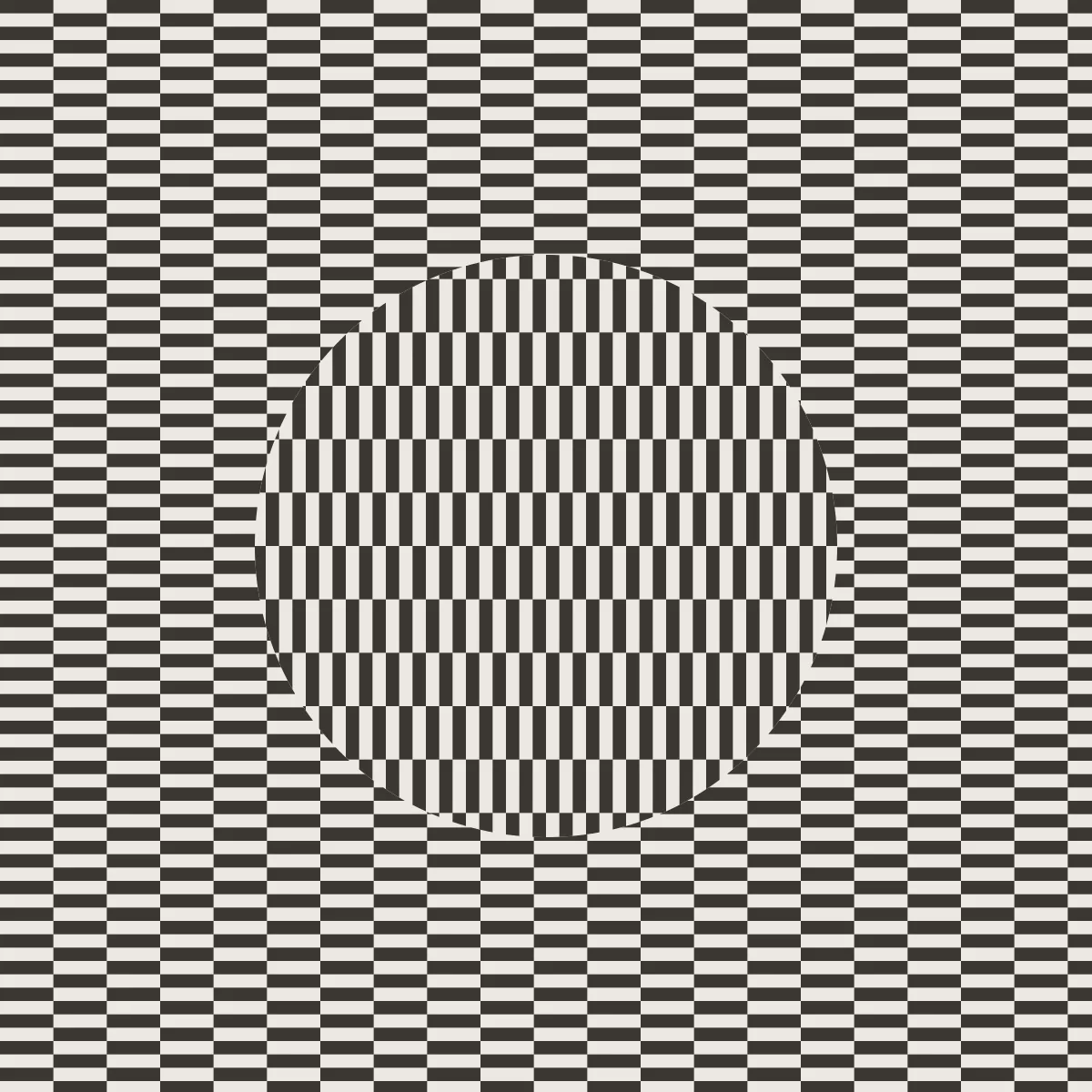
The figure comes from a book of 746 black and white designs, Japanese Optical and Geometrical Art, which the Japanese designer Hajime Ouchi published in 1977 for artists and craftsmen to use freely. The vision scientist Lothar Spillmann noticed that one of them does something strange. A field of long thin bricks lies across the page, laid like a chequerboard, and a disc in the middle holds the same bricks standing upright.
Look at it, or past it, and the disc comes loose: it hovers above the field and drifts against it, as if on its own layer. The usual explanation is that the eye is never still, and its tiny wandering movements shift both patterns at once. But a brick lying flat barely changes when the eye moves along its length; only movements up and down show up in it.
The upright bricks show only movements from side to side. So the brain is told two different stories about how the image moved, one for the disc and one for the field, and it settles the difference by letting the disc slip. Scrolling the picture makes it stronger, which is what the motion here does: the whole drawing shifts round a small circle, every brick moving together, and the disc still seems to slide.
For decades nobody knew who Ouchi was; vision scientists tracked him down in Osaka in 2015. Try rings, which slide against each other in turn.
Behind the mathematics
Japanese Optical and Geometrical Art, 1977
Japanese graphic designer whose 1977 book of 746 copyright-free op art designs, Japanese Optical and Geometrical Art, included the figure now known as the Ouchi illusion.