Shukhov Tower

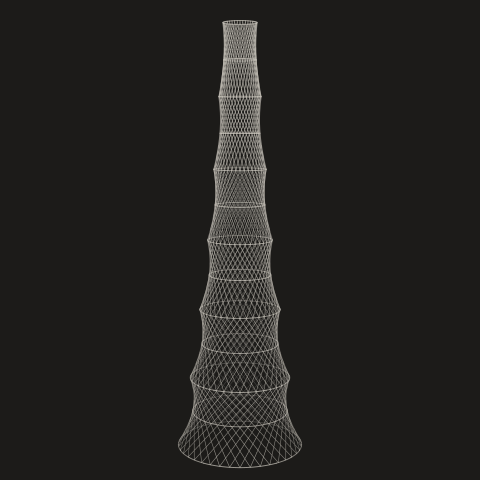
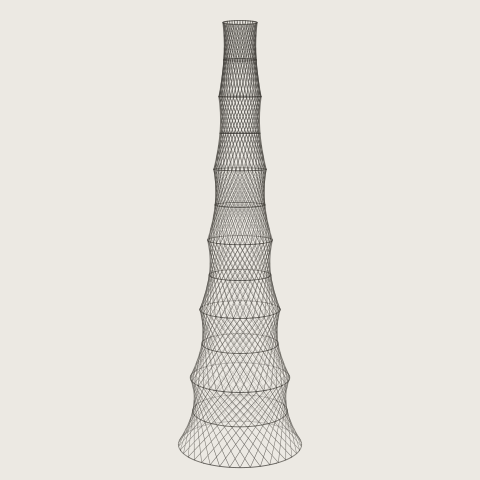
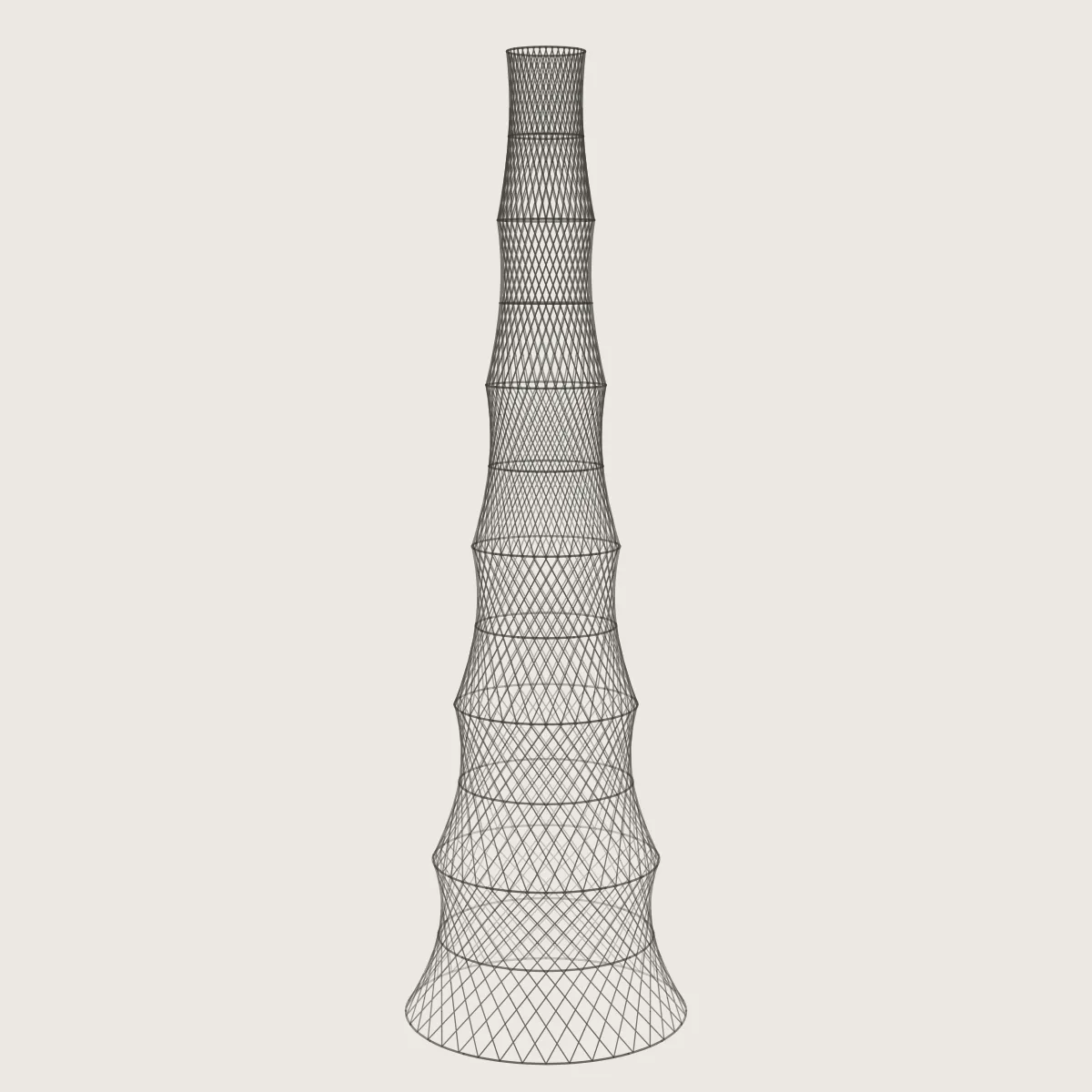
A curved tower made entirely of straight lines. Two sets of lines lean opposite ways between rings, and the waist pulls in by itself, as in Shukhov's steel towers.

Shukhov Tower: A curved tower made entirely of straight lines. Two sets of lines lean opposite ways between rings, and the waist pulls in by itself, as in Shukhov's steel towers.Shukhov Tower: A curved tower made entirely of straight lines. Two sets of lines lean opposite ways between rings, and the waist pulls in by itself, as in Shukhov's steel towers.

About this shape

Vladimir Shukhov, 1896 and 1922

Shukhov Tower, hyperboloid structure, drawn by GART: A curved tower made entirely of straight lines. Two sets of lines lean opposite ways between rings, and the waist pulls in by itself, as in Shukhov's steel towers.
Shukhov Tower · CC BY 4.0

Take two rings, one above the other, and join them with straight rods, each rod leaning a little way round. Add a second set leaning the other way, and the rods cross in a lattice that pinches in at the middle: a hyperboloid of one sheet, a curved surface made only of straight lines. The Russian engineer Vladimir Shukhov saw what that meant for building.

Straight steel is cheap and easy to make, the crossings brace one another, and the result is light and very strong. He showed the first hyperboloid water tower at the Nizhny Novgorod fair in 1896 and went on to build some two hundred of them, followed by lighthouses, pylons and masts; cooling towers all over the world have the same shape for the same reason.

Behind the mathematics

Vladimir Shukhov1853–1939

The first hyperboloid structures, 1896; the Shabolovka radio tower, 1922

Russian engineer who built the first hyperboloid structures, from water towers to the Shabolovka radio tower in Moscow, as well as thin steel shell roofs, pipelines and oil cracking plants.