
Joseph Fourier1768–1830
Fourier series, 1807
French mathematician and physicist who, studying how heat spreads, showed that a wide range of functions can be written as sums of waves, the idea behind the Fourier transform.
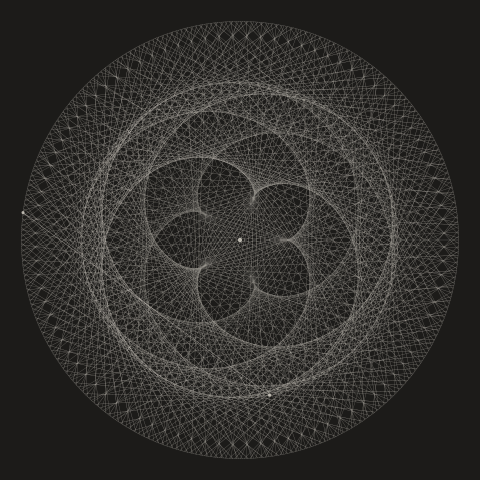
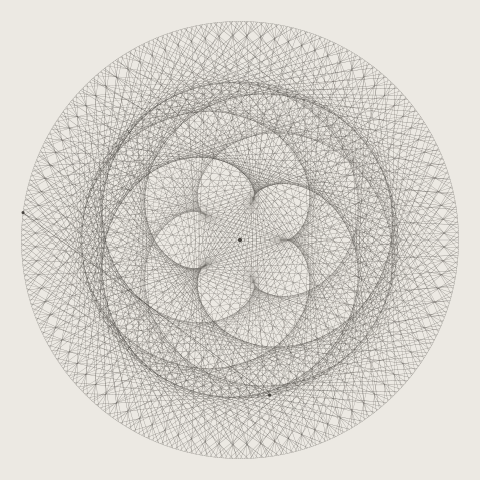
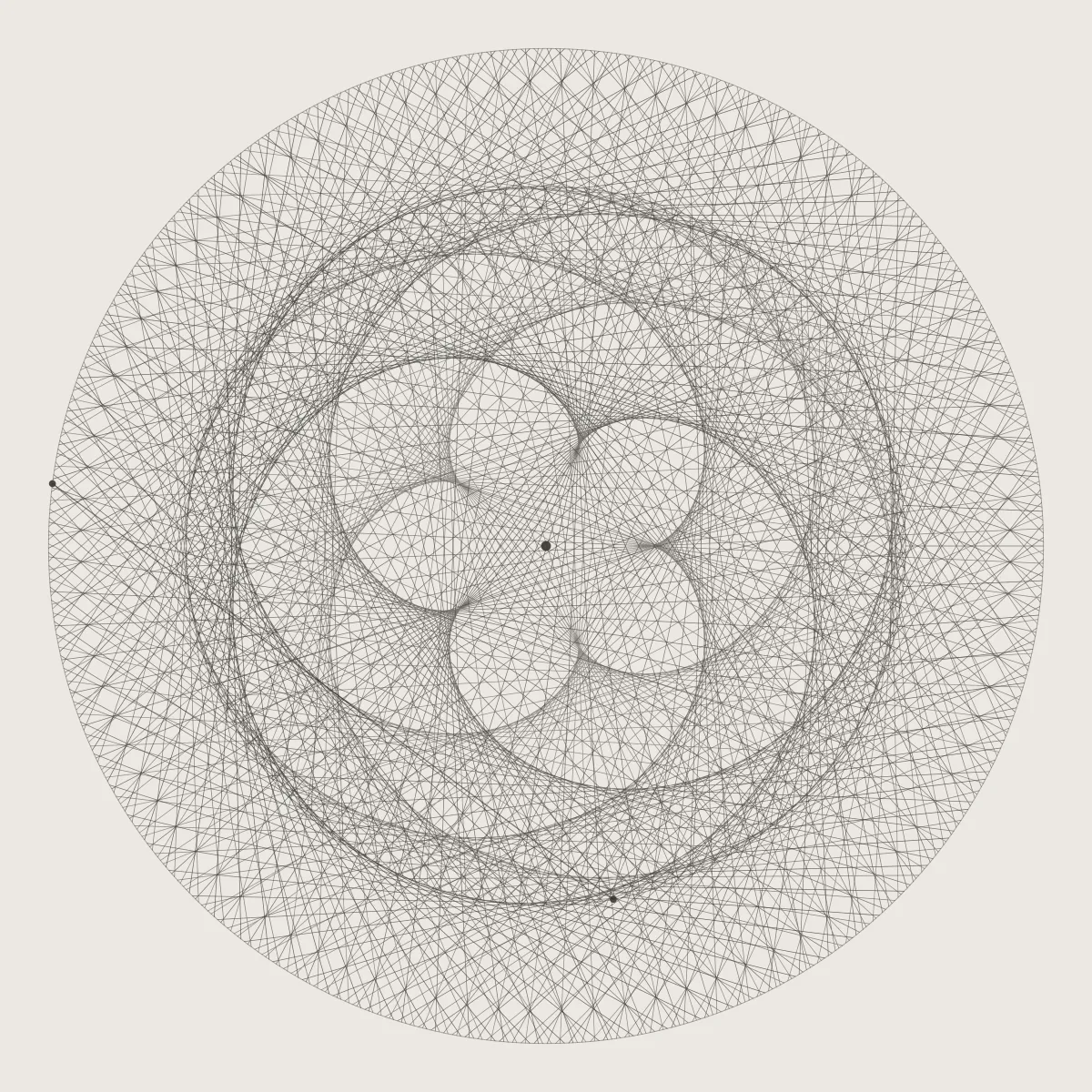
Circles riding on circles. Two are a pair of planets: join Earth and Venus every few days for eight years and the lines open into a five-petalled rose.
Hipparchus and Ptolemy, c. 150 · Joseph Fourier, 1807 · John Martineau, 2001
The astronomers of the ancient world held that the heavens moved in circles, and yet the planets wander: Mars every two years slows down, turns back for a few weeks and then goes on. Hipparchus, and Ptolemy after him in about 150, saved the circles by riding one on another: the planet goes round a small circle, the epicycle, whose centre goes round the Earth on a big one, the deferent.
It worked for fourteen centuries, and for a good reason. A planet seen from a moving Earth really is the sum of two circles, its own orbit less ours; Copernicus kept the same two circles and swapped which one sits in the middle.
Choose Seen from the first planet for Ptolemy's view: each time the two planets pass, the second one loops back on itself, five times in eight years for Venus and seven in fifteen for Mars. Seen from the Sun, draw the line between the two planets every few days. Earth goes round eight times while Venus goes round thirteen, so they pass five times, at almost the same five places, and the lines gather into a five-petalled rose; the Maya, in the Dresden Codex, tracked Venus by the same cycle of five appearances in eight years.
John Martineau drew these dances for every pair of planets in A Little Book of Coincidence in 2001. Jupiter and Saturn meet every twenty years, a third of the way round from the last time, and Kepler drew their meetings as a great slowly turning triangle in 1606. Real planets are never quite in step, so each figure creeps round from one cycle to the next; here the counts are rounded to whole numbers so that every figure closes.
Each line is, in fact, the arm of Ptolemy's epicycle. In 1807 Joseph Fourier showed how far the idea goes: enough circles, each turning a whole number of times, draw any closed curve at all. The heart is drawn exactly by eight; a square or a star takes more and more, every circle tucking the corners in tighter.
Exposures stamp the whole chain of circles at many moments, like a long exposure of the machine. In motion the pen goes round once, and the lines brighten as it passes.
Behind the mathematics
Fourier series, 1807
French mathematician and physicist who, studying how heat spreads, showed that a wide range of functions can be written as sums of waves, the idea behind the Fourier transform.
The trigon of Jupiter and Saturn, De Stella Nova, 1606
German astronomer and mathematician, best known for his laws of planetary motion. His first book, Mysterium Cosmographicum (1596), fitted the five Platonic solids between the spheres of the six known planets.
The dances of the planets, A Little Book of Coincidence, 2001
British designer and writer behind the Wooden Books series. His A Little Book of Coincidence in the Solar System (2001) drew the line between pairs of planets every few days, and the roses and trefoils they make.
