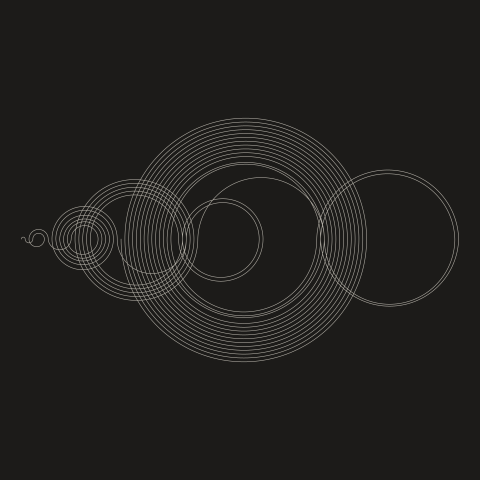
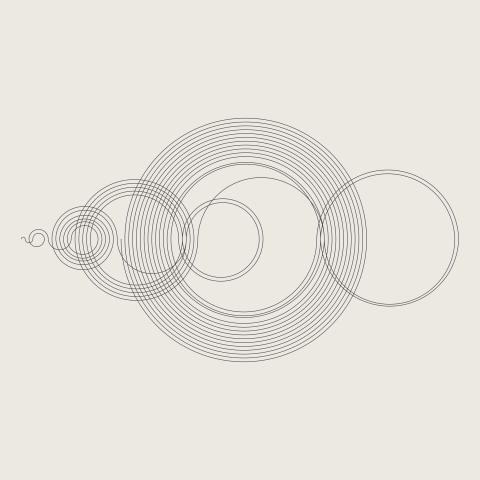
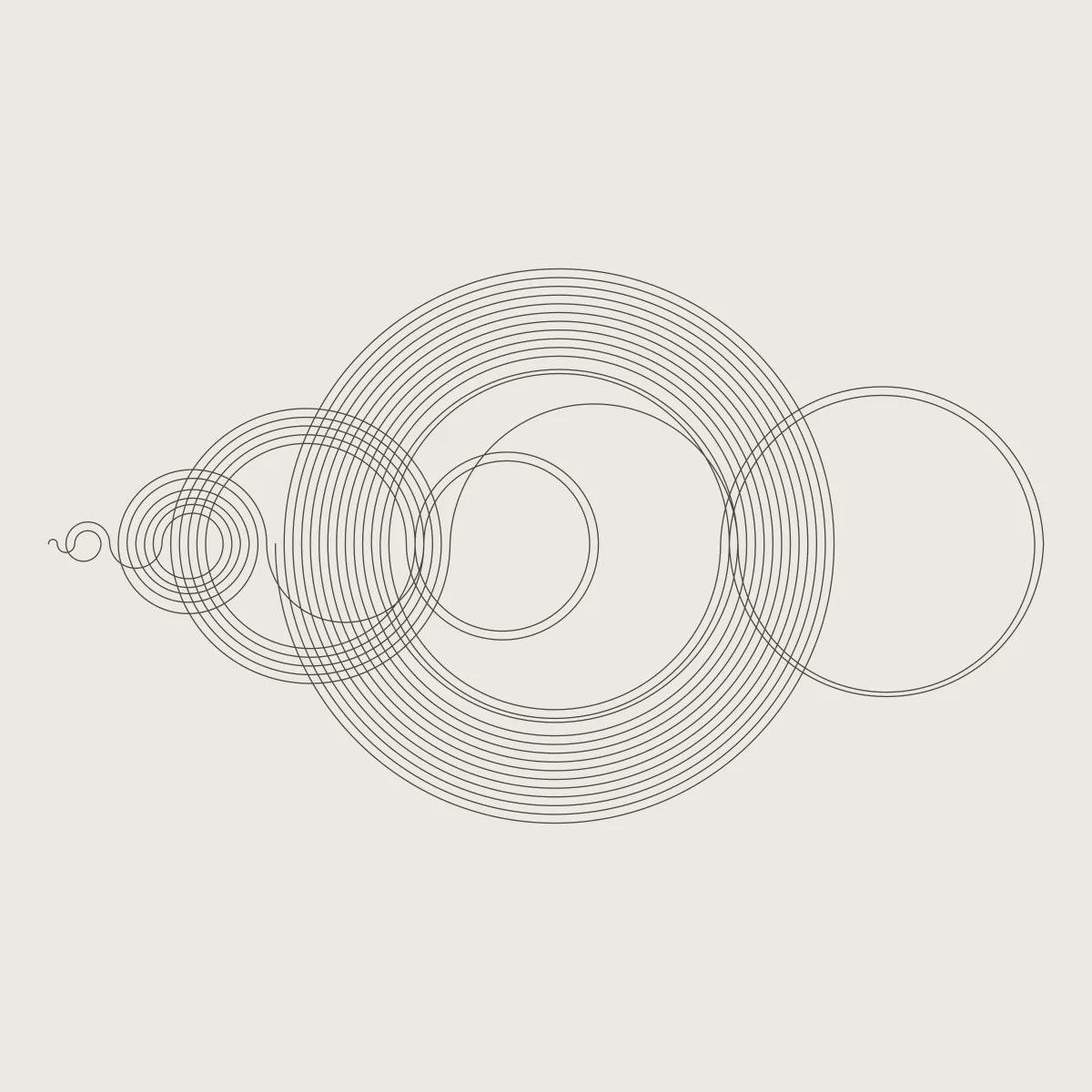
Steps of one, two, three and on along the number line, each back towards zero if it lands somewhere new and forwards if not, every step a half circle. The arcs nest into shells that never quite settle.
Start at zero. Take a step of one, then two, then three, each time going back towards zero if that lands on a number not yet visited and not below zero, and forwards otherwise: 0, 1, 3, 6, 2, 7, 13, 20, 12 and so on. Bernardo Recamán Santos sent the rule to Neil Sloane in 1991 and it became one of the best loved entries in his Online Encyclopedia of Integer Sequences, number A005132.
Drawn with each step as a half circle, alternately above and below the line, the jumps back and forth nest into shells and lenses. Nobody knows whether every whole number is reached in the end; 852,655 is the smallest still waiting, after more than ten to the power 600 terms (Benjamin Chaffin, 2026).
The sequence can start somewhere other than zero, and the arcs can sit on a circle instead of a line. In motion the steps are drawn one after another.
Colombian mathematician and puzzle writer whose rule of steps back and forth, sent to Neil Sloane in 1991, became one of the best loved entries in the Online Encyclopedia of Integer Sequences.
The Online Encyclopedia of Integer Sequences, where it is A005132
British-American mathematician who began collecting integer sequences as a graduate student in the 1960s and turned the collection into the Online Encyclopedia of Integer Sequences, where Recamán's sequence is number A005132.