
Aztec Diamond

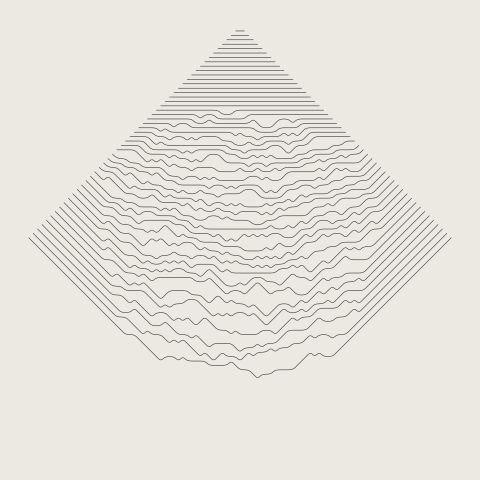
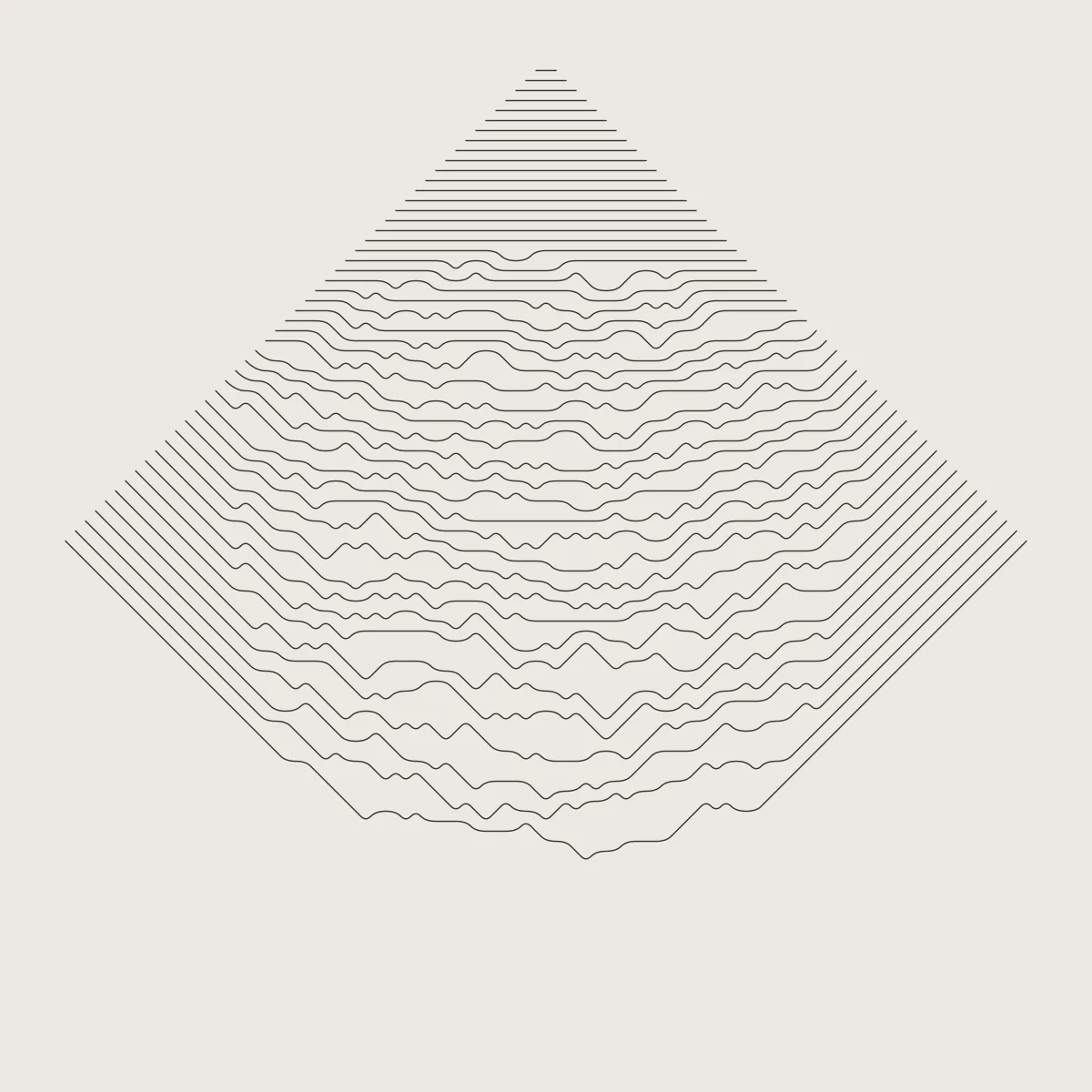
A diamond of squares covered by dominoes, chosen fairly from every way to do it, drawn as the paths hidden in it. Outside a circle everything freezes into straight lines; inside it the paths wander like ridges.

Aztec Diamond: A diamond of squares covered by dominoes, chosen fairly from every way to do it, drawn as the paths hidden in it. Outside a circle everything freezes into straight lines; inside it the paths wander like ridges.Aztec Diamond: A diamond of squares covered by dominoes, chosen fairly from every way to do it, drawn as the paths hidden in it. Outside a circle everything freezes into straight lines; inside it the paths wander like ridges.

About this pattern

Elkies, Kuperberg, Larsen & Propp, 1992 · Jockusch, Propp & Shor, 1995

Aztec Diamond, domino tiling, drawn by GART: A diamond of squares covered by dominoes, chosen fairly from every way to do it, drawn as the paths hidden in it. Outside a circle everything freezes into straight lines; inside it the paths wander like ridges.
Aztec Diamond · CC BY 4.0

Stack rows of squares two, four, six and on up to the middle, then back down, and you have the Aztec diamond. There are 2 to the power n(n + 1)/2 ways to cover one of order n with dominoes, a count found by Noam Elkies, Greg Kuperberg, Michael Larsen and James Propp in 1992, along with domino shuffling, a way to choose one of them perfectly fairly.

Shuffling grows the tiling one order at a time: dominoes about to collide are taken away, the rest each slide one square, and the holes left behind are filled with a pair at the toss of a coin. Large random tilings all look alike. Near the four corners every domino lies the same way, frozen into brickwork, and only inside the circle that touches the diamond's sides is there disorder; William Jockusch, James Propp and Peter Shor proved this arctic circle in 1995.

Behind the mathematics

James Propp

Domino shuffling, 1992, and the arctic circle, 1995

American mathematician at the University of Massachusetts Lowell who with Noam Elkies, Greg Kuperberg and Michael Larsen counted the domino tilings of the Aztec diamond and found domino shuffling, and in 1995 proved its arctic circle with William Jockusch and Peter Shor.

Noam Elkiesborn 1966

Counting the tilings and domino shuffling, 1992

American mathematician at Harvard, where at 26 he became the youngest professor ever given tenure, whose 1992 paper with Kuperberg, Larsen and Propp counted the domino tilings of the Aztec diamond, 2 to the power n(n + 1)/2 of them, and gave domino shuffling to choose one fairly.