Unsettled

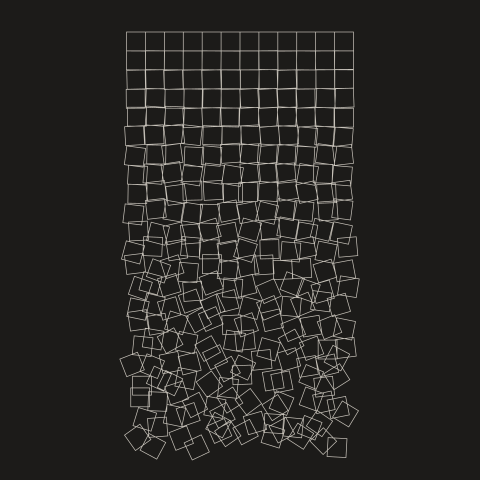
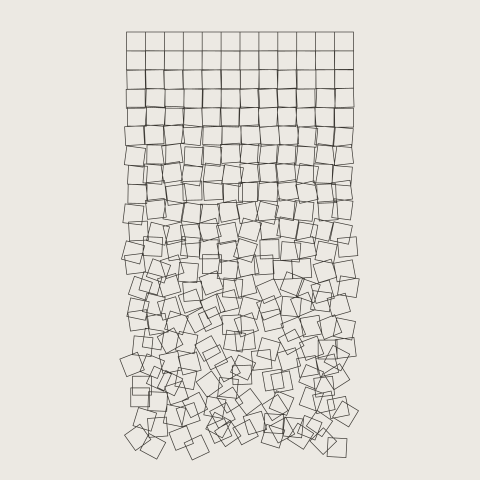
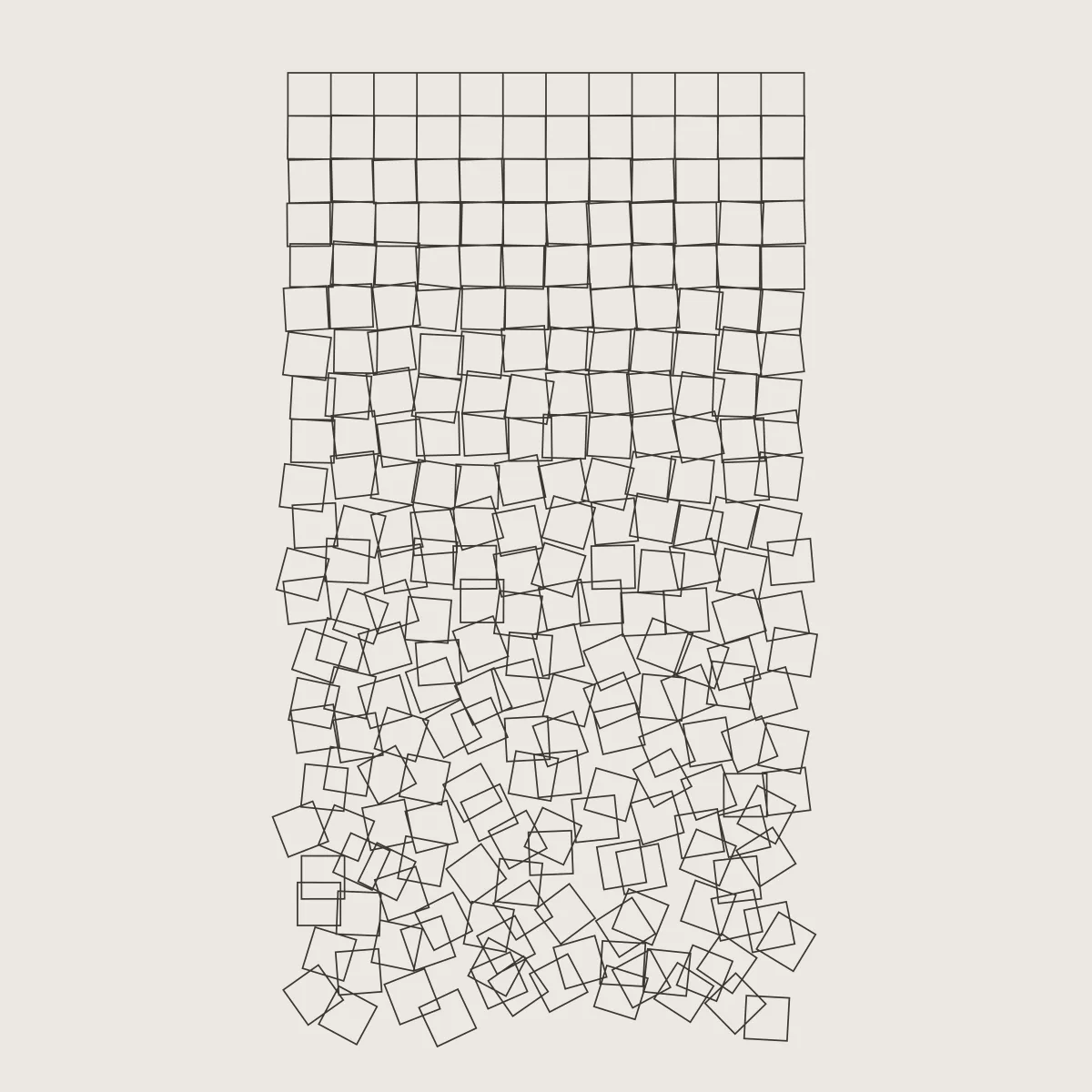
A grid of squares in perfect order at one end, each square turned and shifted a little more along the sheet, until the far rows lie scattered.

Unsettled: A grid of squares in perfect order at one end, each square turned and shifted a little more along the sheet, until the far rows lie scattered.Unsettled: A grid of squares in perfect order at one end, each square turned and shifted a little more along the sheet, until the far rows lie scattered.

About this pattern

After Georg Nees's Schotter, c. 1968

Unsettled, computer art, drawn by GART: A grid of squares in perfect order at one end, each square turned and shifted a little more along the sheet, until the far rows lie scattered.
Unsettled · CC BY 4.0

One of the first lessons of computer art was how little chance it takes to undo order. Georg Nees plotted a column of squares in the 1960s in which each row is allowed a little more random turn and drift than the last, so that a neat grid at the top comes apart into a heap of fallen tiles at the bottom.

This drawing borrows the idea. Every square has its own random turn and shift, the same each time for a given seed, and the disorder scales them from nothing to its full amount along the sheet, in a curve that lets the order hold for a while before it gives. The change can run down the sheet, across it, or out from the middle. In motion the grid settles into order and comes loose again.

Behind the mathematics

Georg Nees1926–2016

Inspiration: Schotter, order falling into disorder

German pioneer of computer art who in 1965 showed some of the first computer-generated drawings, and whose Schotter (Gravel), plotted around 1968, let a grid of squares fall row by row from order into disorder.