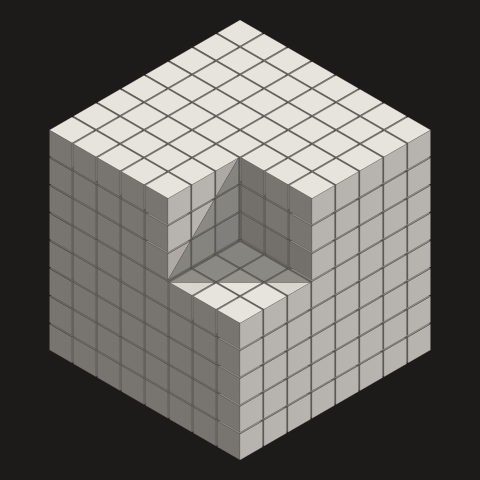
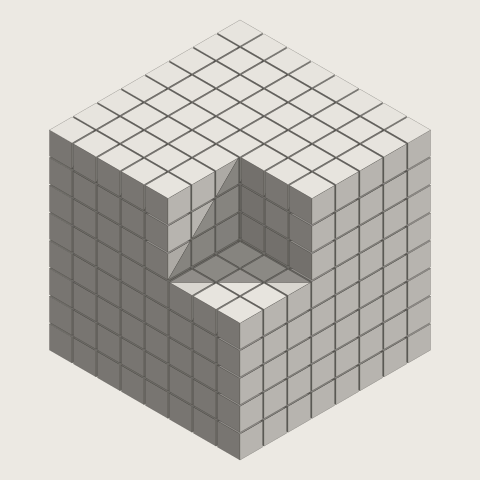
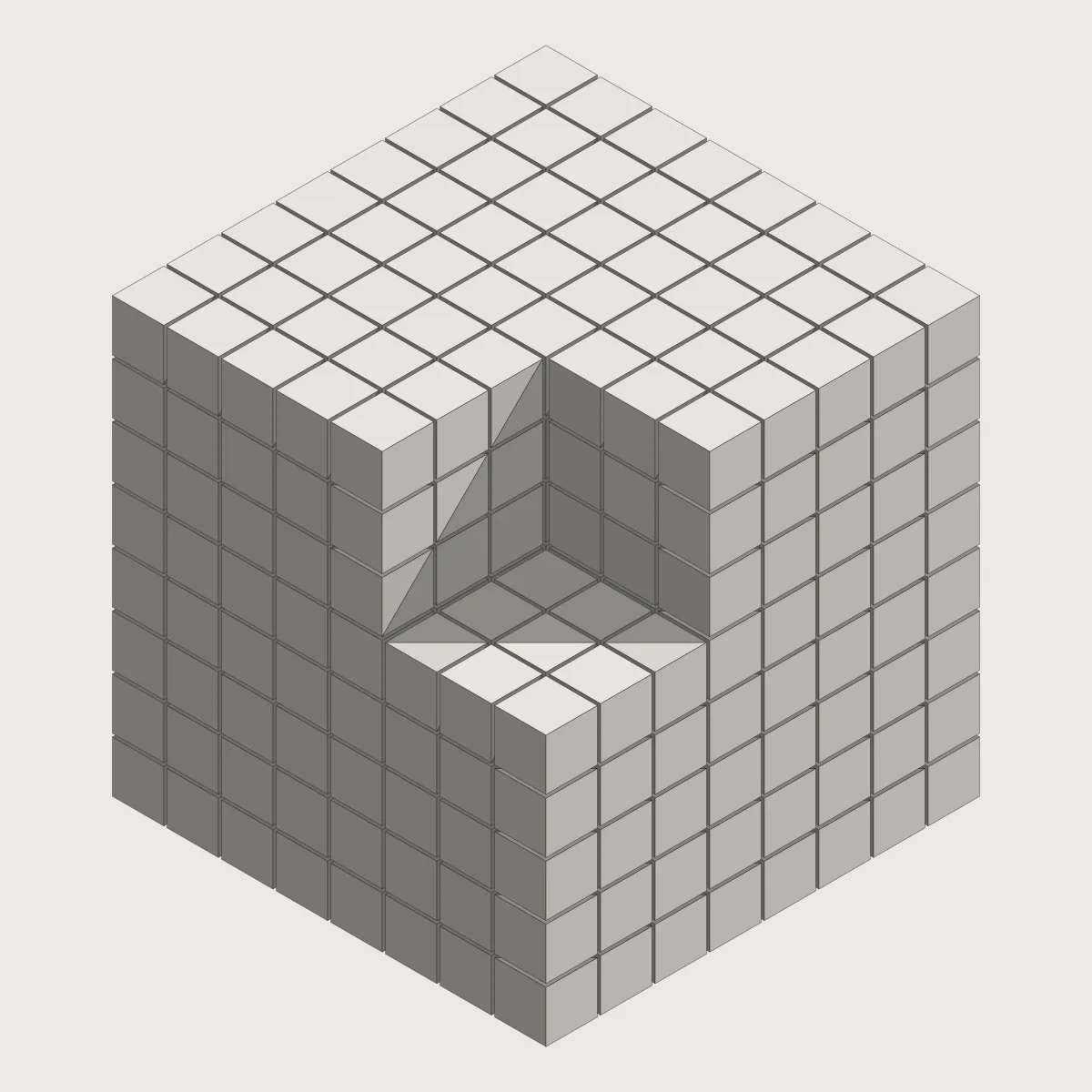
A cube of small cubes with a pile taken out of its corner, lit by a low sun. Every pile that fits is a plane partition, and seen from the corner each one tiles a hexagon with rhombi.
The cube is built from n³ small cubes, and a pile of them is lifted out of the corner nearest you. A pile that sits in a corner, every cube resting on the floor or on others and pushed against both walls, is what mathematicians call a plane partition: write down how tall each column is and the numbers never increase away from the corner.
Percy MacMahon counted the piles that fit in a box in 1916, and his formula is still a small wonder. Seen straight from the corner, every pile is also a tiling of a hexagon by rhombi of three orientations, which is why the eye accepts it as solid.
Choose Random pile and one is picked fairly from all of them: near the corners of the box it settles into flat faces, and only inside a circle is it disordered, the arctic circle that Henry Cohn, Michael Larsen and James Propp proved in 1998. A single sun lights the model from the upper right. Its direction is chosen so every shadow edge falls along the grid or across a face's diagonal, so the shadows here are exact, and the corners where cubes crowd round are darkened by the light they block.
In motion the pile is put back one cube at a time and taken out again, a plane partition at every step.
British mathematician and army officer who founded much of enumerative combinatorics. In Combinatory Analysis (1915–1916) he counted the plane partitions that fit in a box, piles of cubes pushed into a corner.