
Leonhard Euler1707–1783
Knight's tours, 1759
Swiss mathematician who in 1744 found the catenoid, the surface made by spinning a hanging chain, and showed it encloses the least area between two rings.
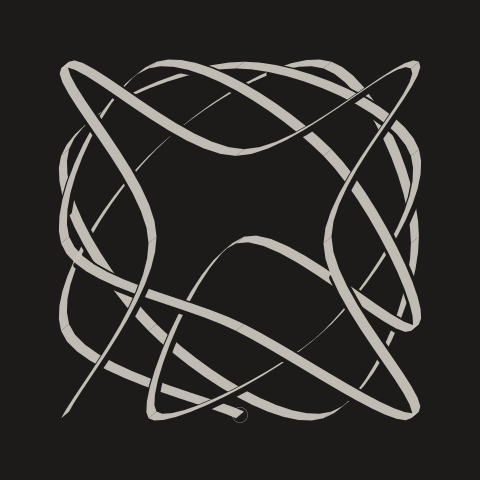
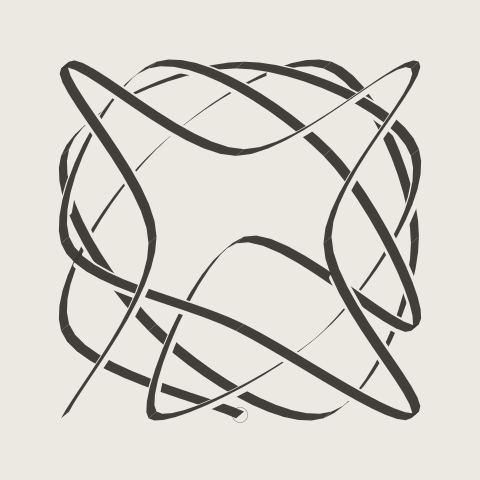
A chess knight visits every square of the board exactly once, and its path of short, crooked jumps becomes a dense star of lines.
Rudrata, 9th century · Leonhard Euler, 1759 · H. C. von Warnsdorff, 1823
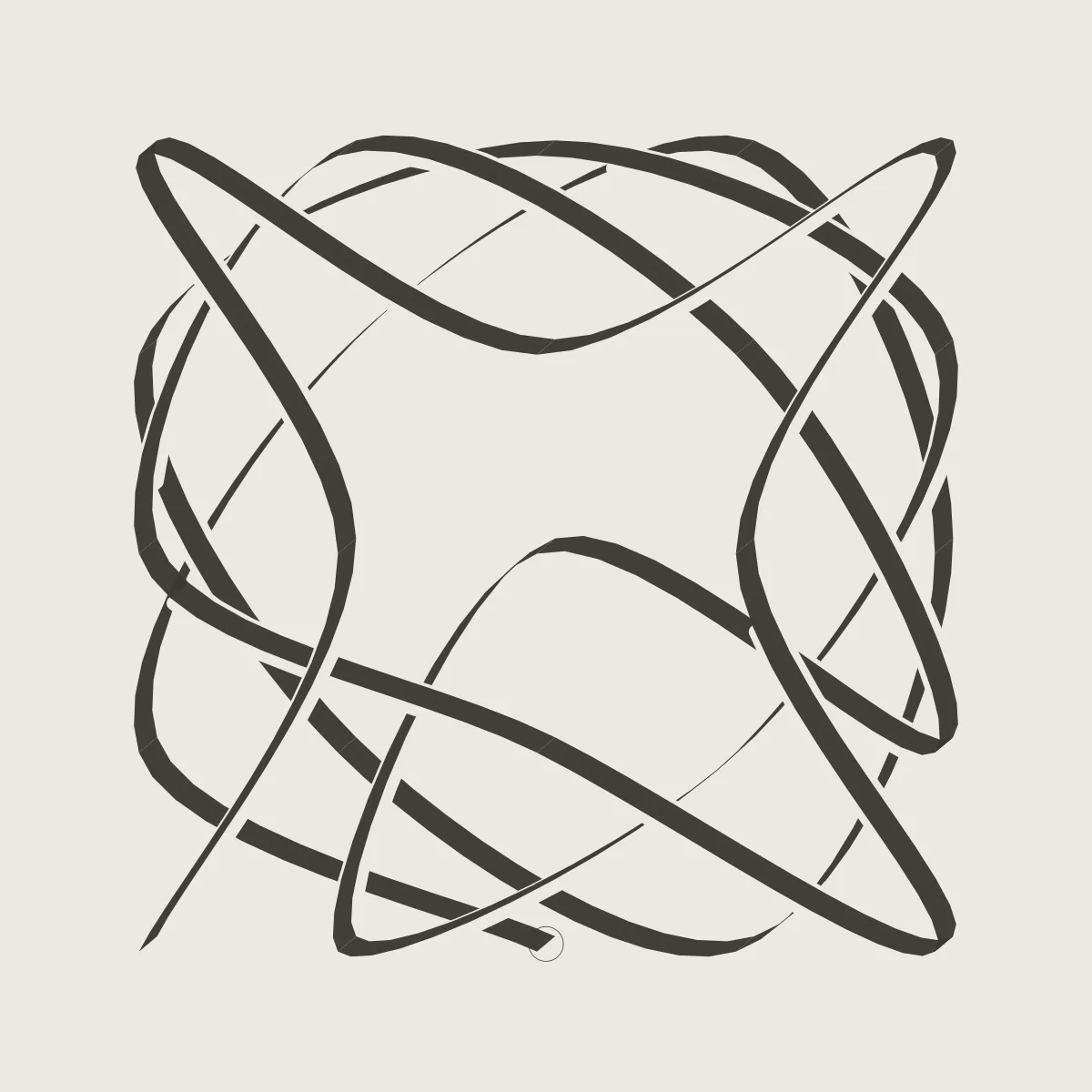
The knight moves two squares one way and one the other, so it can never reach a neighbouring square directly, and a tour that visits every square once has to wander. The oldest known tour is a poem: Rudrata's Kāvyālaṅkāra, a Sanskrit work on poetics from the 9th century, sets a half-board tour in verse. Leonhard Euler studied tours in 1759, and in 1823 H. C. von Warnsdorff gave a rule that finds one almost every time: always jump to the square with the fewest onward moves, so the awkward squares are visited before they can be stranded. A closed tour ends a knight's move from where it began. Allen Schwenk showed in 1991 which boards have one; no square board with odd sides does, because the knight changes colour with every jump and an odd board has one square more of one colour. The ordinary board has more than 13 trillion closed tours, so every seed draws another.
Choose the board, an open or closed tour, and how the jumps are drawn: straight moves, a smooth curve through every square, or dots joined by faint lines. Drawn with a broad nib, the line swells and thins with its direction, as a flat pen held at one angle does in calligraphy: thick across the nib, a hairline along it. With depth, each jump lifts off the ones it crosses, its shadow a gap that lets the ground show through. In motion the knight draws its tour jump by jump.
Behind the mathematics
Knight's tours, 1759
Swiss mathematician who in 1744 found the catenoid, the surface made by spinning a hanging chain, and showed it encloses the least area between two rings.