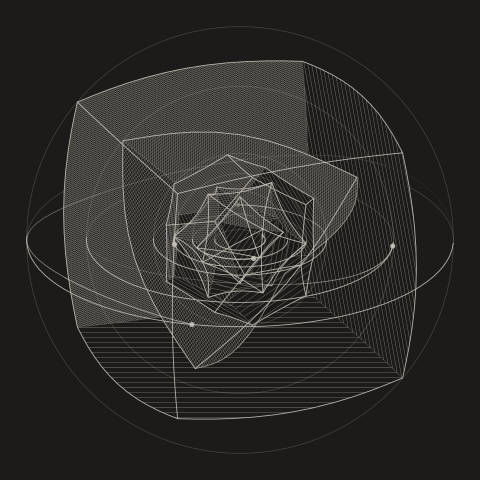
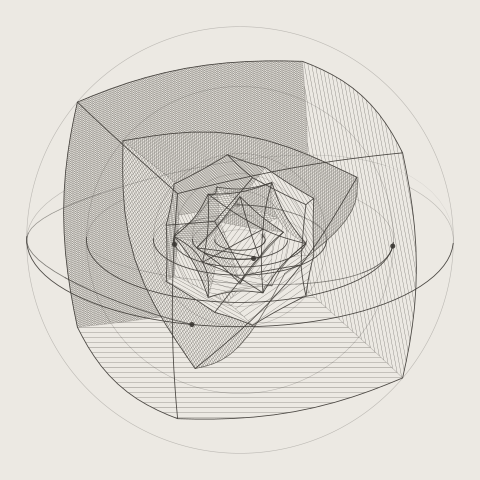
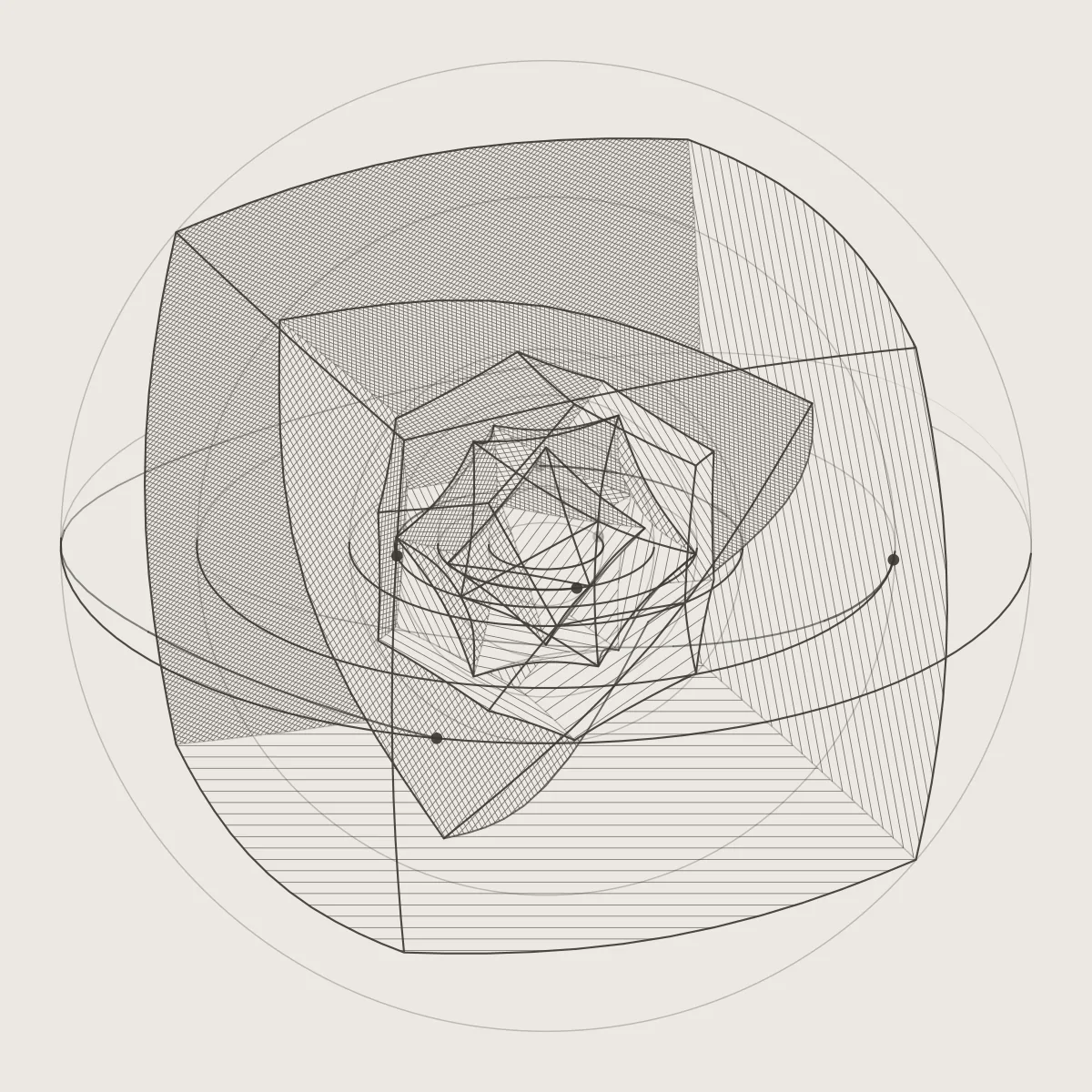
There are exactly five Platonic solids, the shapes whose faces are all the same regular polygon and whose corners all look alike, and in 1596 there were exactly six known planets. The young Johannes Kepler thought that could be no accident. In his first book, Mysterium Cosmographicum, he nested the solids one inside another, each held between two spheres: the sphere outside touches every corner, and the sphere inside touches the middle of every face.
Six spheres, one for each planet, and five gaps, one for each solid. From the Sun out the order is octahedron, icosahedron, dodecahedron, tetrahedron and cube, so the cube sits inside the sphere of Saturn. His predicted sizes for the orbits came within about ten per cent of the measured ones, which he put down mostly to errors in the measurements.
It was wrong, but the search for the true pattern led him, by way of Tycho Brahe's observations, to his laws of planetary motion. With every sphere drawn thin, as here, the fit is looser, worst for Mercury at the centre.
Drawn as an engraving, each solid is cut open at the front and the walls behind are hatched, the lines closer where a wall turns from the light. Drawn sunlit, the Sun sits at the centre and the edges become rods: each one casts a shadow out onto the walls beyond it, widening with distance, and every wall is brightest where it faces the Sun squarely and darkens towards its corners, as light does with distance and slant.
Each solid out from the Sun is a shade nearer the ground, so the nest reads in depth, and the Sun's flares are fixed on its globe, so they sweep round its rim as it turns.
Choose Evened out to look through a lens that gives every gap between the spheres the same room: each point keeps its direction from the Sun and its place between two spheres, so every touch is still a touch, and the edges bow as through a fisheye. The planets go round at speeds set by his third law, the square of the time for one orbit growing as the cube of its size, and leave fading trails.
Choose fewer solids to look inside, and True orbits to compare the spheres with today's distances, scaled to fit. In motion the whole nest turns and gently rocks while the planets keep their orbits.