Peter M. Maurer
"A Rose is a Rose…", American Mathematical Monthly, 1987
American computer scientist whose 1987 article "A Rose is a Rose…" in the American Mathematical Monthly joined points on a rose curve with straight lines.
Hop round a rose curve in steps of the same angle and join the dots. One whole number for petals and one for the step make nets, stars and lace.
Peter Maurer, 1987 · Guido Grandi, 1723
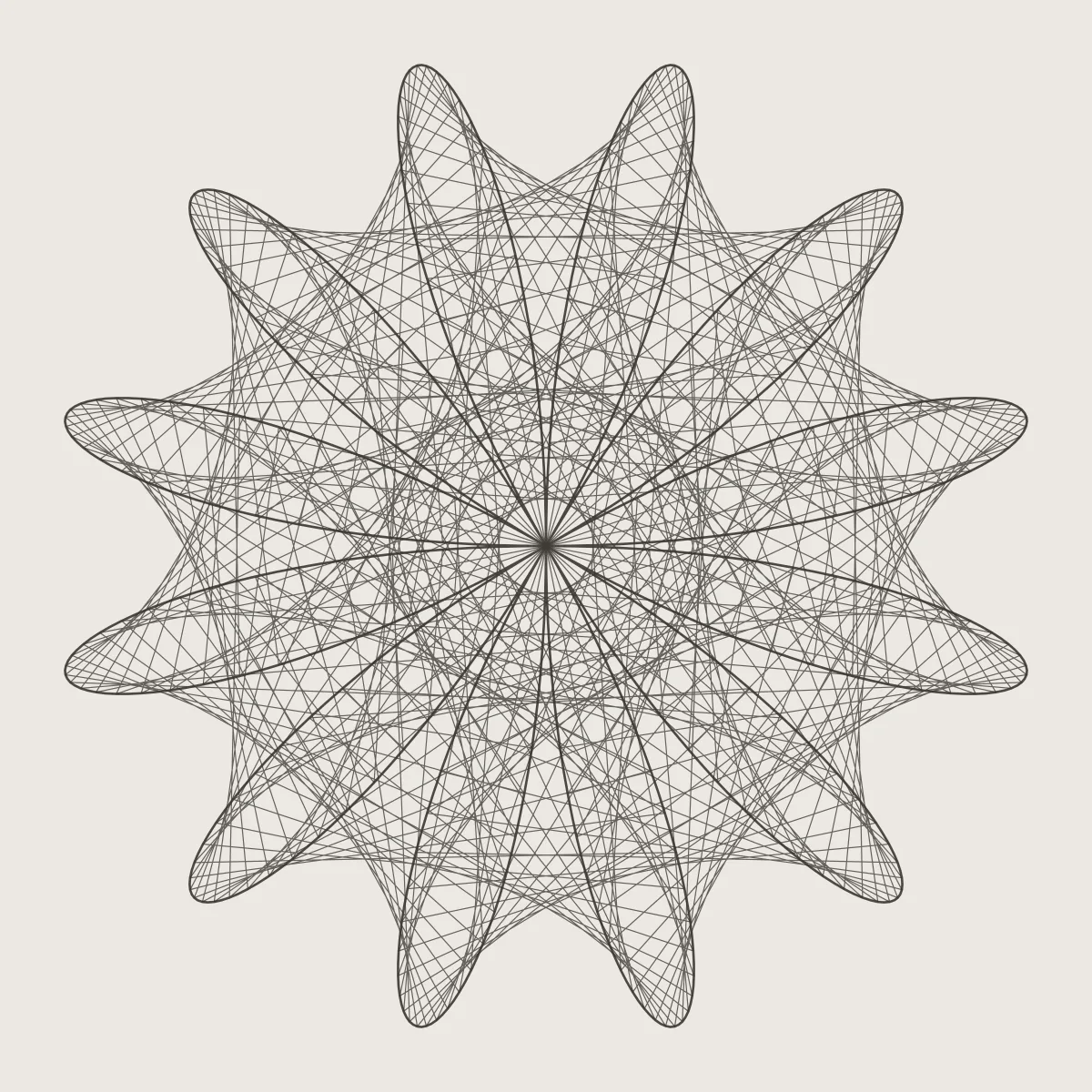
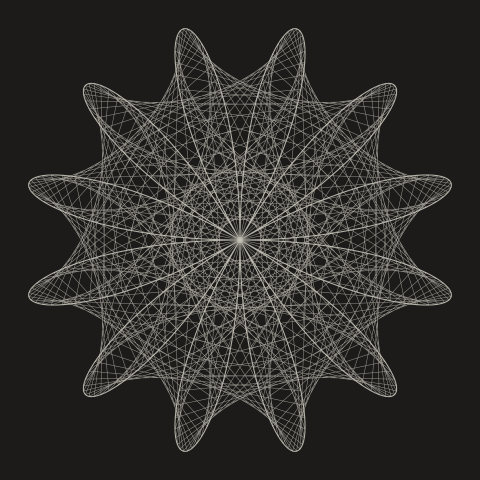
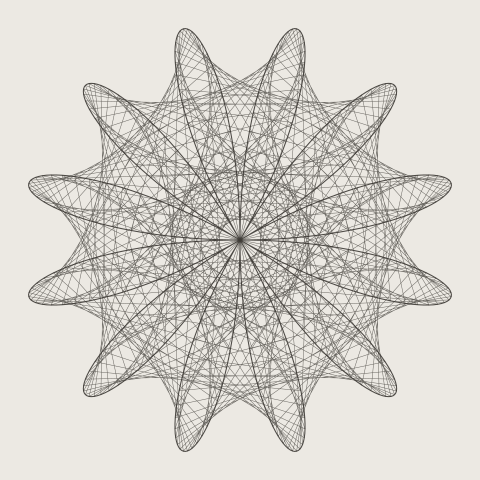
The rose curve r = sin(nθ) was named by the Italian priest and mathematician Guido Grandi, who studied it in the 1720s: it has n petals when n is odd and 2n when n is even. In 1987 Peter Maurer, in an article in the American Mathematical Monthly called "A Rose is a Rose…", gave it a twist. Instead of tracing the curve, jump along it: go round in steps of d degrees, 360 steps in all, and join each point to the next with a straight line.
With d = 1 you just get the rose, drawn with straight segments. With most other steps the line zigzags from petal to petal and the drawing turns into a web, a star, a lace collar or a dense mesh, and steps a single degree apart can look nothing alike. Whatever the step, after 360 of them the pen is back where it started, so every Maurer rose with a whole-number step is a closed polygon.
Steps that share a factor with 360 close up sooner and draw fewer lines, which is why some steps look so sparse. The sheet shows a grid of them, petals increasing down the rows and the step across the columns, like a specimen book.
In motion the step drifts a fraction of a degree to each side, and the whole web shivers through its neighbours.
Behind the mathematics
"A Rose is a Rose…", American Mathematical Monthly, 1987
American computer scientist whose 1987 article "A Rose is a Rose…" in the American Mathematical Monthly joined points on a rose curve with straight lines.