Asanoha
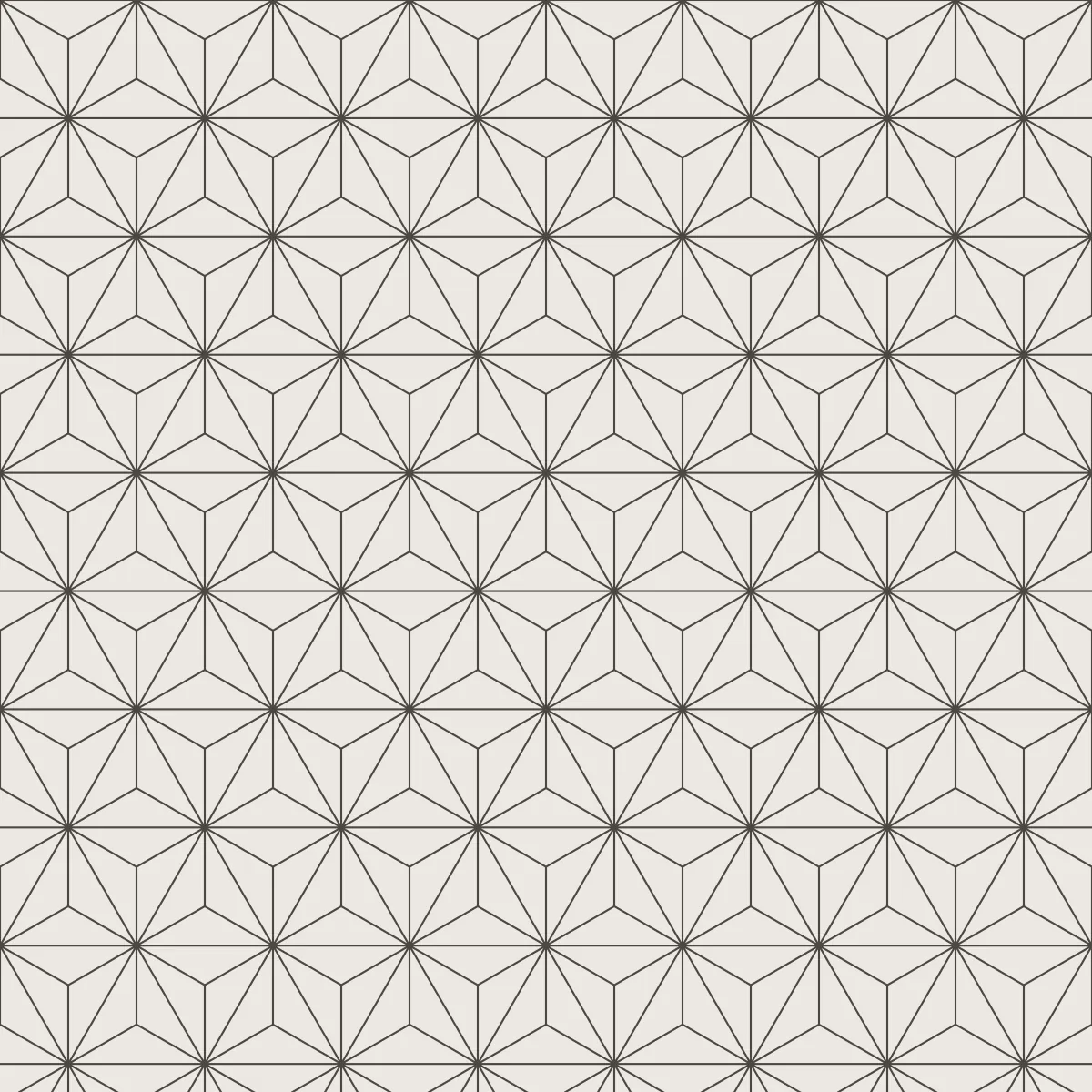
The Japanese hemp-leaf pattern: a grid of triangles with every centre joined to its corners. Drawn as wooden kumiko, it opens into pinwheels.
About this pattern
Japanese textile and kumiko pattern, Heian period onwards
Asa no ha means hemp leaf. The pattern is found on Buddhist statues from the Heian period, a thousand years ago, and in the Edo period it became a favourite for kimono, above all for babies' clothes: hemp grows tall and straight and fast, and it was hoped the child would too. It is very simple to draw.
Start with a grid of equilateral triangles and join the middle of each triangle to its three corners. Around every corner of the grid six long diamonds meet, a star of leaves; look again and you can see cubes, or hexagons, or triangles, all at once. In kumiko, the Japanese craft of screens made from thin strips of wood held together without nails or glue, asanoha is one of the first patterns a joiner learns: the triangle grid is cut and slotted together first, then three tiny strips are planed and pressed into every triangle.
Here the centre where the strips meet can open into a small triangle, and turn, which gives the related patterns that kumiko makers fit into the same frame.
Drawn as wood, each line becomes a strip with two edges, and where strips cross the joints close up. Mixed infills fill some triangles with other kumiko patterns, open leaves, pinwheels turning either way, or nothing at all, chosen by the seed, as joiners often combine several patterns in one screen. In motion the centres open and turn, then close back into leaves.