
Pythagoras of Samosc. 570–c. 495 BCE
a² + b² = c²
Greek philosopher whose school gave its name to the theorem that the squares on a right triangle's two shorter sides together equal the square on the longest, a fact known in Babylon long before.
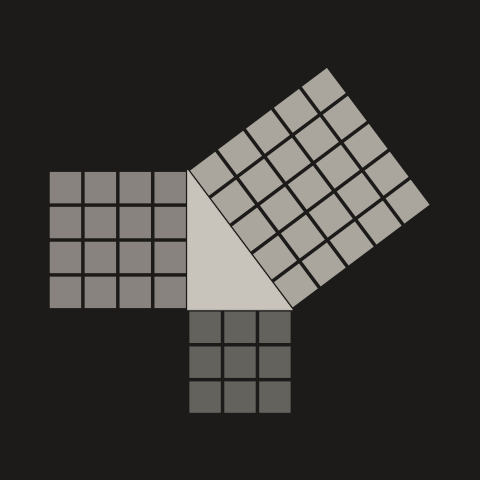
A right triangle with a square on each side. Count the cells: the two smaller squares together hold exactly as many as the largest.

Pythagoras, c. 500 BCE · a² + b² = c²

The figure every proof of the theorem begins from. Square the two shorter sides of a right triangle and the squares, added, equal the square on the longest side. Ruled into unit cells on a whole-number triangle it can be checked by counting, 9 and 16 against 25 on the 3–4–5, which is how the Babylonians knew it centuries before Pythagoras's school gave it his name.
In motion the cells are counted in: the two small squares fill first, then the large one takes the same number.
Behind the mathematics
a² + b² = c²
Greek philosopher whose school gave its name to the theorem that the squares on a right triangle's two shorter sides together equal the square on the longest, a fact known in Babylon long before.