Børge Jessen1907–1993
The orthogonal icosahedron, 1967
Danish mathematician who in 1967 described an icosahedron folded so that every pair of neighbouring faces meets at a right angle, a solid that looks rigid yet feels shaky in the hand.
Twenty triangles whose every pair of neighbours meets at a right angle. Six pairs fold into deep notches, so a regular icosahedron turns star-like.
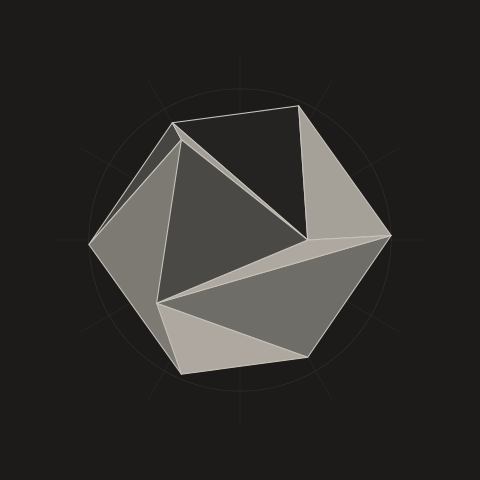
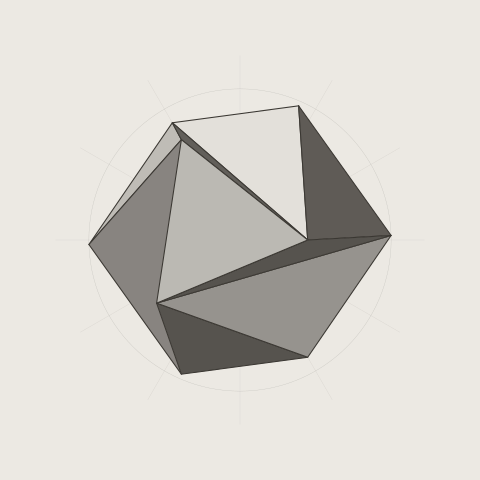
Børge Jessen, 1967 · the icosahedron–cuboctahedron family
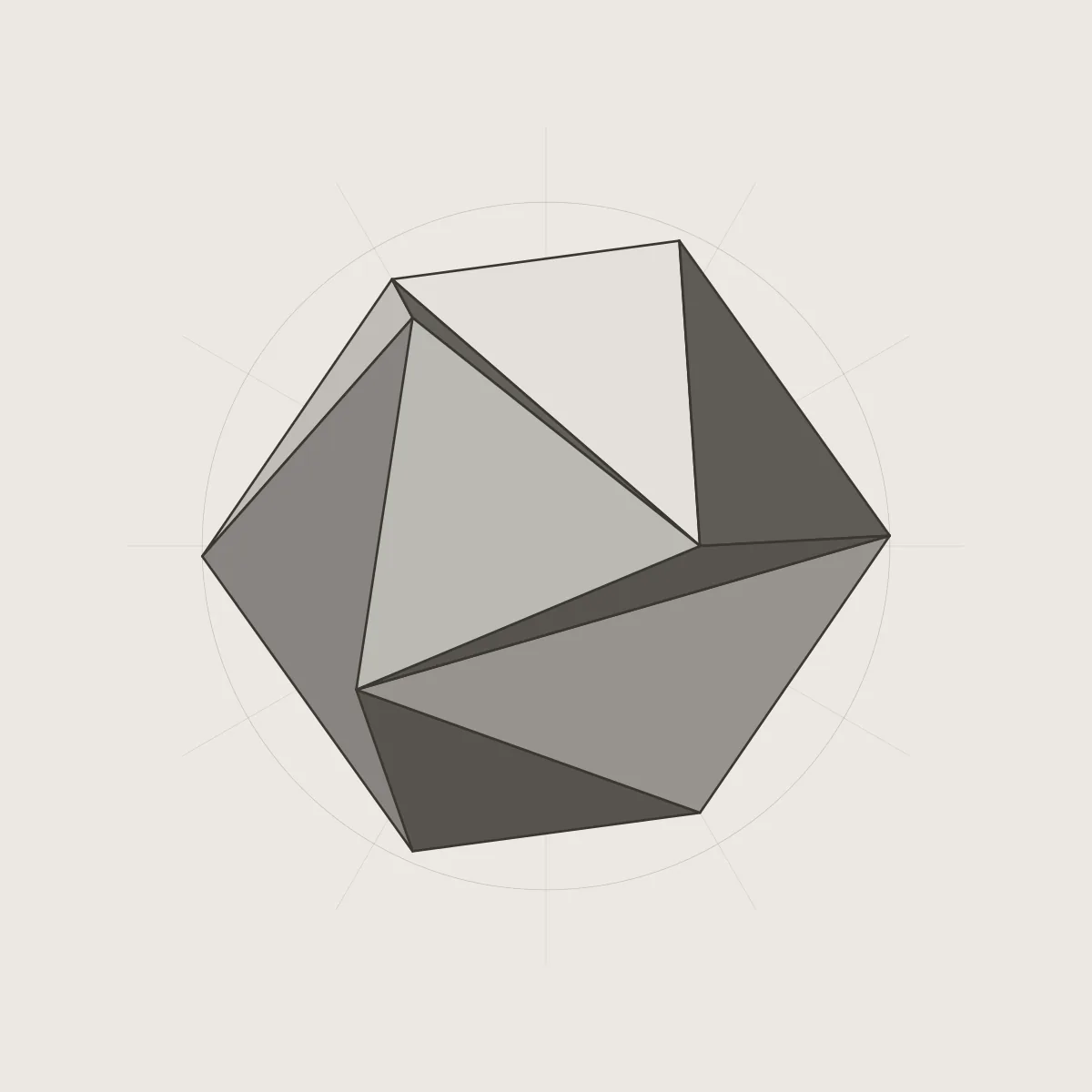
Keep the twelve corners of an icosahedron and its twenty triangles, but let six of its edges hinge. Fold them outward and the solid is the regular icosahedron; open them flat and each pair of triangles becomes a square, giving the cuboctahedron; keep folding and the pairs sink into notches. Børge Jessen found that at one exact depth, with corners at (0, ±1, ±2), every two faces that share an edge meet at a right angle, although the solid is nowhere near a cube.
It is also shaky: it cannot really flex, yet it gives slightly under the fingers. Faces are shaded by how squarely they face a light from the upper left, and motion folds the solid through the whole family and back.
Behind the mathematics
The orthogonal icosahedron, 1967
Danish mathematician who in 1967 described an icosahedron folded so that every pair of neighbouring faces meets at a right angle, a solid that looks rigid yet feels shaky in the hand.