Repeat scale · Line density · Petal curvature
Shapes that cover the plane. Periodic tessellations sit beside aperiodic tilings such as Penrose's and the Spectre, which never repeat, along with Truchet tiles, azulejos and Islamic strapwork.
Repeat scale · Line density · Petal curvature
Repeat scale · Ribbon width · Line density
Repeat scale · Relief · Facet lines
Repeat scale · Drift · Reach
Cells · Line density · Curvature
Columns · Weight

Columns · Shade · Tumble
Depth
Tiles
Columns · Fill
Sites · Nested · Ring spacing
Columns · Fill
Sites
Columns · Weight
Columns · Rows · Flare
Underlying tiling · Contact angle · Scale
Contact angle · Scale · Weight
Sides · Meeting at a corner · Rings

Columns · Depth · Split chance
Columns · Row shift · Mortar
Columns · Bar width · Disc size
Columns · Band height · Lean
Columns · Depth offset · Weight
Columns · Recess · Rim
Tiles across · Depth · Horizon
Ridges · Lines a ridge · Weight
Cells · Weight
Directions · Wavelength · Dot size
Cells · Cycles · Relief
Blocks across · Joint · Contrast
Circles across · Weight · Radius
Crossings · Band width · Gap
Bands · Zig width · Contrast
Cells across · Rule · Motif size
Regime · Thickness
Fans across · Rings · Style

Cells across · Roundness · Joined cells
Triangle · Style · Turn
Shape · Style · Gap
Patch · Edges · Tiles
Sides · Plate · Repeats across
Spread · Twist · Style
Cuts · Turn · Style
Change · Tiles across · Bend
Sides · Rings · View
Order · Drawn as · Gap between
Show · Copies round · Steps out
Bar · Squares across · Drawn as
Triangles across · Centre opening · Centre turn
Laid out · Steps · Turn
Tiling · Repeats across · Fill
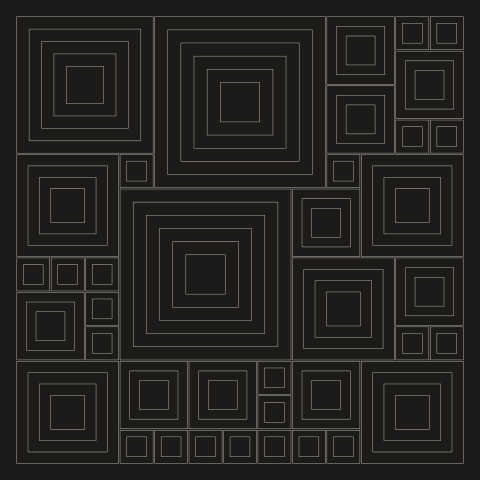
Square · Side · Big pieces
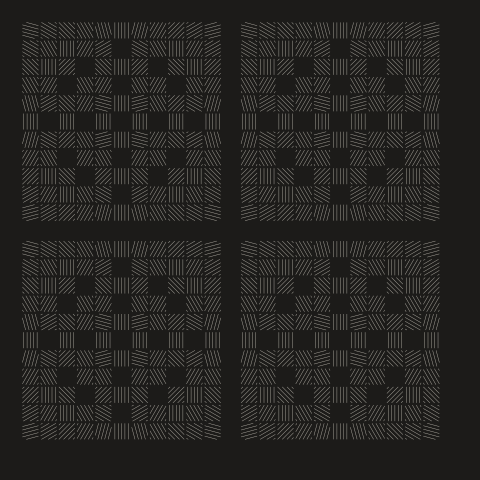
Divide by · Table size · Operation
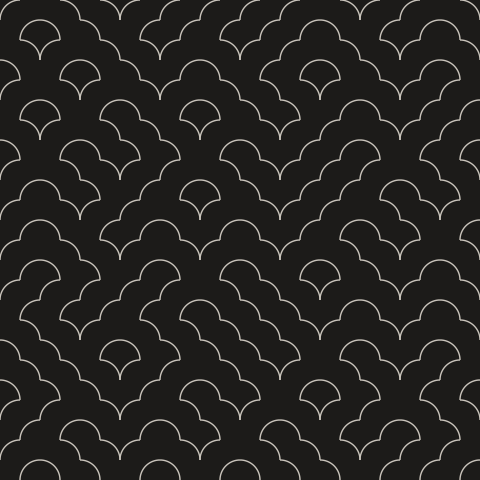
Scalloped flowers and curved diamonds grow from a repeating ornamental field. Nested ink lines give each tile a delicately engraved rhythm.
Interlaced square ribbons form eight-pointed stars. Fine parallel strands carry a quiet pulse through alternating over-and-under crossings.
Fine ruled facets turn a tiled surface into a field of raised diamonds. Peaks rise, flatten and invert in a slow travelling wave.
A field of ornamental tiles gathers into a fluid swirl, then settles back into symmetry. Move its centre to pull the geometry across the page.
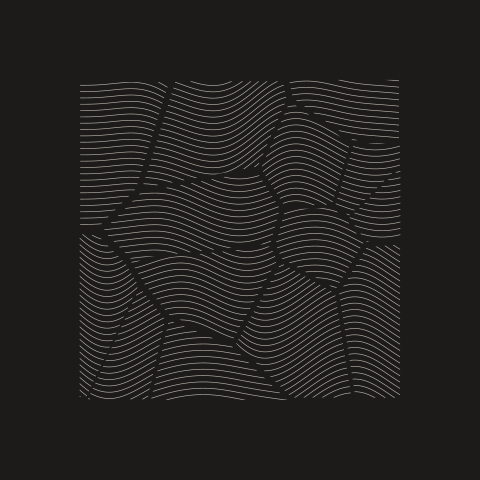
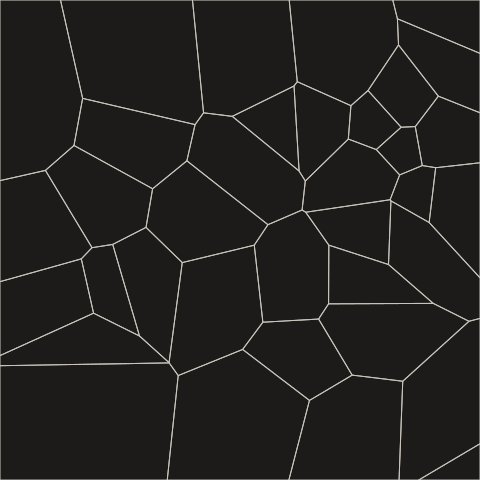
A cellular engraving: continuous currents pass through irregular Voronoi islands, separated by fine channels of open space.
A square grid of quarter-circle pairs. Each tile flips by seed, so the sheet reads as one continuous maze of arcs.
A rhombille tiling: each hexagon is three rhombi, and the sheet reads as a stack of cubes.
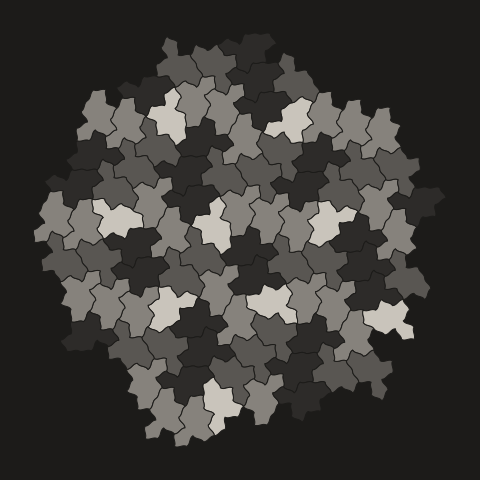
Kites and darts that cover the plane without ever repeating. Five-fold symmetry, golden-ratio edges, and no translational grid.
A 13-sided polykite, the hat, that tiles the plane but never periodically. The first aperiodic monotile; Spectre later dropped the reflections.
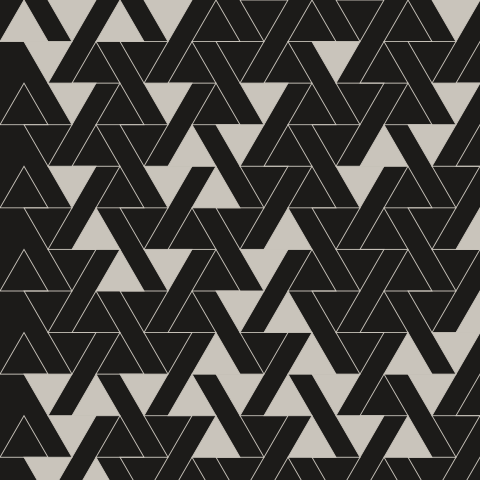
A tessellation of equilateral triangles. Fill is the chance a face is inked rather than outlined.
Sites from the seed, cells from the nearest-site rule. Some cells fill with copies of themselves, each ring an even step inside the last, like the rings of a contour map.
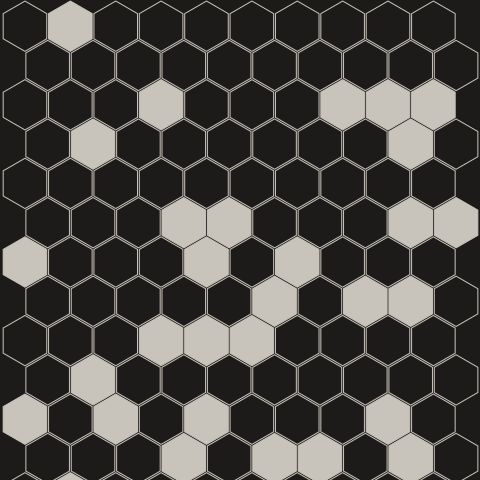
A pointy-top hex grid. Fill is the chance a cell is inked rather than outlined.
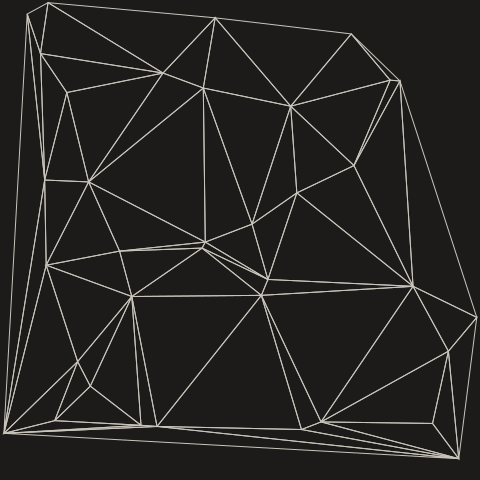
The dual of Voronoi: every site joins its neighbours into triangles. Same seed and site count as Voronoi Cells gives the matching mesh.
Each hex picks one of two arc orientations. Adjacent edge midpoints join with 120° arcs so paths continue across the honeycomb.
Pins and tails along a seam: the planar ancestor of the universal joint. Flare is how hard the lock bites; columns is how many keys fit the run.
Islamic star patterns drawn the way the craftsmen did: lines leave the midpoint of every tile edge at one fixed angle and run until they meet. One slider changes the order of every star at once.
Ten-fold star patterns on a tiling that never repeats. Two rhombus shapes carry the same strapwork rule as the periodic panels, but nothing about the arrangement comes back around.
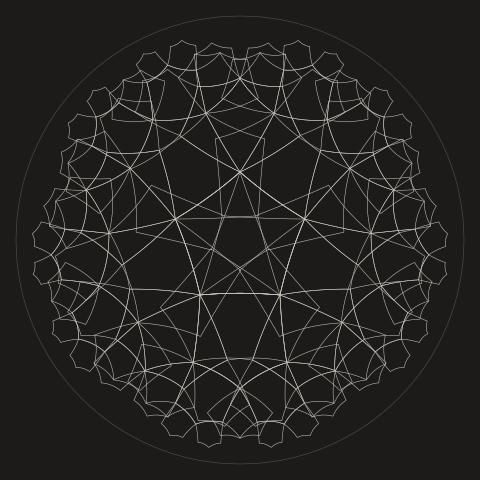
Every tile here is the same size. The whole infinite hyperbolic plane is drawn inside one circle, and the rim is infinitely far away, so the tiles appear to shrink as they approach it.
Truchet's tiles, but each square may break into four smaller ones before it decides which way to turn. Arcs still meet at every edge midpoint, so coarse and fine areas join without a break.
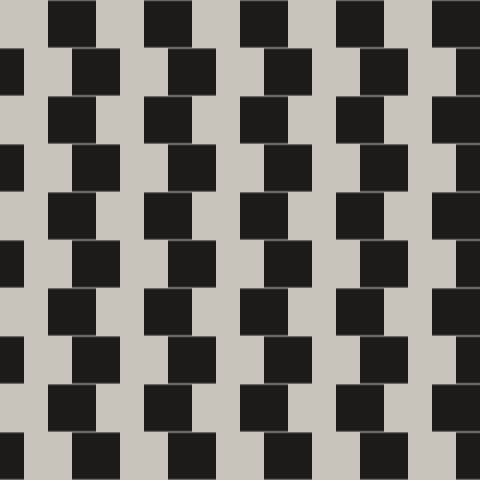
Offset rows of blocks divided by thin mortar. Every row is exactly horizontal, and almost nobody sees them that way.
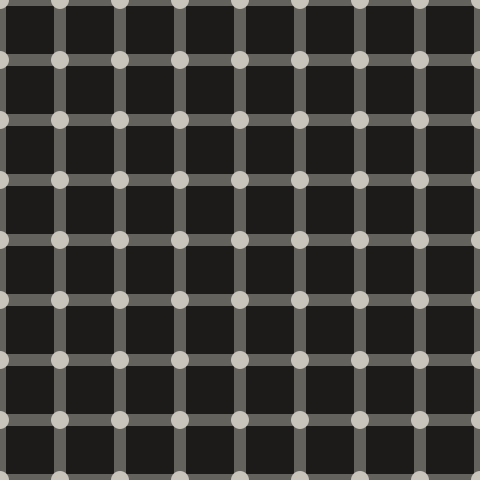
Pale bars with a disc at every crossing. Dark spots appear in the discs you are not looking at, and never in the one you are.
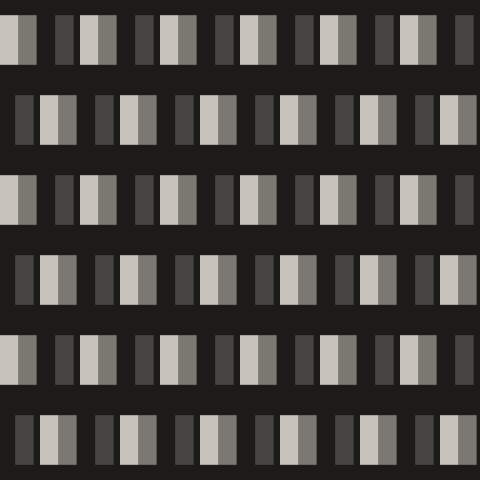
Nothing here moves. Each band runs dark to light the same way round, and the field creeps sideways whenever you look past it.
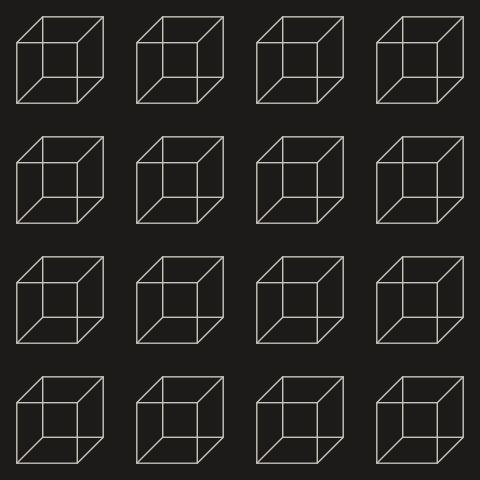
A field of wireframe cubes with nothing to say which face is nearer. Stare, and the whole field turns inside out at once.
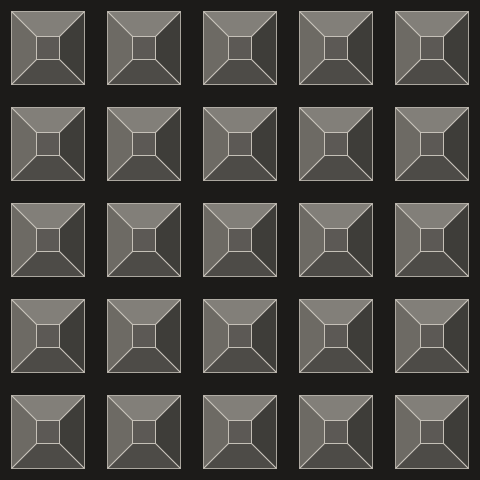
A ceiling of sunk panels. Every recess is cut the same way, and the four sides of each take their own tone.
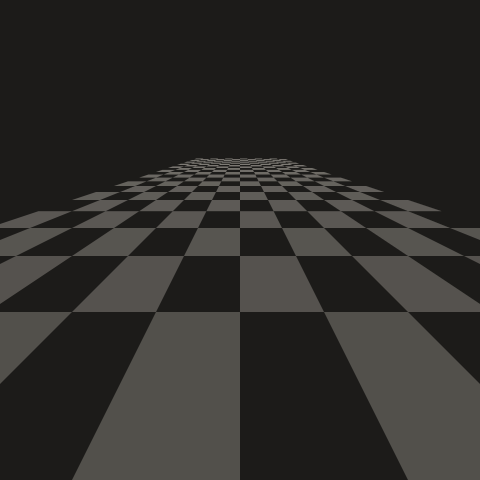
A chequered pavement running to the horizon. Every tile is square and no two are drawn the same shape.
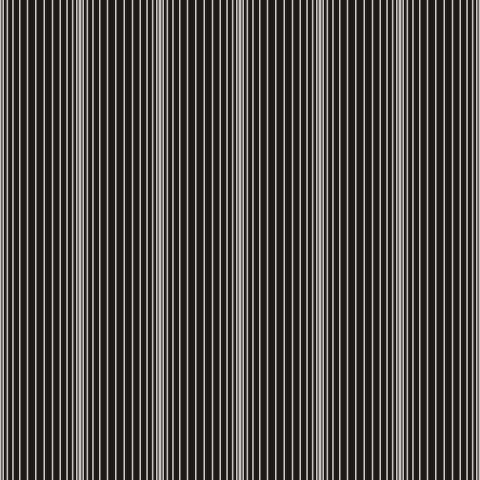
Ruled lines that crowd where the sheet turns away and open where it faces you. Nothing is shaded; the spacing does all of it.
Running stitches along every row and column, each starting a half step in or not. The boxes and crosses that appear were never stitched.
Five or seven flat waves laid over one another at equal angles. Order everywhere, and the same patch never twice.
One dot per cell, sized by a surface nobody drew. The grid is dead flat and the sheet rolls like beaten metal.
Pairs of planks laid at right angles, turn and turn about. Flat on the page, and it will not stop going over and under.
Circles of one size, each through the centres of its neighbours. Every petal, lens and six-pointed star in it is an accident of the overlap.
Two families of bands crossing on the diagonal, each one over, then under, without exception. No band ever ends.
Bands of zigzag, every one the same and every other one a shade apart. The eye reads the pairs as ridges and folds the sheet.
The original Truchet tile: a square cut on its diagonal, one half dark. Four turns of it, arranged by rule, give diamonds, chevrons and pinwheels.
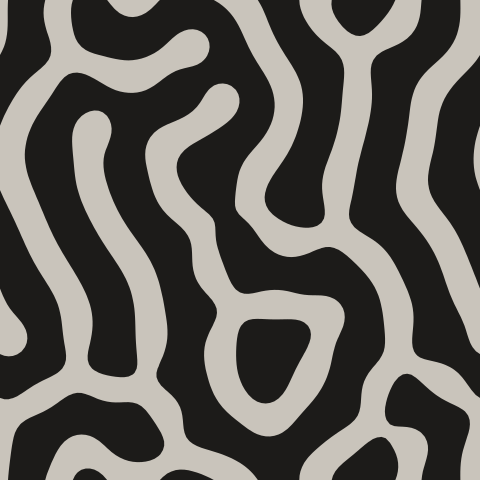
Two chemicals, one spreading faster than the other, settle into spots, mazes or coral from an almost uniform start. No edge anywhere, so it repeats forever.
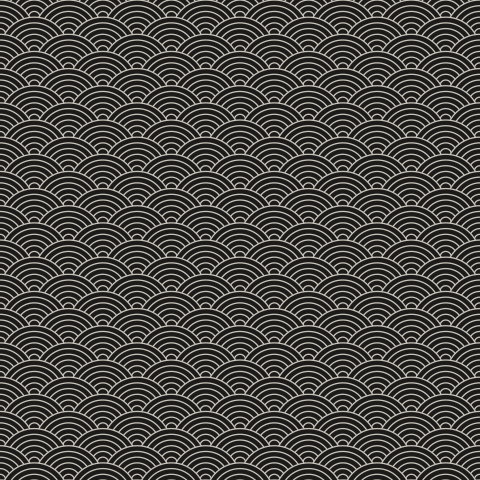
Fans of concentric arcs in overlapping rows, each row laid over the last. Only the top of every fan survives, and the field turns into swell.
Squares that round off some corners and keep others. Drops, leaves, arches and circles fall out of one choice per corner, set in a strict grid.
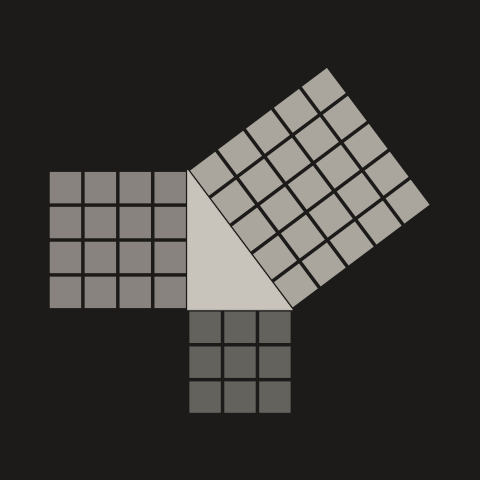
A right triangle with a square on each side. Count the cells: the two smaller squares together hold exactly as many as the largest.
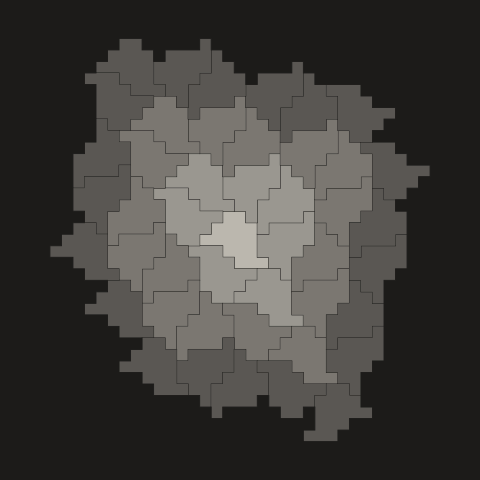
A shape that cannot tile the plane, surrounded by rings of its own copies until no further ring will close. The count of rings is its Heesch number.
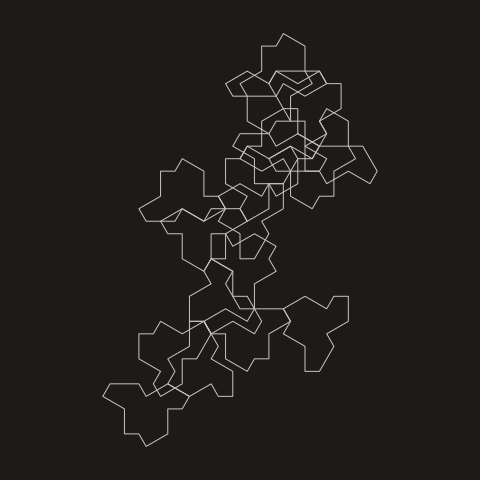
A single tile that covers the plane without ever repeating, using copies that are only turned, never flipped. Bend its edges and it cannot be flipped at all.
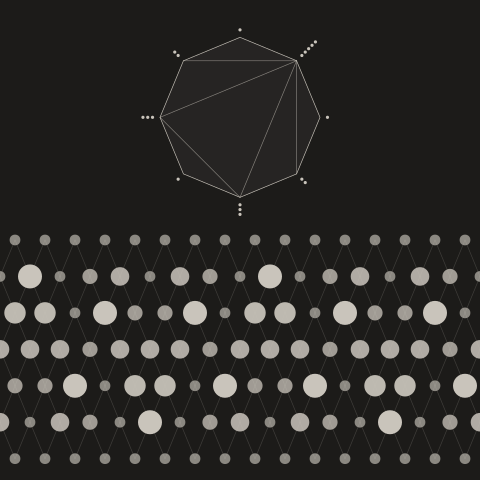
Rows of whole numbers held between two rows of 1s, every diamond of four obeying one rule. Each such frieze comes from a polygon cut into triangles, drawn above it.
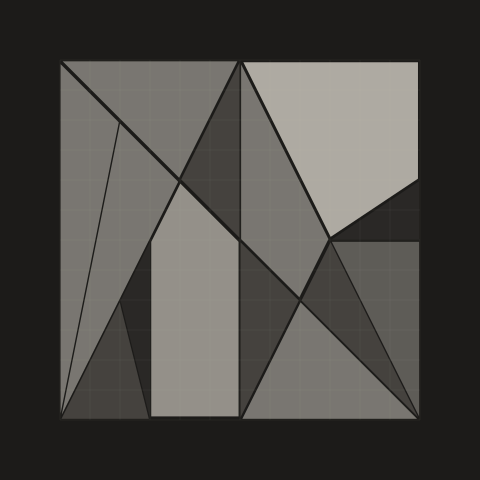
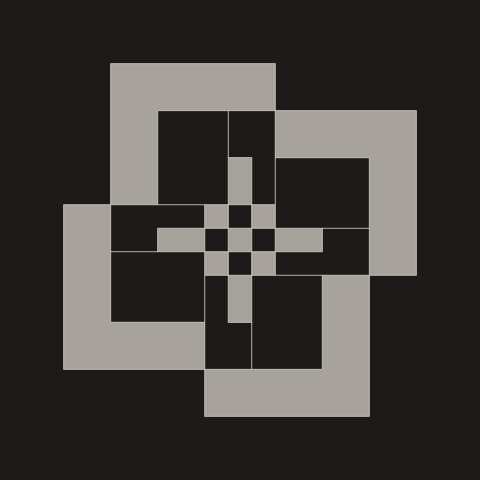
Archimedes' square of fourteen pieces, every corner on a 12 × 12 grid. In motion it comes apart, turns, and closes up again.
One right triangle, legs one and two, cut again and again into five smaller copies of itself. Its tiles end up pointing in infinitely many directions.
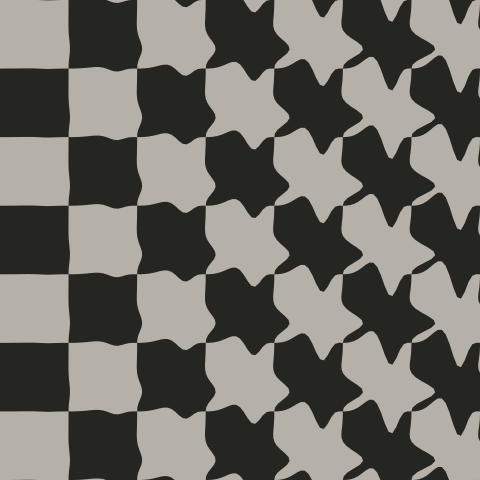
A plain grid of squares whose shared edges bend across the sheet until the tiles lock together like creatures. However far they bend, every tile still fits its neighbours exactly.
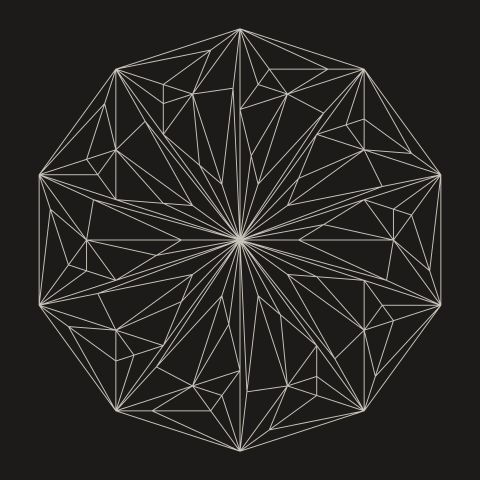
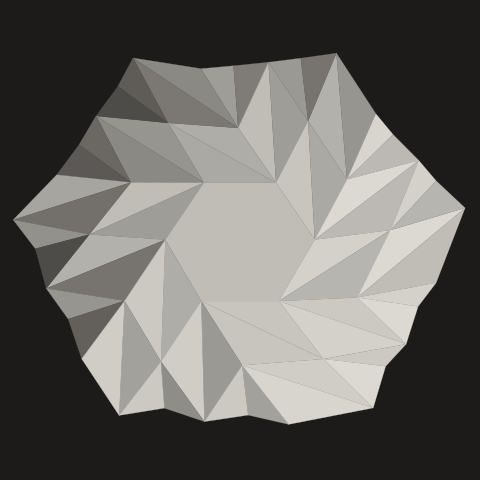
A polygon ringed with Yoshimura creases that folds from a flat sheet through a bowl to a flat stack the size of its centre, like a flower closing.
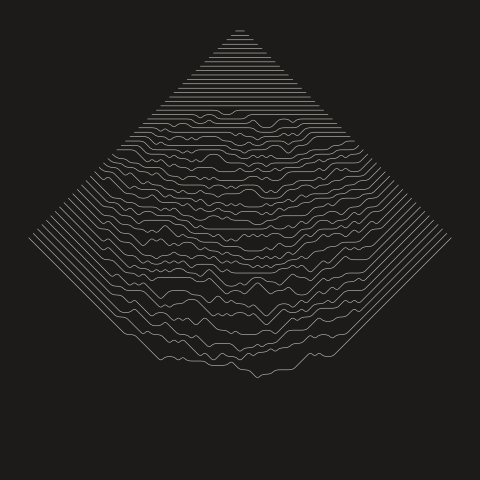
A diamond of squares covered by dominoes, chosen fairly from every way to do it, drawn as the paths hidden in it. Outside a circle everything freezes into straight lines; inside it the paths wander like ridges.
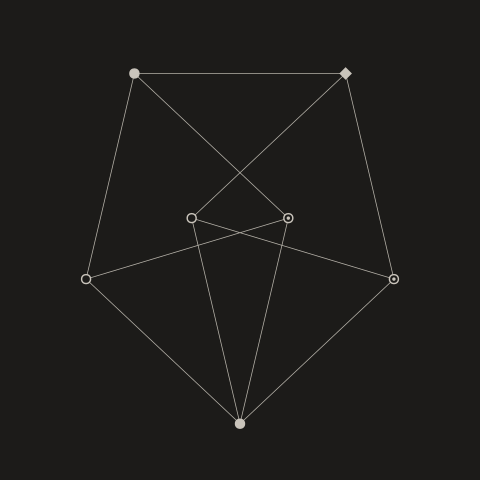
Seven points and eleven edges, every edge one unit long, that three colours cannot colour. So a plane coloured to keep points one apart different needs four colours at least; seven are enough.
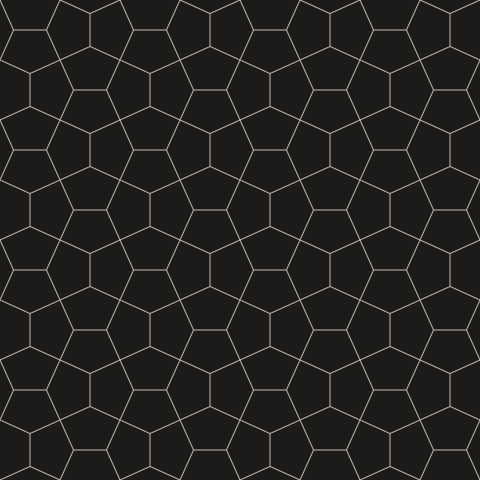
Pentagons laid like paving, four ways round, two by two into hexagons. Slide the bar and the whole floor shifts from squares through equal-sided pentagons and back.
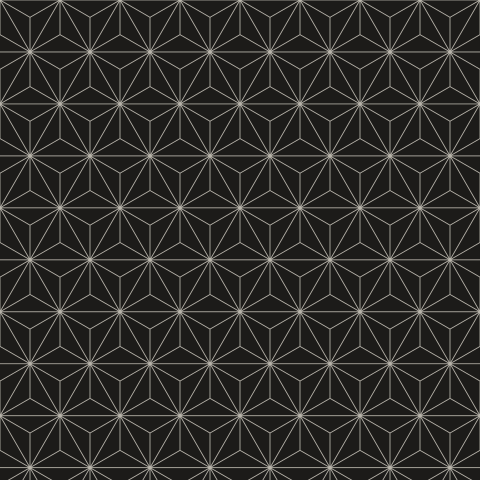
The Japanese hemp-leaf pattern: a grid of triangles with every centre joined to its corners. Drawn as wooden kumiko, it opens into pinwheels.
Walk one step, turn; two steps, turn; and so on up to n, then start again. Most walks come home, drawing knots and stars from one simple rule.
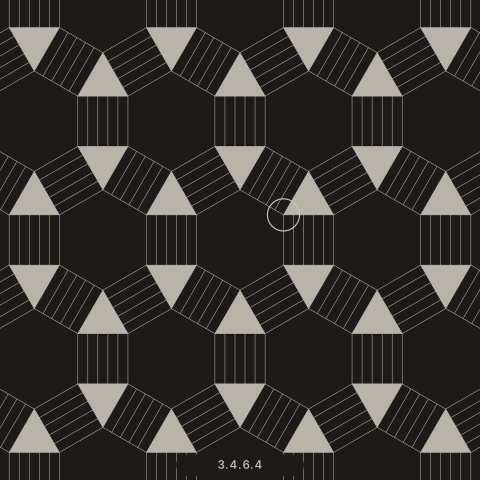
Only eleven ways exist to tile a floor with regular polygons so that every corner looks the same. Each is named by the shapes round a corner: 4.8.8 is a square and two octagons.
Cut a square into smaller squares. Let the sizes repeat and you have a patchwork quilt; make every one different and you have one of the hardest puzzles in geometry.
A times table where every answer is swapped for its remainder. Hatch each remainder at its own angle and the table weaves itself into a symmetric quilt.