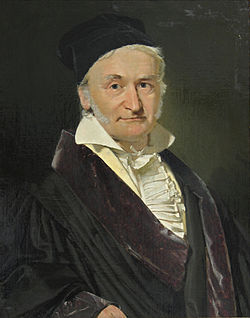
Carl Friedrich Gauss1777–1855
The modern approach to modular arithmetic, 1801
German mathematician, astronomer and physicist. His Disquisitiones Arithmeticae, 1801, set out the modern approach to number theory through modular arithmetic.
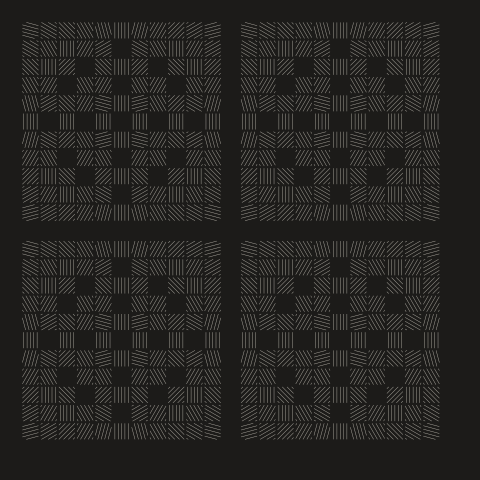
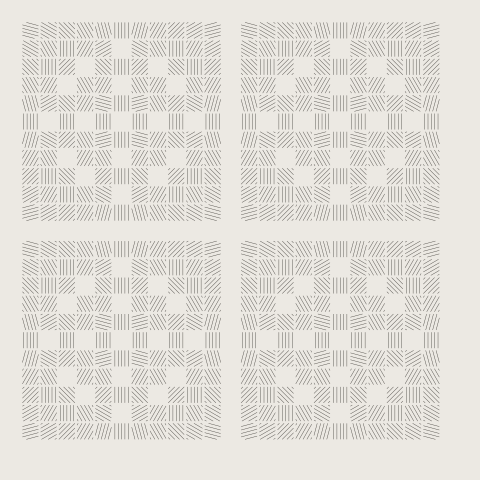
A times table where every answer is swapped for its remainder. Hatch each remainder at its own angle and the table weaves itself into a symmetric quilt.
Carl Friedrich Gauss, Disquisitiones Arithmeticae, 1801
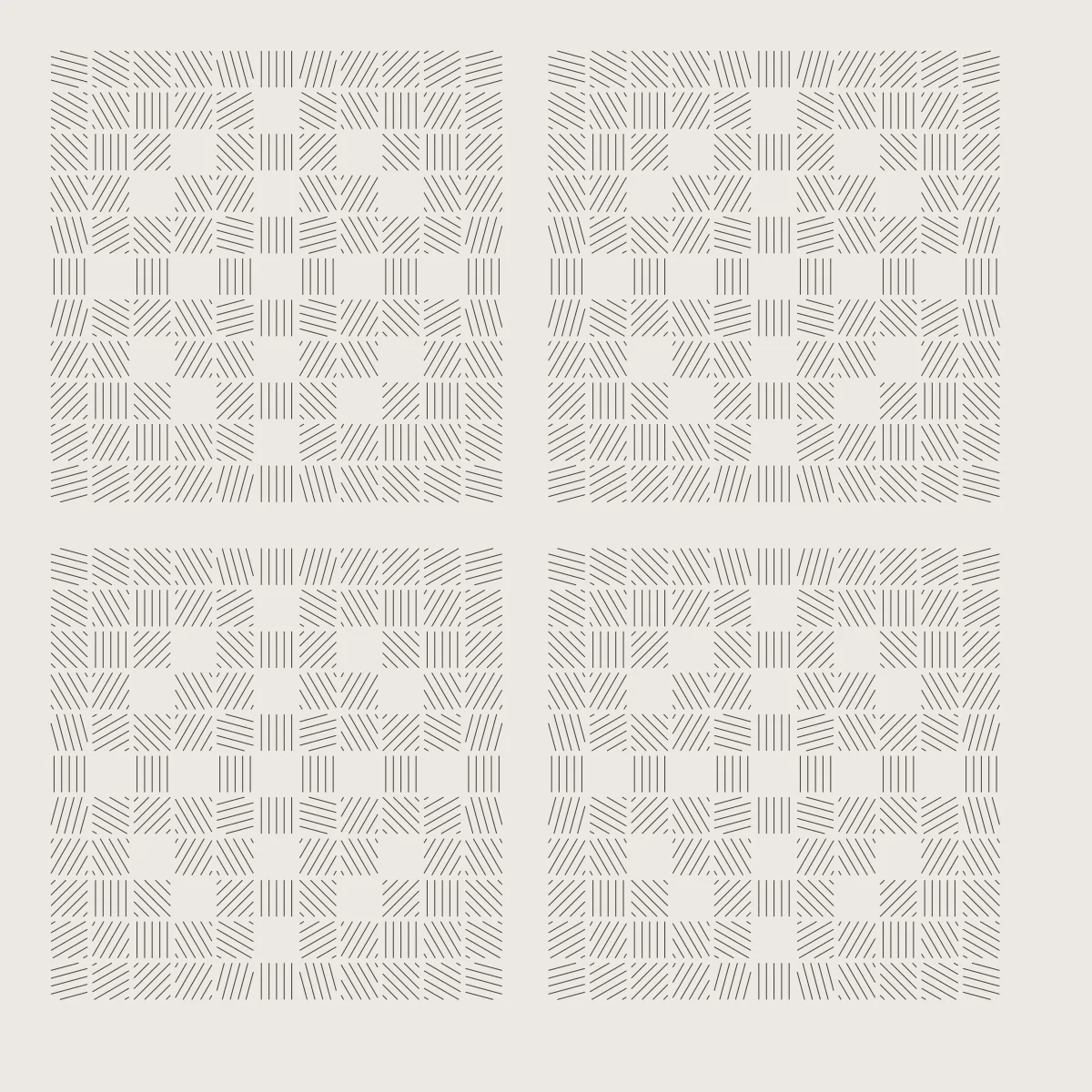
Write out a times table, then replace every answer with what is left over after dividing by some number m: with m = 6, row 2 reads 2, 4, 0, 2, 4, 0. That is arithmetic on a clock face, where counting past m brings you back to the start, and it is called modular arithmetic; the modern approach to it was set out by Carl Friedrich Gauss in his Disquisitiones Arithmeticae in 1801.
Turned into a picture, the table is full of structure. It is a mirror image across its diagonal, because 3 × 5 is 5 × 3. Rows and columns of zeros appear wherever the numbers multiply up to a multiple of m. And a row whose number shares a factor with m never reaches some remainders at all, which the Units highlight shows: it picks out the cells whose remainder shares no factor with m, the ones that can be undone by dividing.
Each remainder here is a mark a pen can draw: hatching turned by an angle that grows with the remainder, nested squares, or a dot of a size. Laid out in rings instead of rows, the same table becomes a rose window. Adding instead of multiplying gives stripes; powers break the symmetry and show which numbers cycle quickly.
In motion the divisor steps up and back down, holding on each value long enough to see the weave change.
Behind the mathematics
The modern approach to modular arithmetic, 1801
German mathematician, astronomer and physicist. His Disquisitiones Arithmeticae, 1801, set out the modern approach to number theory through modular arithmetic.