
Henry Fox Talbot1800–1877
Saw a grating reimage itself, 1836
English inventor of the calotype who patented the ruled screen that lets a printing press render continuous tone as varying dot area.
Light passing through a row of slits rebuilds the row further on, and in between splits into finer and finer copies of it. Followed downstream, the field weaves a fractal lace.
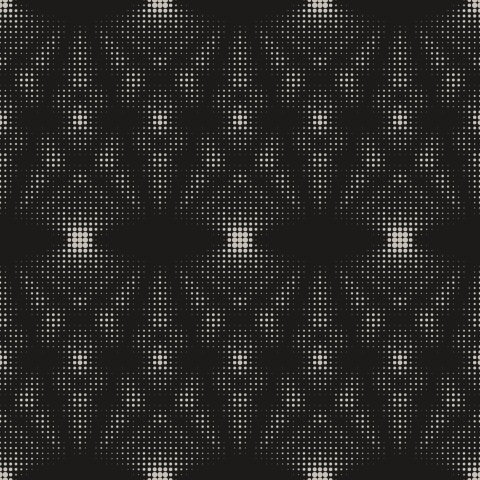
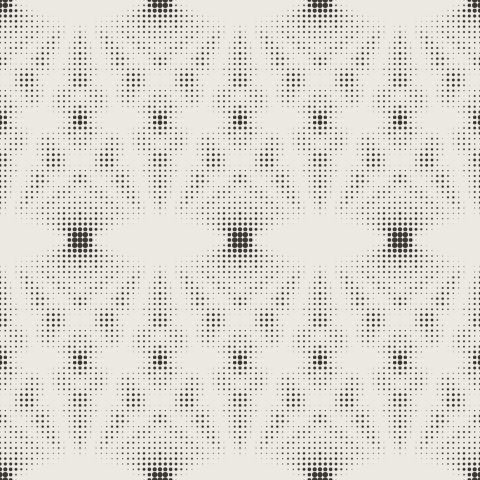
Henry Fox Talbot, 1836 · Lord Rayleigh, 1881
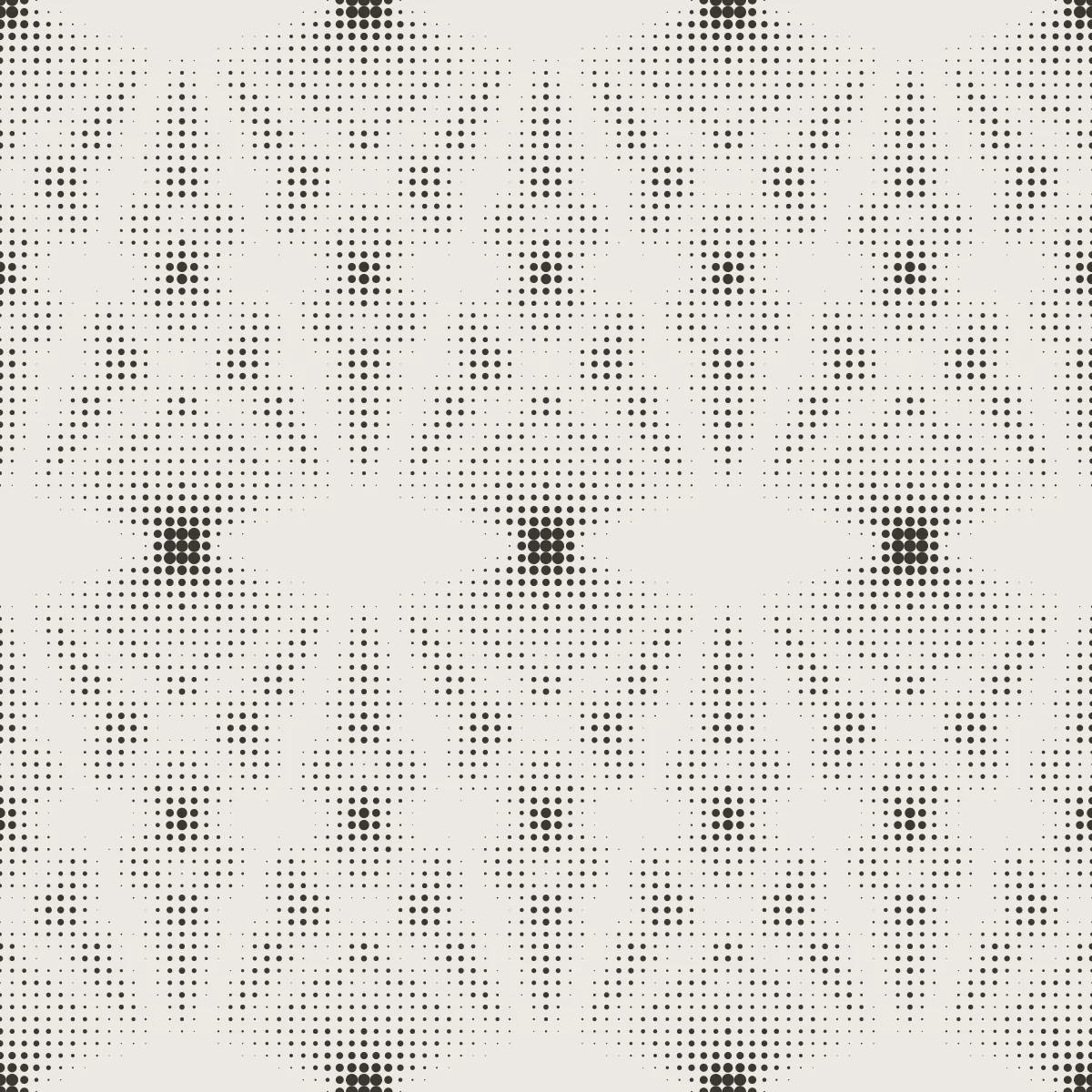
In 1836 Henry Fox Talbot looked at a diffraction grating through a magnifier and found that, at certain distances behind it, a sharp image of the grating reappeared, with no lens to form it. Lord Rayleigh explained why in 1881. Each beam leaving the grating, its diffraction order, falls behind the straight-through beam by an amount that grows with the square of its number, so every order comes back into step at the same distance, now called the Talbot length, and the grating is reimaged.
At simple fractions of that distance they come into step in smaller groups, making two, three or more copies of each slit, and the whole field between becomes a lace of nested arches. The carpet here is that field computed directly, a sum of the grating's orders, printed as a halftone: across is position along the grating, down is distance from it, and each dot is as large as the light is bright. It repeats in both directions, so in motion it flows downstream without end.
Behind the mathematics
Saw a grating reimage itself, 1836
English inventor of the calotype who patented the ruled screen that lets a printing press render continuous tone as varying dot area.
Explained it and found the Talbot length, 1881
English physicist who in 1881 explained Talbot’s self-imaging gratings, predicting the distance at which the pattern repeats.
