David Smith
Discovery
British shape enthusiast who discovered the hat, the first known single tile that forces an aperiodic covering of the plane.
A single tile that covers the plane without ever repeating, using copies that are only turned, never flipped. Bend its edges and it cannot be flipped at all.
Smith, Myers, Kaplan & Goodman-Strauss, 2023
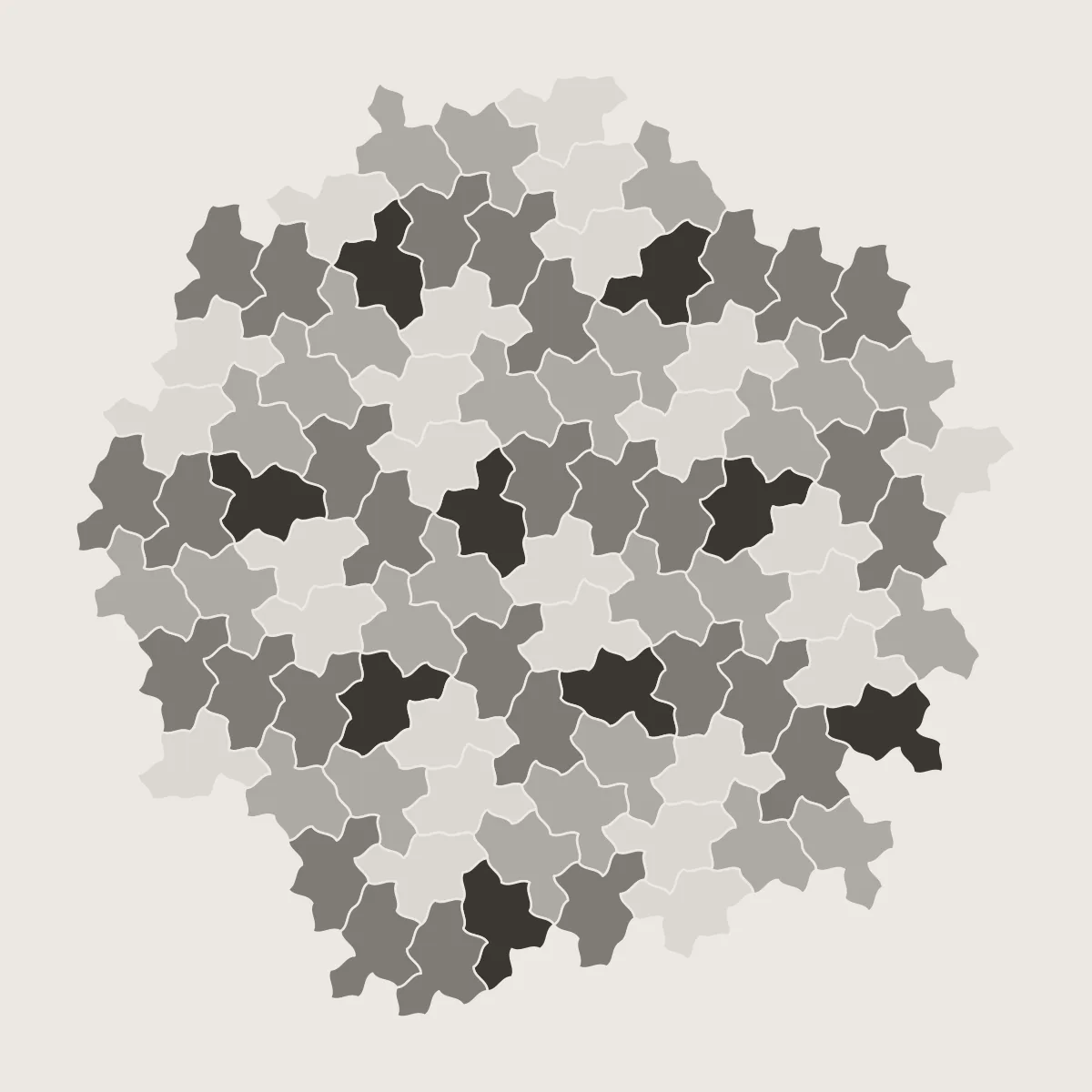
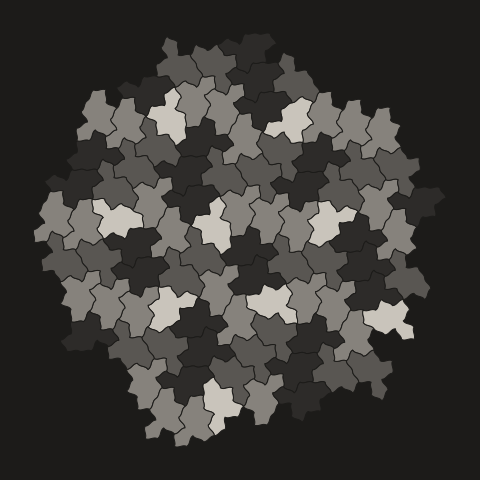
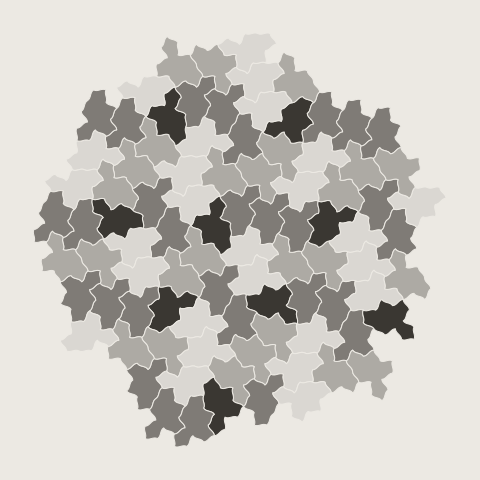
Months after the hat, its discoverers found that one member of its family, the shape with all fourteen edges the same length, tiles the plane aperiodically on its own terms: every copy is turned, none mirrored. It is called the Spectre. Straight-edged, it could still be fitted together with mirror images into periodic tilings, but bend every edge into the same S-curve, symmetric about its midpoint, and only turned copies will meet, so the curved Spectre is a true chiral aperiodic monotile.
The patches here were grown by a search that adds one Spectre at a time to the tightest gap left and backs out whenever no copy will fit, so no flipped copy, overlap or hole is ever used. The tiles in full ink are the rare ones, about one in eight, turned an odd number of 30° steps from the rest. In motion the patch is laid down in the order it was found.
Behind the mathematics
Discovery
British shape enthusiast who discovered the hat, the first known single tile that forces an aperiodic covering of the plane.
Proof and construction
Mathematician and tiling researcher who helped prove that the hat monotile admits tilings but can never tile periodically.
Proof and visualisation
Canadian computer scientist whose research joins geometry, computation and ornamental design, including the proof and visualisation of the hat monotile.
Proof of aperiodicity
American mathematician and geometer whose work on substitution tilings helped establish the hat’s forced aperiodicity.

