James Terrell
The invisibility of the Lorentz contraction, 1959
Physicist who independently explained why a rapidly moving object appears rotated rather than simply contracted in a photograph.
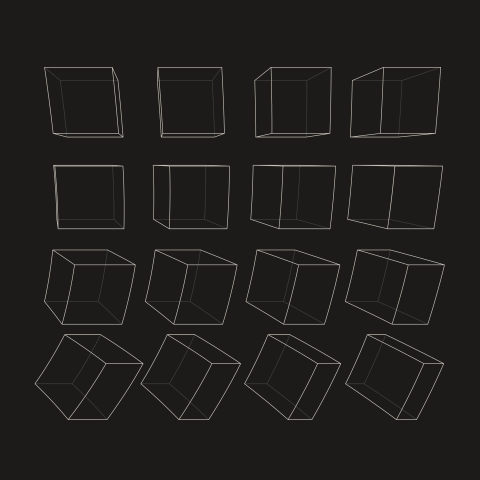
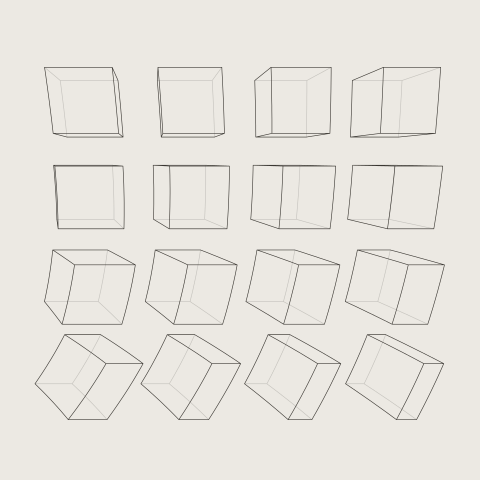
Cubes photographed as they rush past at near light speed. They are shorter in motion, yet the camera shows them turned, not squashed: the Terrell–Penrose effect, computed exactly.
James Terrell & Roger Penrose, 1959
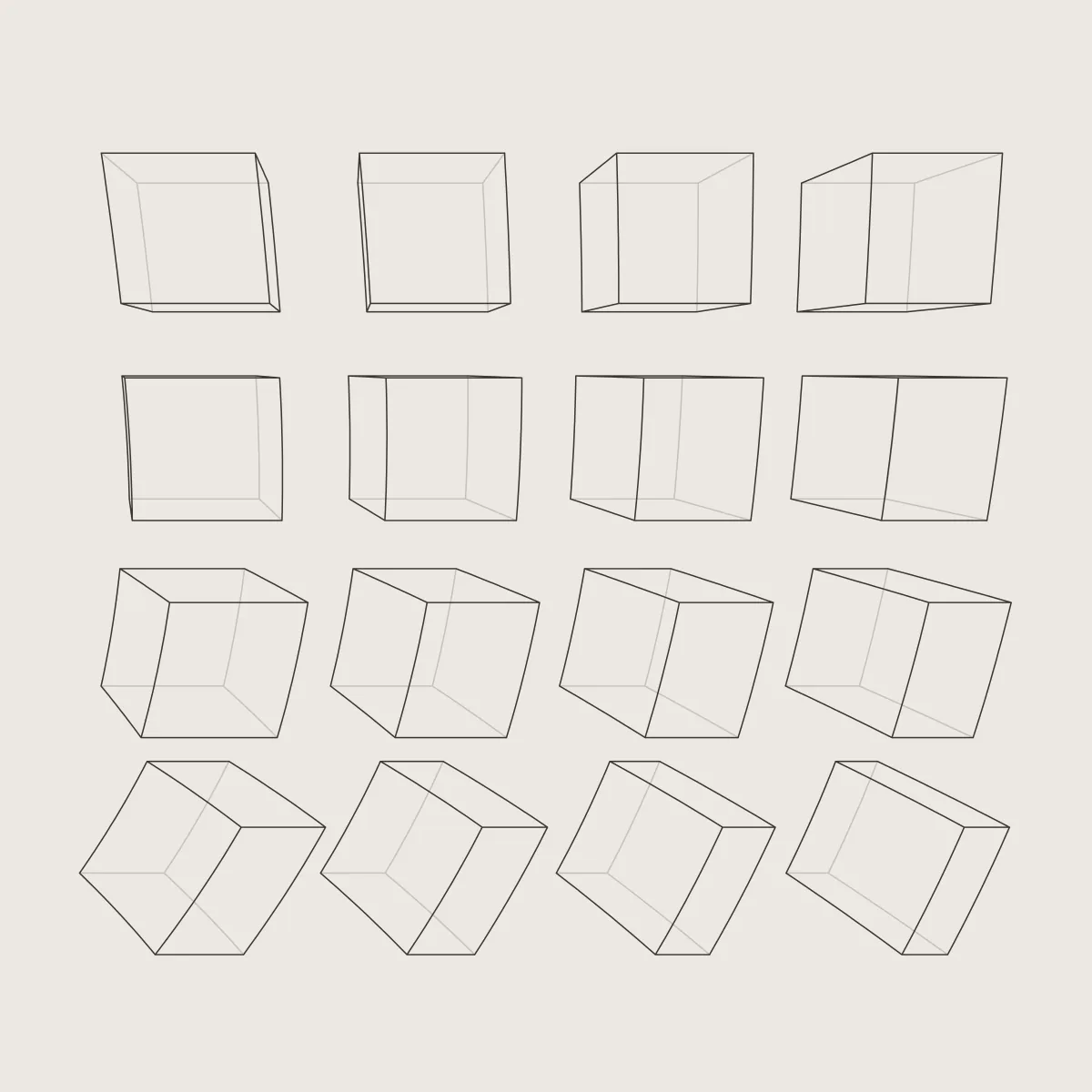
Terrell and Penrose showed independently in 1959 that the Lorentz contraction can never be seen. Every point here is drawn where it was when its light set out to reach the camera at one instant, and the faces that show are chosen by the light's direction in the cube's own frame, so the cubes are exactly what a camera would record.
Rows move faster down the page; each loop moves every row on by whole cube spacings, so the cycle closes on itself.
Behind the mathematics
The invisibility of the Lorentz contraction, 1959
Physicist who independently explained why a rapidly moving object appears rotated rather than simply contracted in a photograph.
Independent derivation, 1959
British mathematical physicist whose non-periodic tilings and work on impossible geometry reshaped how repetition and symmetry are understood.
