
Nicolaas Govert de Bruijn1918–2012
Pentagrid construction
Dutch mathematician who showed that Penrose's aperiodic tilings fall out of five crossing families of parallel lines, turning an intricate construction into arithmetic.
Ten-fold star patterns on a tiling that never repeats. Two rhombus shapes carry the same strapwork rule as the periodic panels, but nothing about the arrangement comes back around.
N. G. de Bruijn, 1981 · pentagrid and strapwork
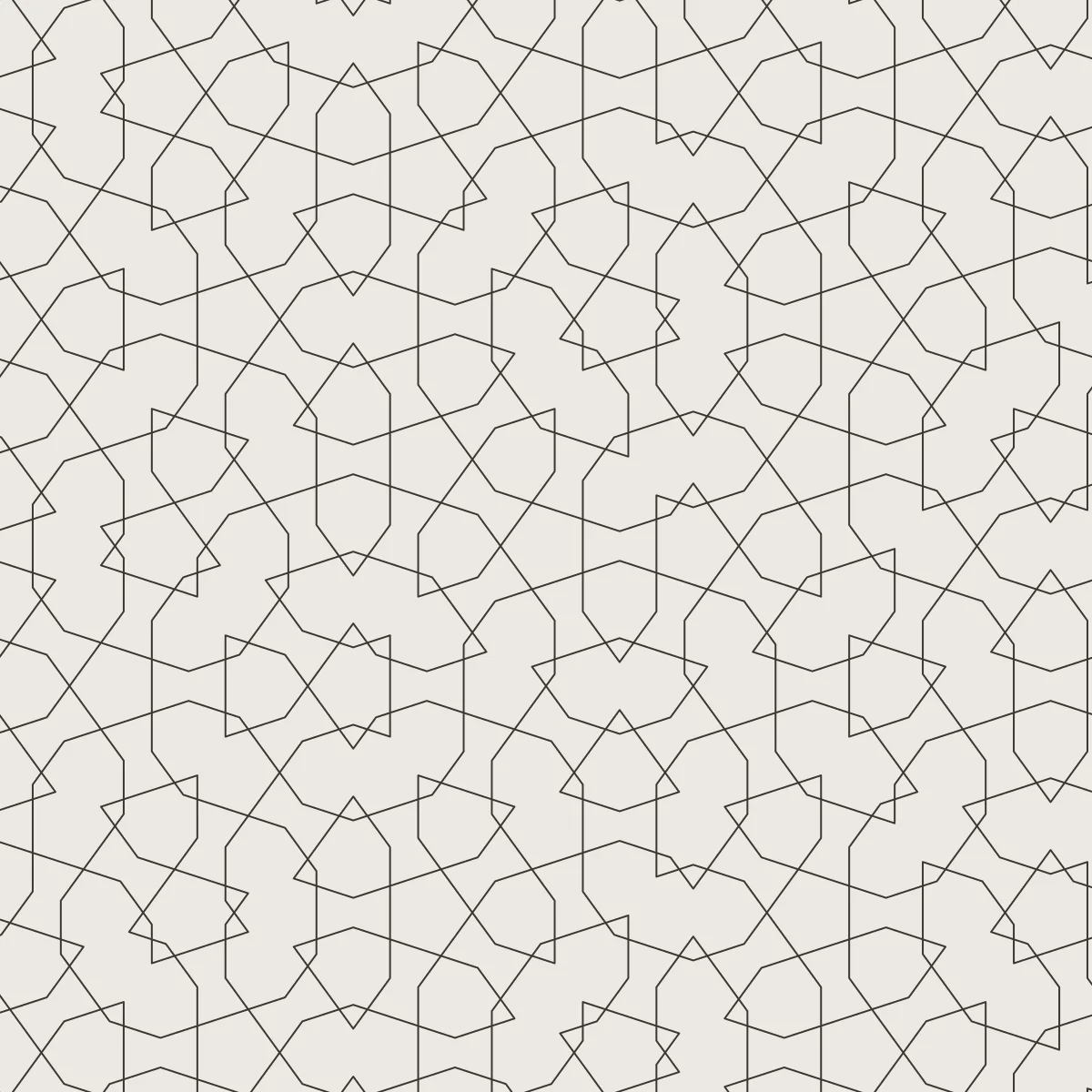
Five families of parallel lines cross at generic offsets; de Bruijn showed that every crossing names one rhombus of a Penrose tiling, and that reading them off in order fills the plane with just two tile shapes and no period. Strapwork is then laid on by Hankin's rule: two lines leave each edge midpoint at the same contact angle and run until they meet.
At 54° this is exactly the angle the girih craftsmen used, and it is the coincidence Lu and Steinhardt pointed to in 2007 when they argued that the decagonal panels at Darb-i Imam are built on quasi-periodic geometry. The five girih tiles themselves are a different tile set from these rhombi; what they share is the strapwork rule and the tenfold order it produces.
Behind the mathematics
Pentagrid construction
Dutch mathematician who showed that Penrose's aperiodic tilings fall out of five crossing families of parallel lines, turning an intricate construction into arithmetic.
Aperiodic rhombus tiling
British mathematical physicist whose non-periodic tilings and work on impossible geometry reshaped how repetition and symmetry are understood.
Strapwork construction
British bacteriologist in India who reverse-engineered the hidden polygonal scaffolding behind Islamic star patterns and published the polygons-in-contact method.

