
Dan Shechtmanborn 1941
Discovered quasicrystals, 1982
Israeli materials scientist who in 1982 saw five-fold symmetry in a metal alloy, discovering quasicrystals and winning the 2011 Nobel Prize in Chemistry.
Five or seven flat waves laid over one another at equal angles. Order everywhere, and the same patch never twice.
Dan Shechtman, 1982 · Penrose and de Bruijn's five-fold symmetry
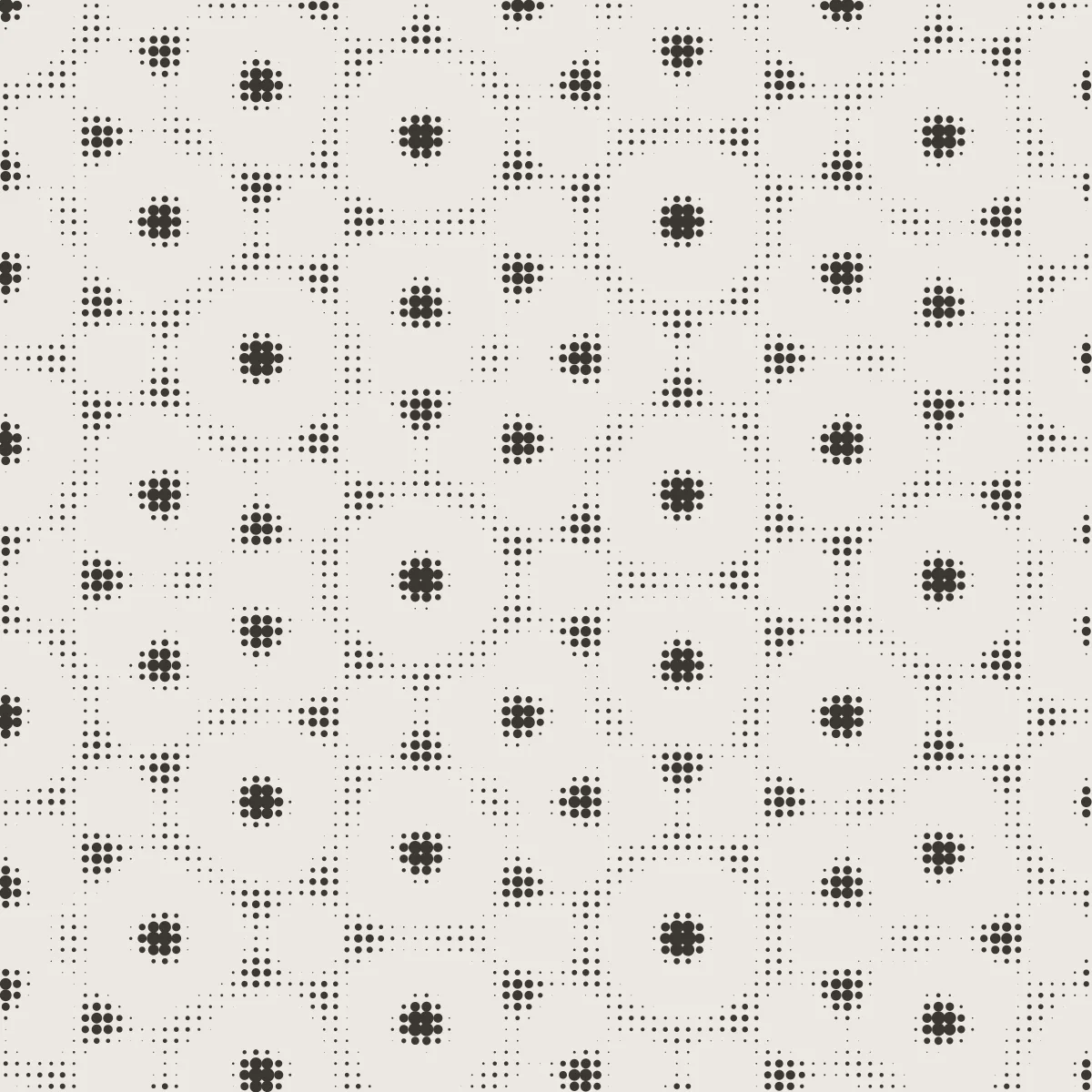
Add plane waves at equally spaced angles and the sum has the symmetry of that number of directions. With four or six it settles into an ordinary repeating lattice, because those angles are commensurate. With five, seven or eleven no repeat is possible, and the field fills with rosettes that look placed by hand and are entirely determined, with the same order Penrose found in his tiles and Shechtman later found in metal.
Behind the mathematics
Discovered quasicrystals, 1982
Israeli materials scientist who in 1982 saw five-fold symmetry in a metal alloy, discovering quasicrystals and winning the 2011 Nobel Prize in Chemistry.
Five-fold grids
Dutch mathematician who showed that Penrose's aperiodic tilings fall out of five crossing families of parallel lines, turning an intricate construction into arithmetic.
Five-fold tiling
British mathematical physicist whose non-periodic tilings and work on impossible geometry reshaped how repetition and symmetry are understood.

