
Oscar Reutersvärd1915–2002
The first impossible triangle, 1934
Swedish artist who drew the first impossible triangle, made of cubes, in 1934 and hundreds of impossible figures after it.
Three arms of cubes, each turning a square corner on the last, arriving back where they began. Follow any arm and it is ordinary.
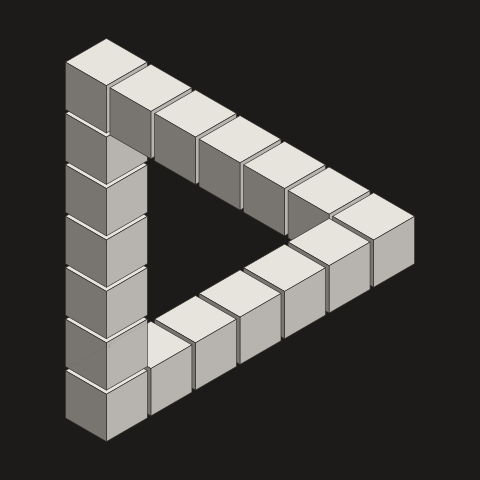
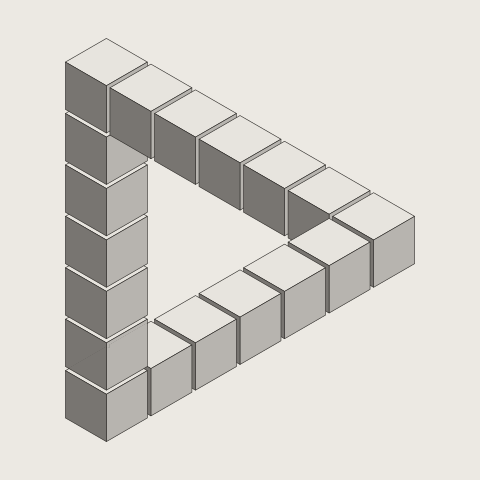
Oscar Reutersvärd, 1934 · Lionel and Roger Penrose, 1958
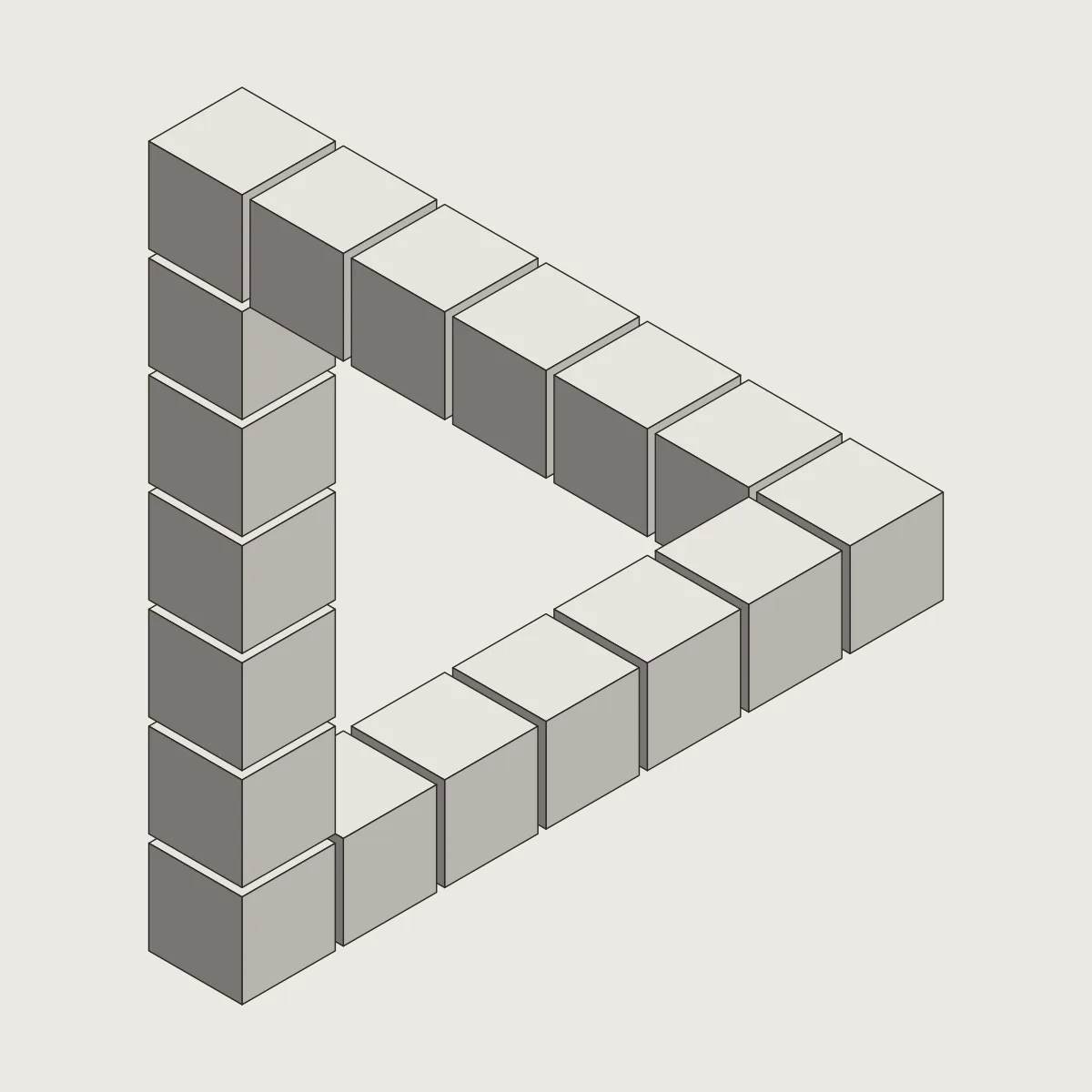
Reutersvärd drew the first one as a schoolboy in 1934, a ring of cubes; the Penroses published it as three solid beams in 1958 as an impossibility in its purest form, and Escher built Waterfall on it. The trick is in the projection rather than the drawing: these three axes sum to zero on the page, so travelling the same distance along each of them returns the pen to its starting point while the object has climbed a whole arm away from itself.
Then comes the overlap. Every cube hides part of the next one round the ring, as a nearer cube does, and that is the part no solid can do: going all the way round, each cube is in front of the one after it, so the last is in front of the first. Locally every corner is honest; only the circuit is a lie.
Behind the mathematics
The first impossible triangle, 1934
Swedish artist who drew the first impossible triangle, made of cubes, in 1934 and hundreds of impossible figures after it.
Impossible-figure geometry
British mathematical physicist whose non-periodic tilings and work on impossible geometry reshaped how repetition and symmetry are understood.
