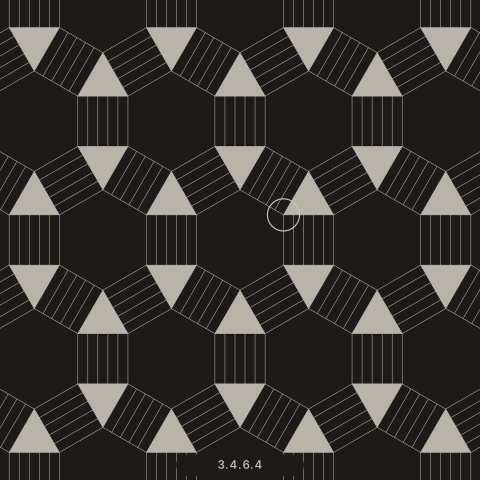
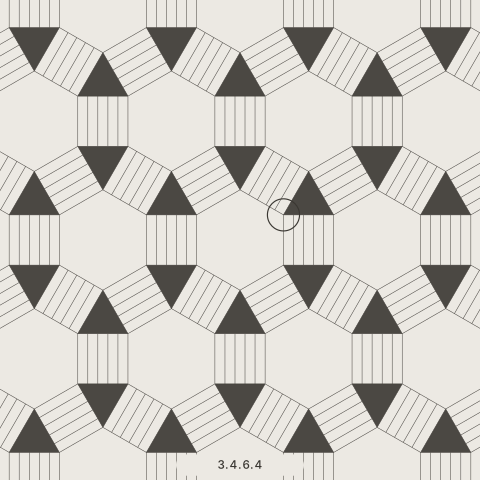
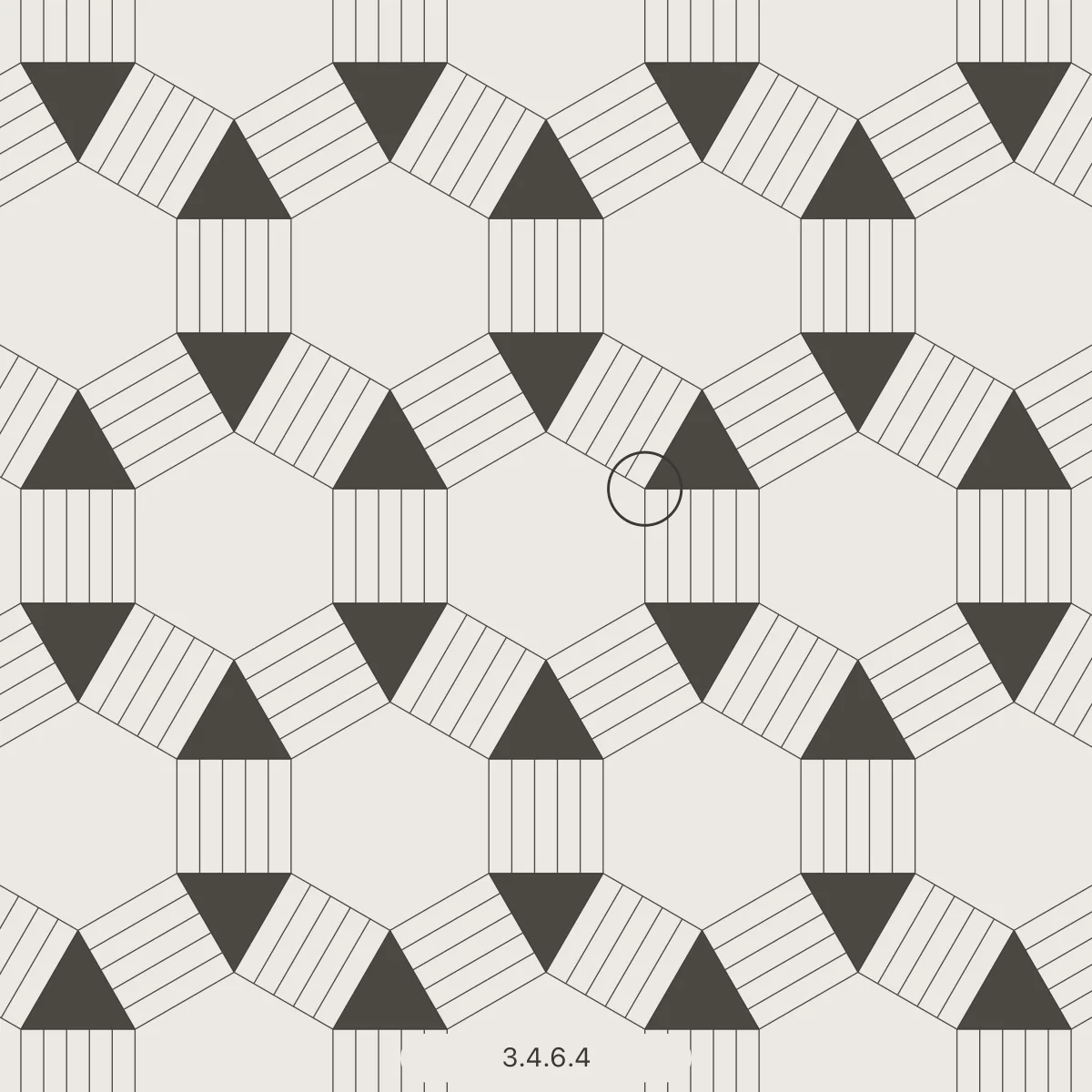
Only eleven ways exist to tile a floor with regular polygons so that every corner looks the same. Each is named by the shapes round a corner: 4.8.8 is a square and two octagons.
Floors and walls have been tiled with triangles, squares and hexagons since antiquity, and octagons mixed with small squares are still a common pattern for floor tiles. Suppose the tiles must be regular polygons, meeting edge to edge, and every corner of the tiling must look exactly like every other.
The angles at each corner have to add up to a full turn, 360 degrees, and that leaves very few possibilities: there are exactly eleven. Three use a single shape, the triangles, squares and hexagons. The other eight mix shapes, and each is named by listing the polygons round a corner, so 3.4.6.4 means a triangle, a square, a hexagon and another square, and 4.8.8 is a square between two octagons.
Johannes Kepler gave the first systematic account of them in Harmonices Mundi, The Harmony of the World, in 1619. One of them, 3.3.3.3.6, the snub hexagonal tiling, comes in two mirror forms, one turning left and one right. Every tiling has a dual: put a point in the middle of each tile and join the points of tiles that share an edge.
The dual of the snub square tiling, 3.3.4.3.4, is the Cairo pentagonal tiling. Triangles are drawn solid and squares hatched, so the tone comes from line work and a pen plotter keeps it; with a gap between the tiles the floor becomes a mosaic. Scattered gives every tile its own fill, solid, hatched, ringed or open, chosen by the seed, the way a tiler mixes glazes on a real floor; each seed lays a different floor. In motion the floor slides by one step of its repeat, so the loop has no seam.
The first systematic account of these tilings, Harmonices Mundi, 1619
German astronomer and mathematician, best known for his laws of planetary motion. His first book, Mysterium Cosmographicum (1596), fitted the five Platonic solids between the spheres of the six known planets.