
Jean Baptiste Meusnier1754–1793
Showed the helicoid is a minimal surface, 1776
French mathematician and engineer who showed in 1776 that the helicoid and the catenoid are minimal surfaces, the shapes a soap film settles into.
A spiral staircase of straight lines, the shape a soap film takes on a twisted wire. Bend it and it rolls up into a catenoid without stretching a single line.
Meusnier, 1776 · Catalan, 1842 · Bonnet's associate family
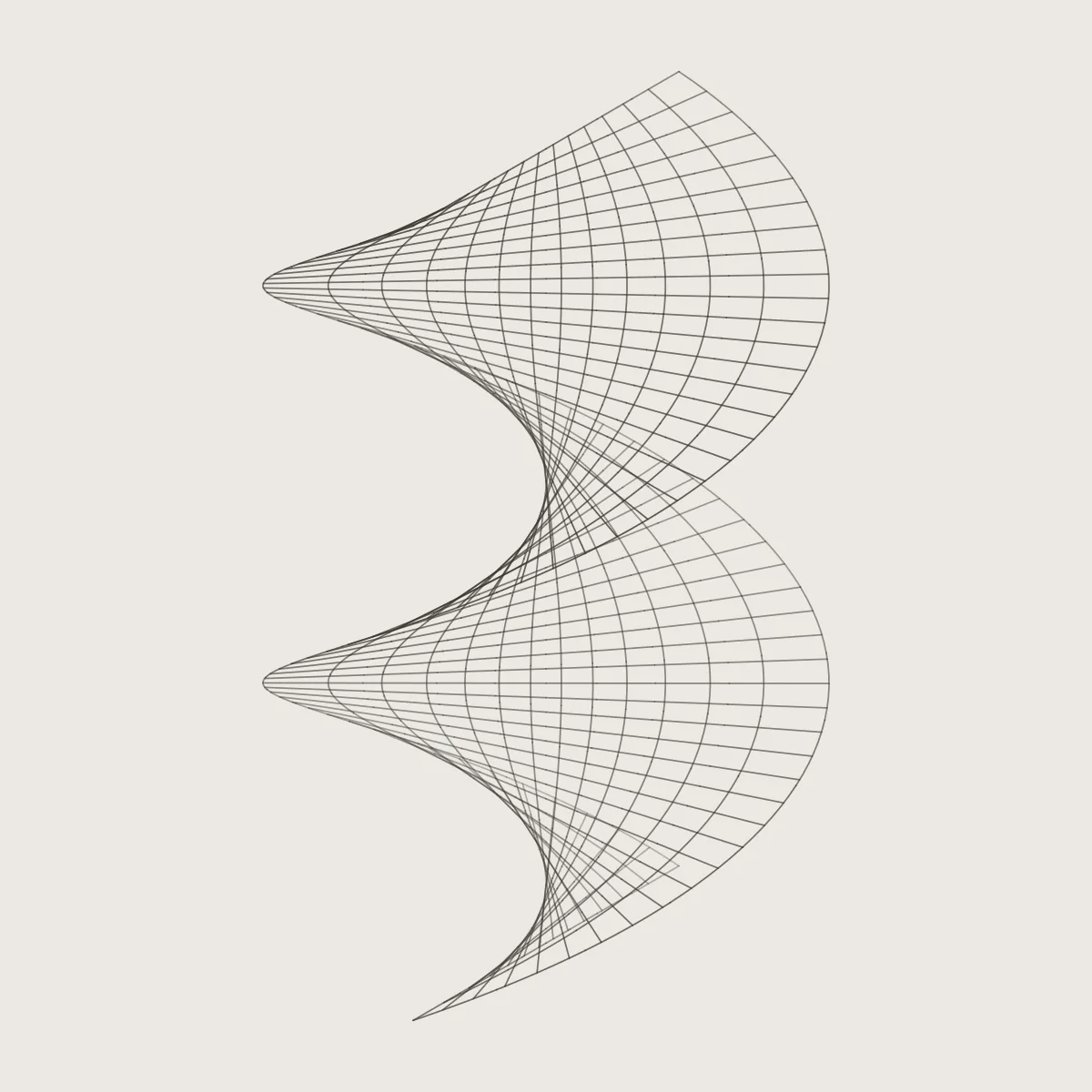
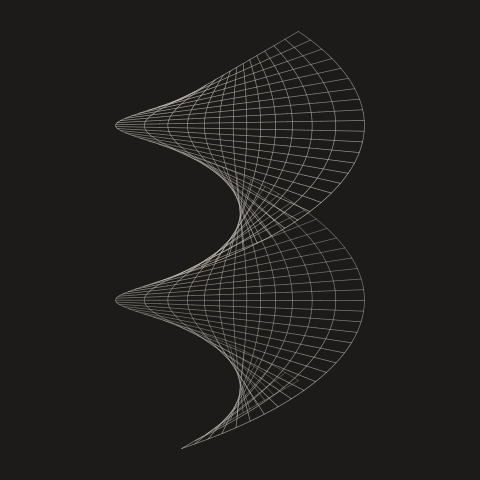
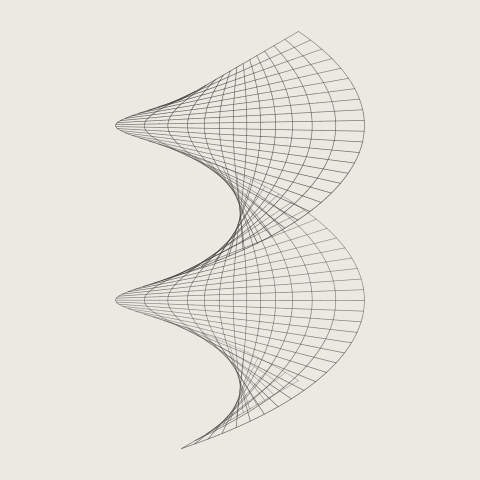
Every line here is drawn on one minimal surface. At Bend 0 it is the helicoid: straight rulings climbing a screw, which Catalan proved is the only way to rule a minimal surface other than a flat plane. At Bend 90 it is Euler's catenoid. Between them lies Bonnet's associate family, where each sheet has the same lengths and angles as the last, so the rulings curl into meridians and the helices close into rings without any stretching. Motion swings through the whole family and back.
Behind the mathematics
Showed the helicoid is a minimal surface, 1776
French mathematician and engineer who showed in 1776 that the helicoid and the catenoid are minimal surfaces, the shapes a soap film settles into.
Proved it the only ruled minimal surface besides the plane, 1842
Belgian mathematician who proved in 1842 that the helicoid is the only minimal surface, apart from the plane, that can be swept out by a moving straight line.
The associate family that bends it into a catenoid
French mathematician whose work on surfaces includes the associate family, which bends a minimal surface through a continuum of others without stretching it.
Found the catenoid, 1744
Swiss mathematician who in 1744 found the catenoid, the surface made by spinning a hanging chain, and showed it encloses the least area between two rings.


