
Leonhard Euler1707–1783
Studied the curve, 1744
Swiss mathematician who in 1744 found the catenoid, the surface made by spinning a hanging chain, and showed it encloses the least area between two rings.
A curve that bends a little more with every step, winding from a straight middle into two tightening eyes. The same curve eases trains and roads into their bends.
Leonhard Euler, 1744 · Marie Alfred Cornu, 1874
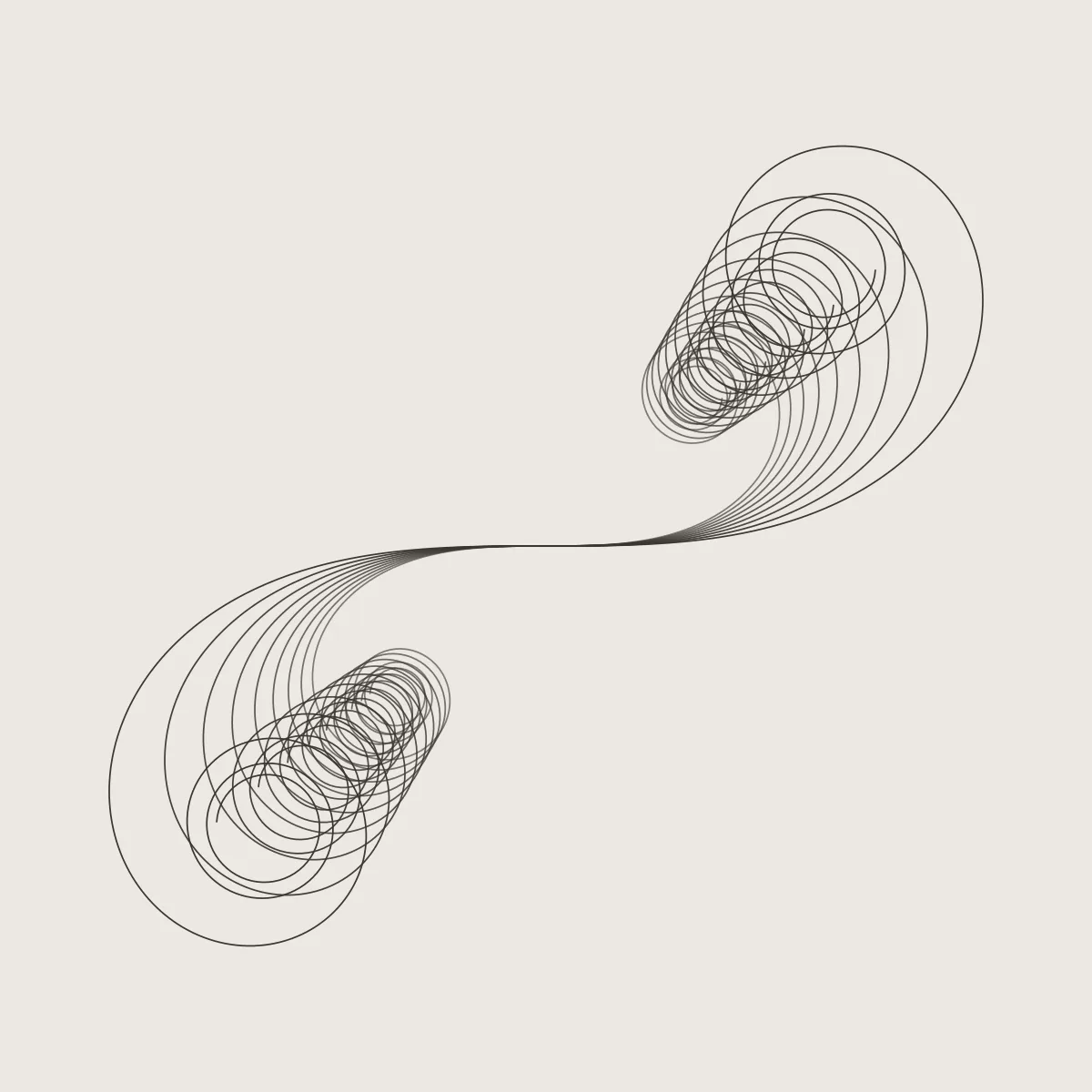
Along an Euler spiral the curvature grows in proportion to the distance travelled: straight at the middle, then bending harder and harder until it coils into a point. Jacob Bernoulli raised the problem of an elastic strip that it answers, Leonhard Euler worked out its form in 1744, and Marie Alfred Cornu drew it in 1874 to compute how light spreads past an edge, so it is also called the Cornu spiral, or clothoid.
Engineers lay it between a straight track and a curve so that a train turns in gradually instead of with a jolt. Here it is drawn by adding up the heading step by step: one double spiral, a fan of spirals leaving the same point at different rates, or a grid of small ones. In motion the curves grow longer and wind tighter.
Behind the mathematics
Studied the curve, 1744
Swiss mathematician who in 1744 found the catenoid, the surface made by spinning a hanging chain, and showed it encloses the least area between two rings.
Drew it for diffraction, 1874
French physicist who drew the Euler spiral to compute diffraction at an edge, giving it the name Cornu spiral.
Posed the elastic problem behind it
Swiss mathematician so taken with the logarithmic spiral, which keeps its shape as it grows, that he called it spira mirabilis and asked for it on his tombstone.

