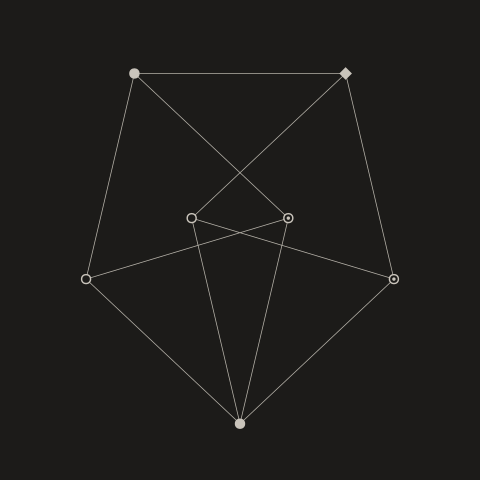
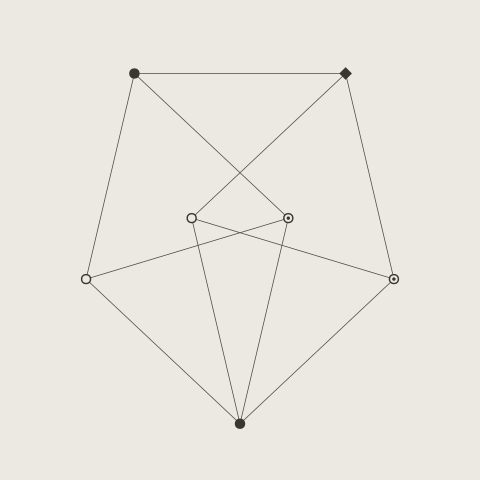
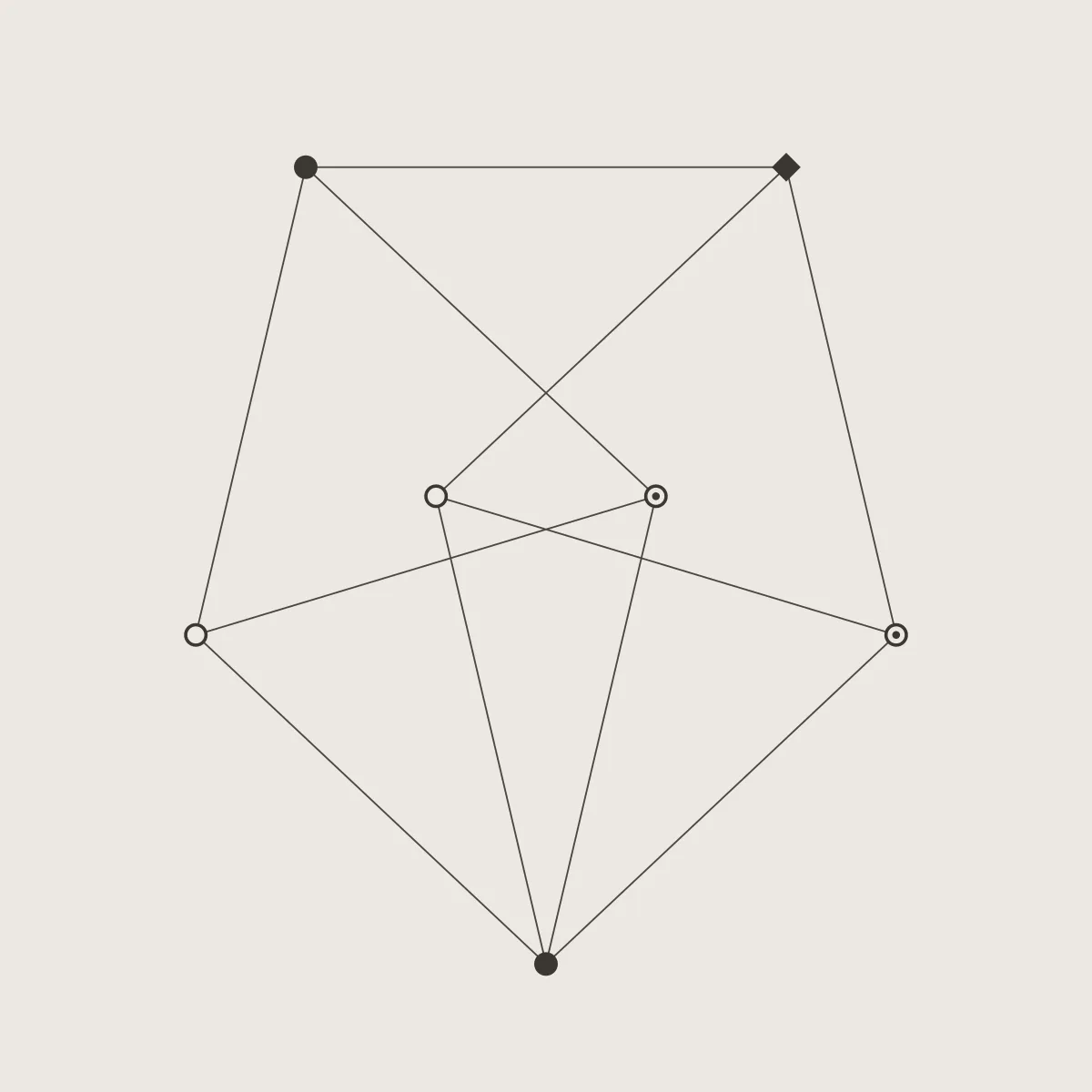
Colour every point of the plane so that no two points exactly one unit apart share a colour. How few colours will do? This is the Hadwiger–Nelson problem, and the Moser spindle, found by the brothers Leo and William Moser in 1961, shows that three are not enough. Take two diamonds, each made of two equilateral triangles with sides of one unit, and join them at a blunt corner.
Turn one until its far tip is exactly one unit from the other's. With three colours, each diamond forces its tip to match the shared corner, so the two tips would match, yet they are one unit apart. A fourth colour is needed. John Isbell had already shown that seven are enough, with a tiling of hexagons slightly under a unit across, coloured so that hexagons of one colour sit more than a unit apart.
For decades the answer lay somewhere from four to seven, until in 2018 Aubrey de Grey built a graph of 1,581 points that needs five, partly from copies of the spindle.
Choose Lace for every point reached by unit steps in the spindle's directions, joined wherever two are one unit apart, the kind of crowded graph de Grey searched.
Choose Seven colours for Isbell's hexagons. In ink the seven colours become seven sizes of dot, seven greys, or counts of one to seven pips, and around every hexagon the six neighbours are all different.
Drawn as pips, the flowers of seven that hold one of every colour are outlined; they tile the plane. Spindles laid over the field are drawn as lines that can ring the hexagons their points land in, or as silhouettes inside which the field turns over, ink for paper. Not one edge ever joins two hexagons of the same colour, however they turn.
In motion the second diamond of the spindle swings, and the tips are joined only where they are one unit apart; the lace turns, and spindles on the seven colours turn on the spot.