Jeff Jones
The agent model of Physarum transport networks, 2010
Researcher at the University of the West of England whose 2010 paper in Artificial Life modelled the slime mould Physarum as many simple agents following and laying trails.
A slime mould has no brain, yet it builds efficient networks. Thousands of tiny agents follow each other's trails, and veins grow on their own.
Jeff Jones, 2010 · popularised by Sage Jenson
Physarum polycephalum is a slime mould, a single enormous cell that creeps across the forest floor looking for food. It has no brain and no nerves, and yet when it finds several meals it links them with a network of tubes that is remarkably efficient. In a 2010 experiment, oat flakes were laid out in the pattern of Tokyo and the towns around it, and the slime mould grew a network much like the region's railways.
In 2010 Jeff Jones also published a simple computer model of how it might do it. Thousands of tiny agents each sniff the trail at three points just ahead of them, straight on and a little to either side, turn towards the strongest smell, take a step and leave a little more trail behind. The trail spreads out and slowly fades.
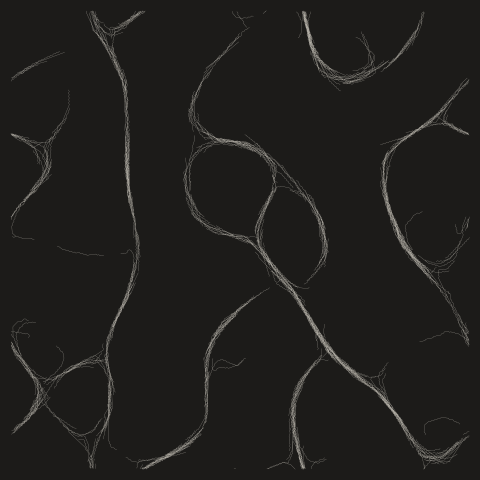
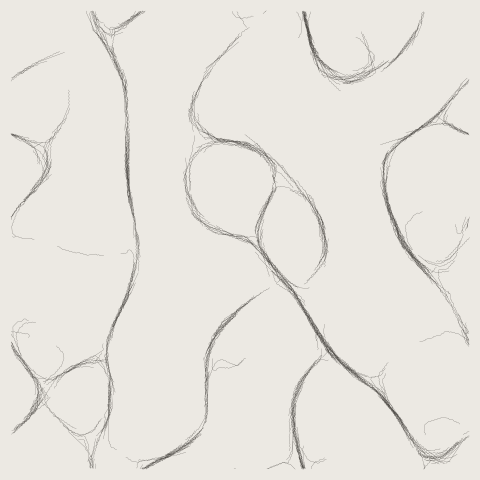
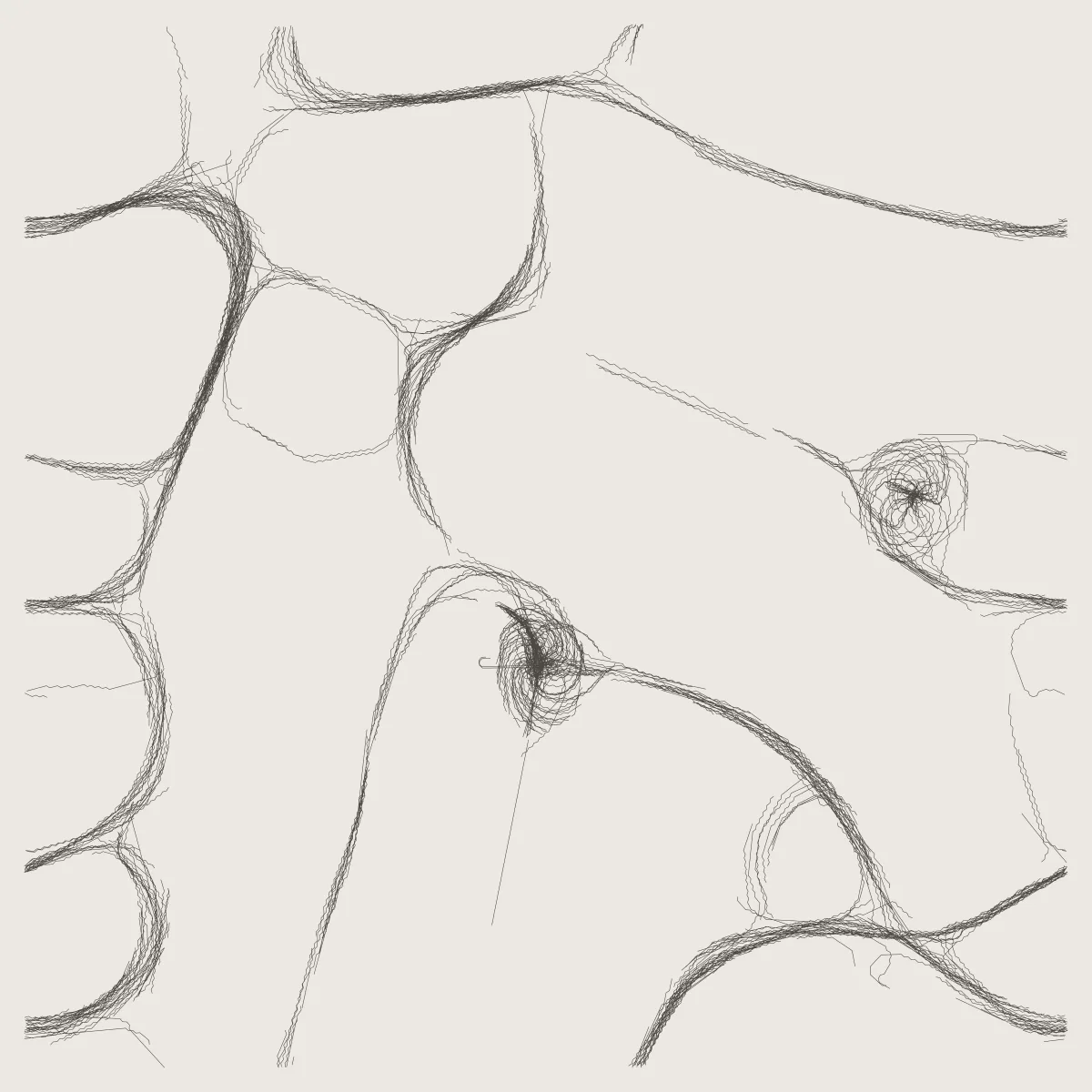
Nothing tells the agents to build veins, but they follow each other into them, and the veins thicken, branch and join. The artist Sage Jenson's write-up of the model brought it to a great many generative artists. Here the last few dozen steps of six hundred agents are drawn as paths, strands that bundle into veins and swirl at the junctions, or the trail itself is drawn as contour lines, like a map of where the agents crowd.
Add food and the spots keep topping up the trail, so the veins reach out and link them. Narrow sensors and small turns give fine lace; wide sensors and sharp turns give big round cells. The network is grown once for each set of dials, so it is drawn still.
Behind the mathematics
The agent model of Physarum transport networks, 2010
Researcher at the University of the West of England whose 2010 paper in Artificial Life modelled the slime mould Physarum as many simple agents following and laying trails.
Brought the model to generative artists
Artist whose write-up and images of the Physarum transport model brought it to a great many generative artists.