
Henry Dudeney1857–1930
Mrs Perkins's quilt, Amusements in Mathematics, 1917
English author and mathematician, one of the great puzzle makers. Mrs Perkins's quilt is problem 173 of his Amusements in Mathematics, 1917.
Cut a square into smaller squares. Let the sizes repeat and you have a patchwork quilt; make every one different and you have one of the hardest puzzles in geometry.
Henry Dudeney, 1917 · Roland Sprague, 1939 · A. J. W. Duijvestijn, 1978
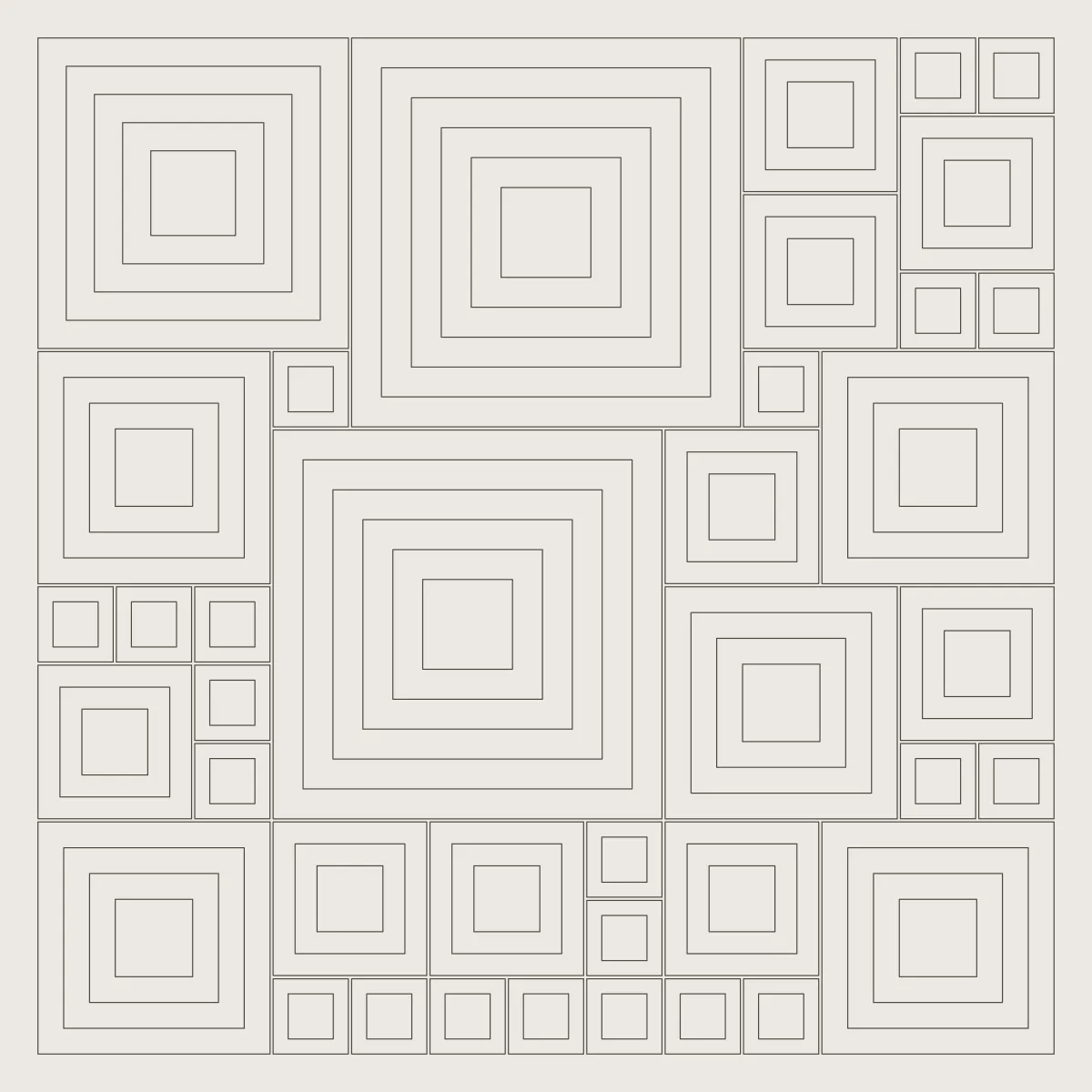
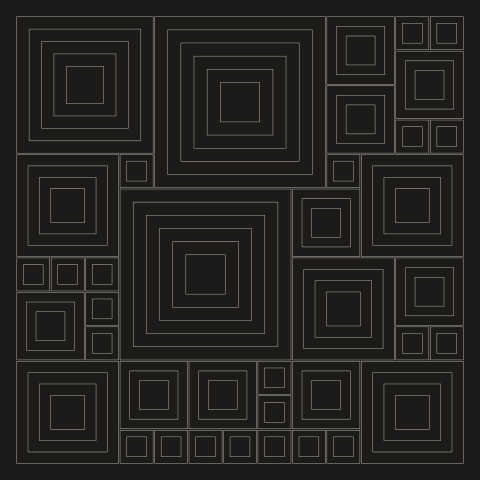
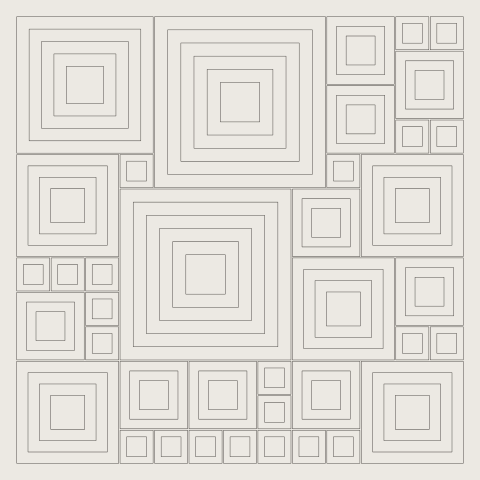
Can a square be cut into smaller squares, all of them different sizes? For a long time nobody could find one, and some thought it could not be done. Henry Dudeney, the great English puzzle writer, asked a gentler question in Amusements in Mathematics in 1917: Mrs Perkins has a patchwork quilt 13 squares across, made of square patches of whole sizes, and it is to be made from as few patches as possible.
The answer is eleven, with sizes free to repeat; one way to do it is drawn here. Dudeney asked only for the fewest pieces: the rule that the patches must not all share a common factor came later, when mathematicians took up the same question for quilts of every size. The hard version, with every square a different size, is called a perfect squared square.
Roland Sprague published the first in 1939, with 55 squares and a side of 4,205. In 1978 A. J. W. Duijvestijn used a computer to find the one drawn here: 21 squares, no two alike, fitting a side of 112 exactly, and it has been proved that no perfect squared square uses fewer. Its placements are worked out from its Bouwkamp code, a list of the sizes row by row, and checked so that the areas add up and nothing overlaps.
The patchwork fills a grid of any size with squares at random, leaning towards big pieces or small. Hatching gets finer on the smaller squares; nested squares give each piece rings in proportion to its size, like an Albers painting.
In motion the squares are laid one after another, in the order they are placed, and the quilt holds.
Behind the mathematics
Mrs Perkins's quilt, Amusements in Mathematics, 1917
English author and mathematician, one of the great puzzle makers. Mrs Perkins's quilt is problem 173 of his Amusements in Mathematics, 1917.
The first perfect squared square to be published, 1939
German mathematician, known for the Sprague–Grundy theorem of games and for publishing the first perfect squared square in 1939: 55 squares, all different, in a square of side 4,205.
The 21-square perfect squared square, 1978
Dutch researcher who in 1978 found, by computer search, the simple perfect squared square of side 112 made of just 21 squares, which has been proved the smallest possible.