Regime · Starting form · Contour layers
Textures that look grown rather than drawn. Noise functions, reaction and diffusion, and contour lines turn a few equations into terrain, spots, stripes and fields.
Regime · Starting form · Contour layers
Landform · Contours · Erosion
Line density · Curvature · Depth
Scale · Lines
Columns · Warp
Field · Dot pitch · Screen angle
Regime · Thickness
Played on · Corners · Jump towards the corner
Start from · Food spots · Sensor angle
Picture · Dots · Settling
Two reacting, diffusing chemicals grow into islands and labyrinths. Watch cells spread, divide and meet, then scrub back to a composition worth keeping.
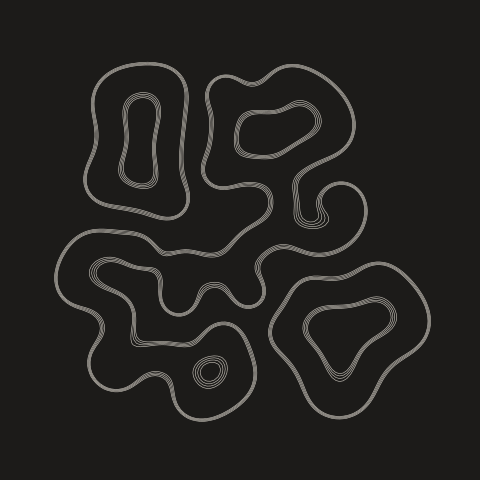
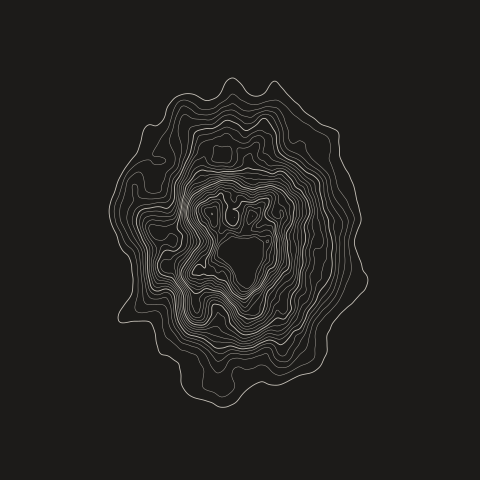
Equal-height lines trace an imagined landscape. A mountain, a crater or a long ridge is folded by smooth noise into islands of nested contours.
Long, evenly seeded currents gather into folds of silk. A smooth noise displacement bends each strand while leaving room for the drawing to breathe.
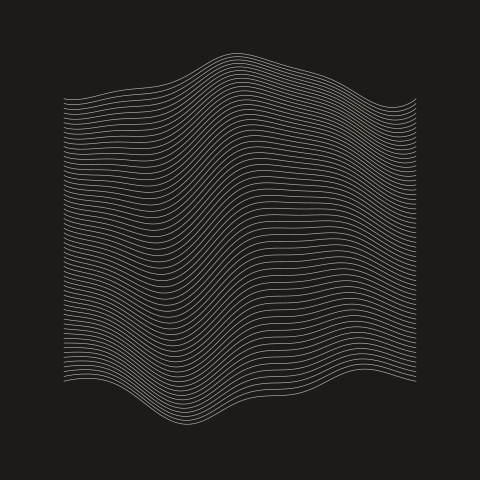
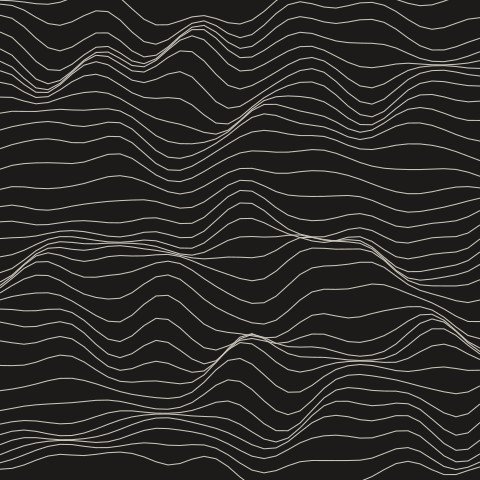
Horizontal hatches displaced by simplex noise. The drawing is the noise itself, with no particles, no field walking.
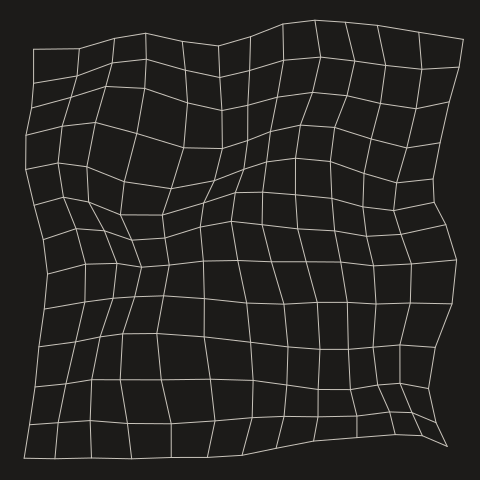
A regular lattice, each vertex shoved by simplex noise. The drawing is the grid’s own edges after the shove: a cloth, not a triangulation of random sites.
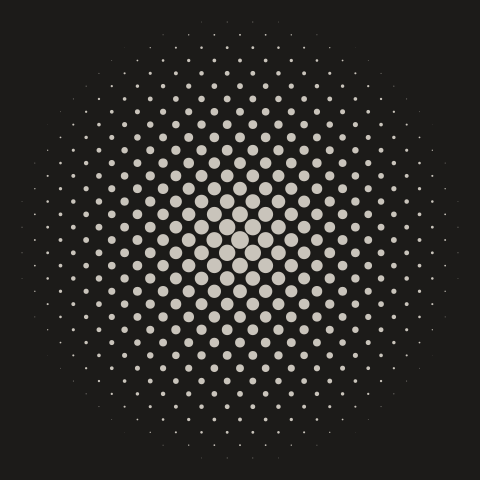
A regular screen of dots where only the size carries the picture. Turn the screen off-axis, change the field beneath it, and tone becomes texture.
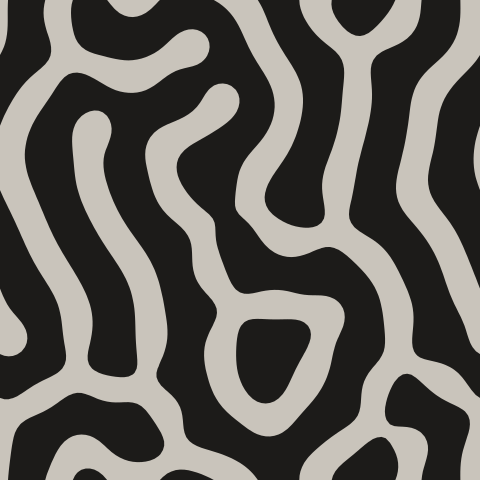
Two chemicals, one spreading faster than the other, settle into spots, mazes or coral from an almost uniform start. No edge anywhere, so it repeats forever.
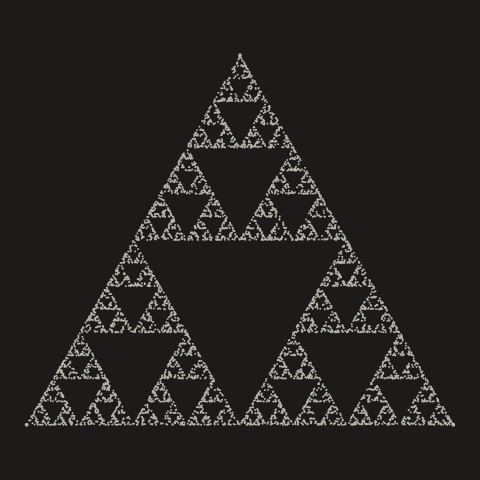
Pick a corner at random and jump half way towards it, again and again. The dots never land anywhere near randomly: they draw the Sierpiński triangle.
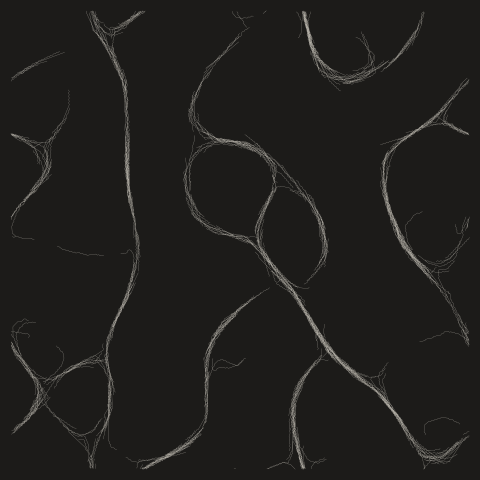
A slime mould has no brain, yet it builds efficient networks. Thousands of tiny agents follow each other's trails, and veins grow on their own.
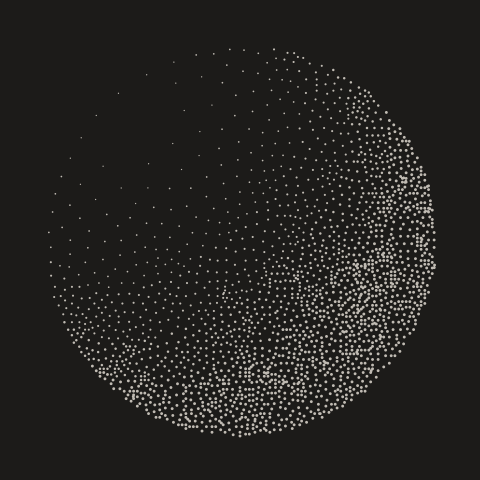
Thousands of dots, crowded where the picture is dark, nudge themselves apart until they settle like a hand-stippled print. Joined by one line that never crosses itself, they become a drawing in a single stroke.