
Frank Odds1945–2020
Spirolaterals, The Mathematics Teacher, 1973
British microbiologist who described spirolaterals in The Mathematics Teacher in 1973, figures drawn by walking 1, 2, 3 and more steps with a fixed turn after each.
Walk one step, turn; two steps, turn; and so on up to n, then start again. Most walks come home, drawing knots and stars from one simple rule.
Frank Odds, 1973
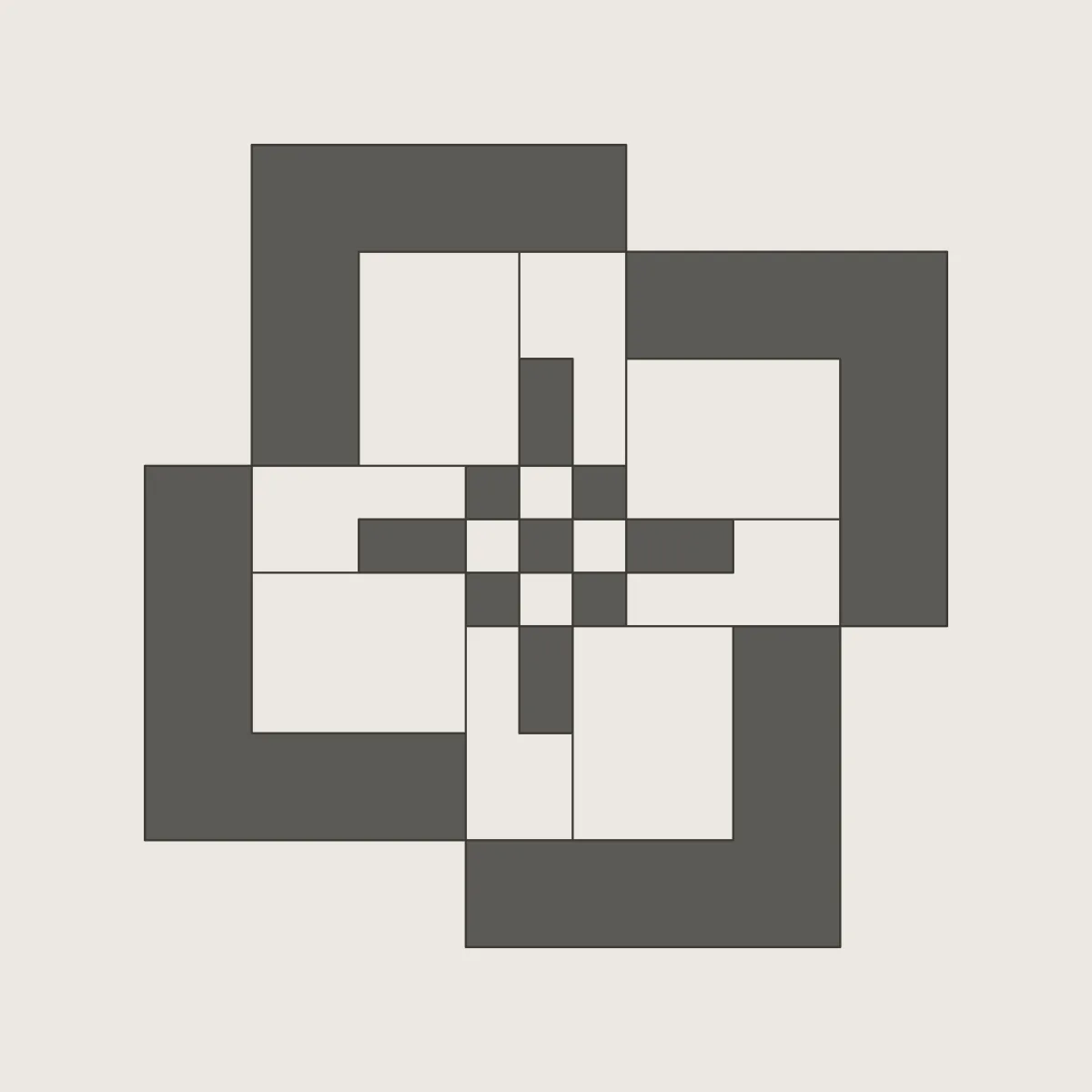
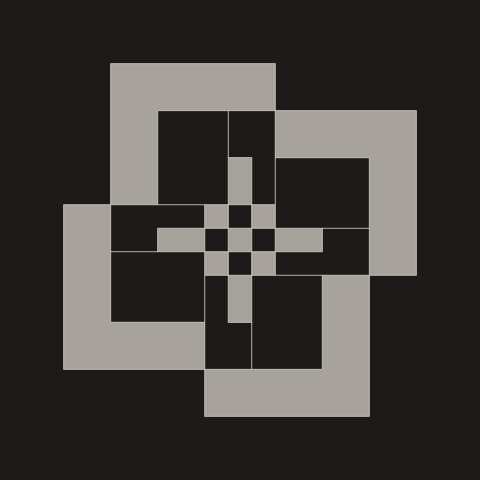
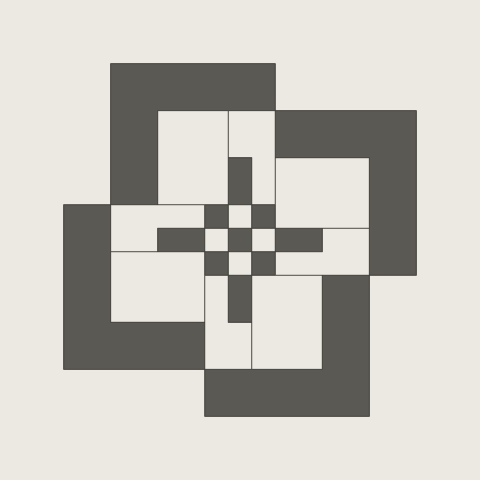
The rule fits on a postcard. Pick a number n and an angle. Walk 1 step and turn by the angle; walk 2 steps and turn the same way; carry on up to n steps, then start again from 1. Keep going until you are back where you began, facing the way you set off. Frank Odds, later a biologist, wrote them up as spirolaterals in The Mathematics Teacher in 1973, and they have been a favourite of maths classrooms and of turtle-drawing programs ever since.
Whether a walk comes home depends on how far one cycle turns you round. With a right angle and n = 4, a cycle turns you all the way round, and the walk sets off in a straight line for ever; with n = 5, each cycle turns you a quarter, so four cycles bring you home, and the figure has four-fold symmetry.
Odds's other idea was to make some turns go the other way, which gives knots and keys and fretwork. The sheet lays out a whole family, one more step in each square, like a sampler; open walks are drawn as four cycles and left unfinished. Filled, the overlapping loops alternate in and out, as a chequerboard does.
In motion each figure turns round its centre by one step of its own symmetry, so the loop ends where it began.
Behind the mathematics
Spirolaterals, The Mathematics Teacher, 1973
British microbiologist who described spirolaterals in The Mathematics Teacher in 1973, figures drawn by walking 1, 2, 3 and more steps with a fixed turn after each.