
H. S. M. Coxeter1907–2003
Frieze patterns, 1971
British-Canadian geometer who worked out the regular hyperbolic tilings and whose diagrams sent Escher off to draw the Circle Limit prints.
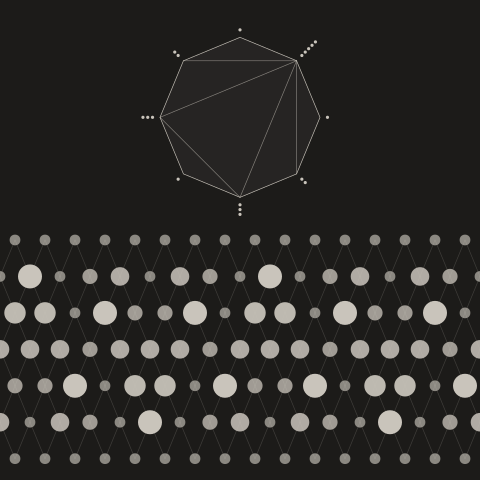
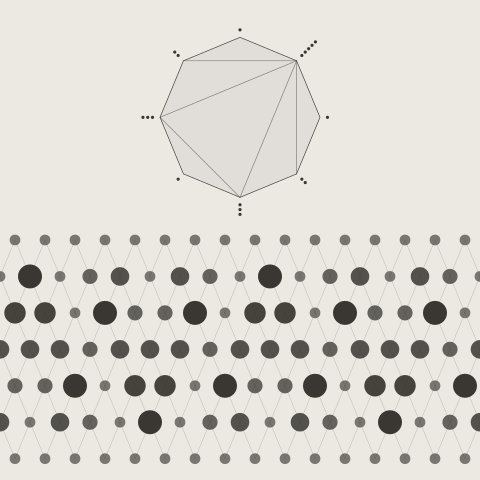
Rows of whole numbers held between two rows of 1s, every diamond of four obeying one rule. Each such frieze comes from a polygon cut into triangles, drawn above it.
H. S. M. Coxeter, 1971 · John Horton Conway and Coxeter, 1973
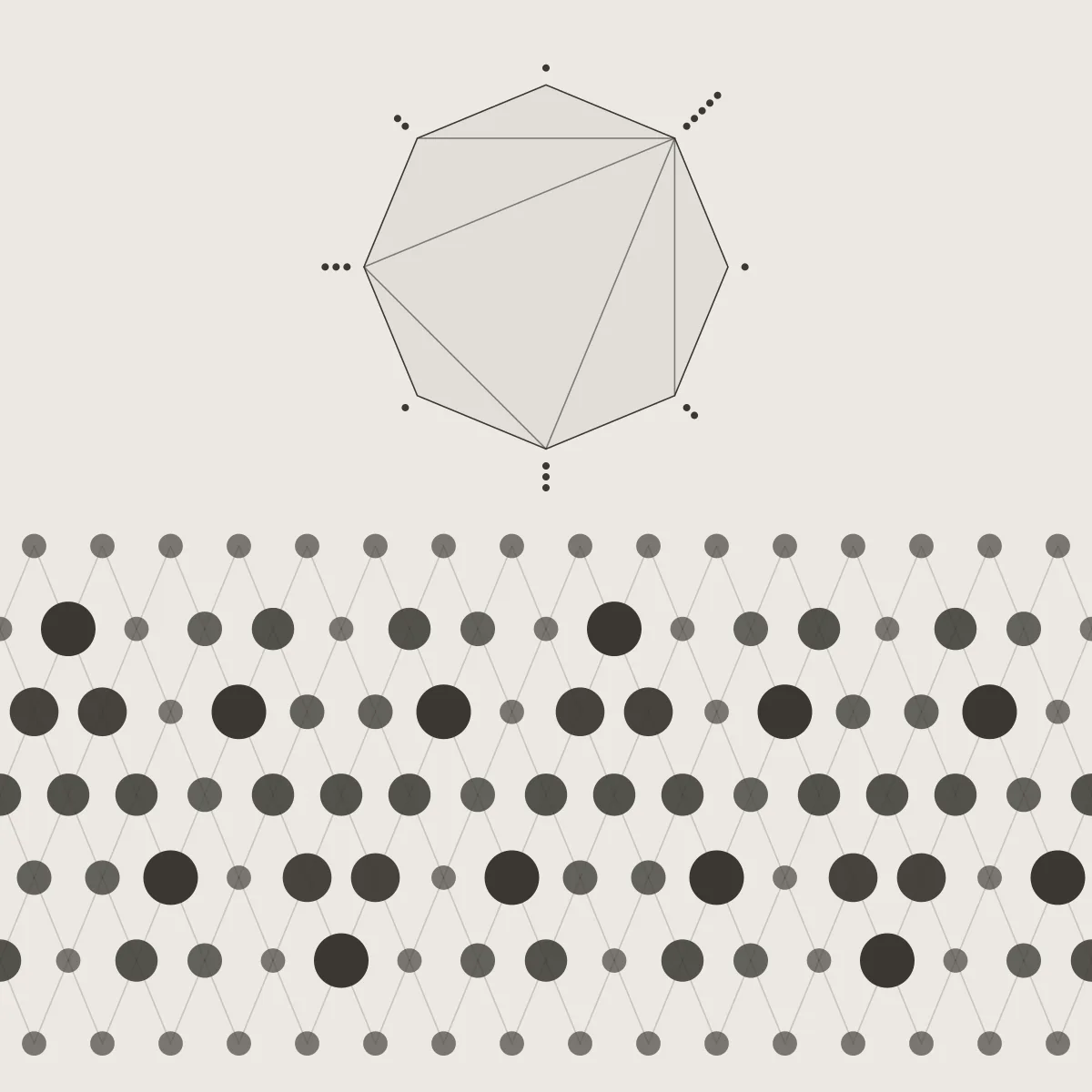
Start with a row of 1s and, below it, a row of whole numbers. Every new row is forced: for each diamond of four neighbours, the left and right multiplied, less the top and bottom multiplied, must make 1. Usually the numbers soon turn into fractions, but Coxeter found friezes that stay whole all the way down and close with a second row of 1s, and in 1973 Conway and Coxeter proved exactly which ones do: the second row must count the triangles meeting at each corner of a polygon cut into triangles.
Here the polygon and its cuts are drawn above and the frieze below, each number as a disc whose area grows with it. The frieze repeats every n columns, turned upside down halfway, so it wraps round the sheet; in motion its rows are filled in one at a time, each forced by the ones before.
Behind the mathematics
Frieze patterns, 1971
British-Canadian geometer who worked out the regular hyperbolic tilings and whose diagrams sent Escher off to draw the Circle Limit prints.
Friezes from triangulated polygons, 1973
English mathematician who invented the Game of Life, and with Coxeter discovered the number friezes that close up by a single rule, and with Charles Radin the pinwheel tiling.
