
Heinrich Heesch1906–1995
Posed the problem, 1968
German mathematician who in 1968 asked how many times a shape that cannot tile the plane can be surrounded by copies of itself, the question now answered for each shape by its Heesch number.
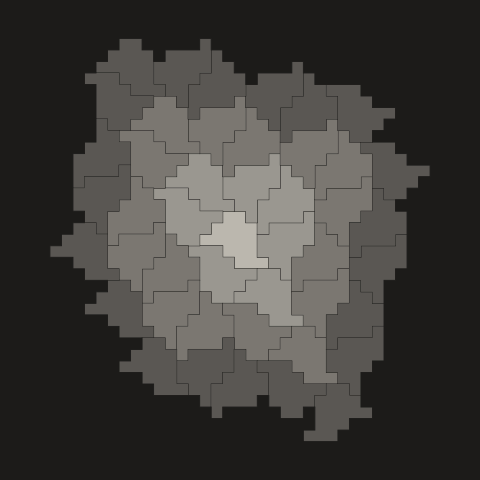
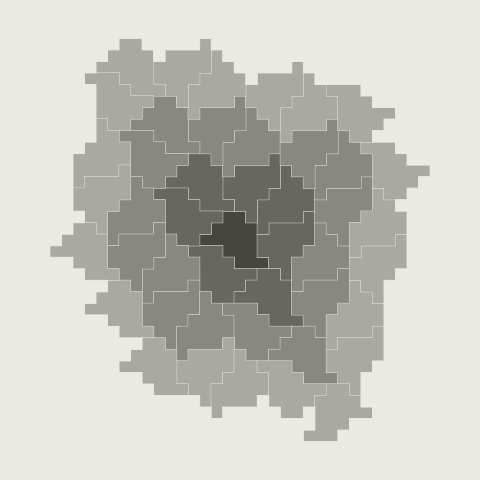
A shape that cannot tile the plane, surrounded by rings of its own copies until no further ring will close. The count of rings is its Heesch number.
Heinrich Heesch, 1968 · Craig S. Kaplan, 2022
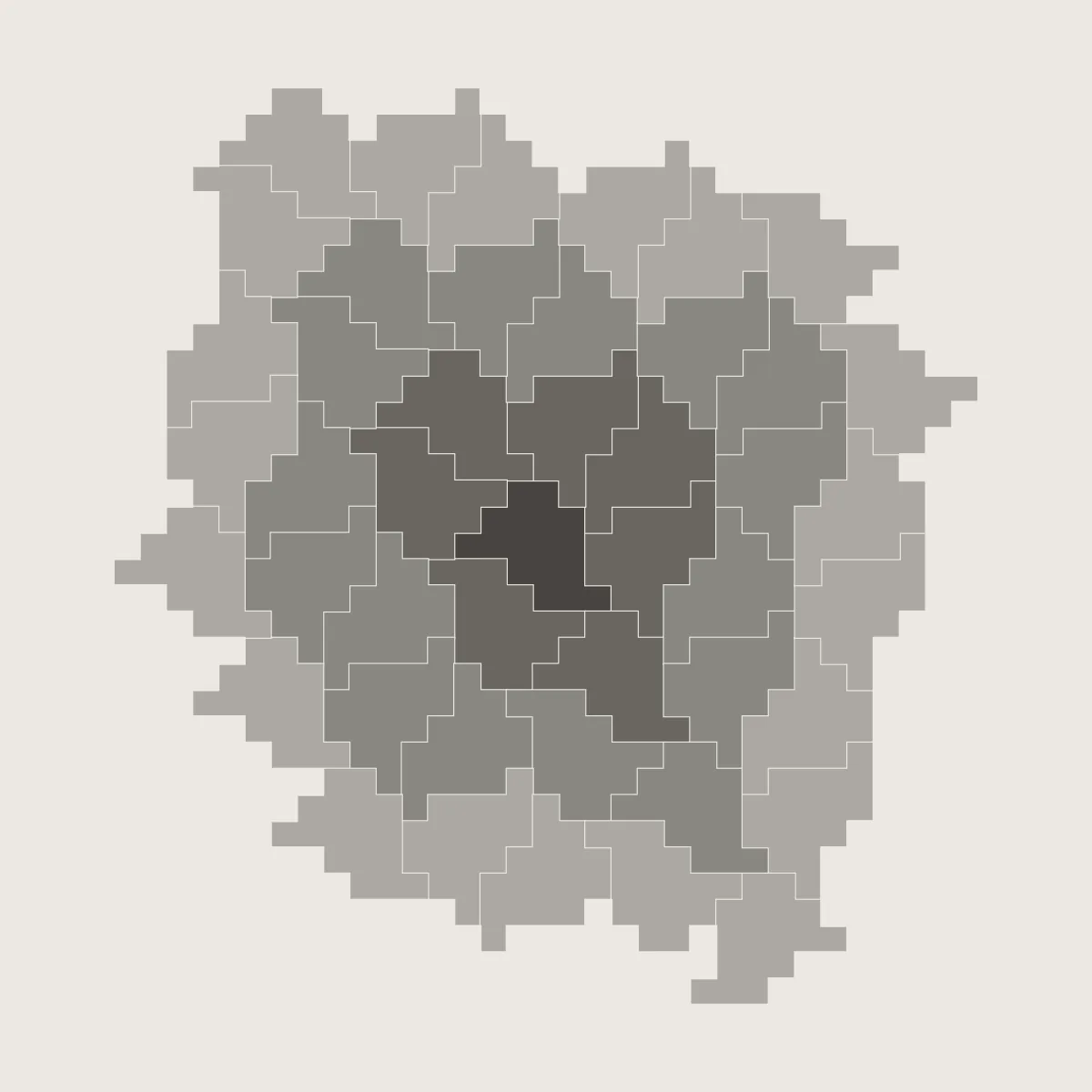
Some shapes tile the plane forever, and most cannot be surrounded even once. Between them are shapes that can be ringed by copies of themselves a few times and then no more: Heinrich Heesch asked in 1968 how many rings, or coronas, are possible, and the answer for a given shape is its Heesch number.
Each ring here covers every square that touches the rings inside it, at an edge or a corner, with nothing overlapping and no gap left inside. Casey Mann found shapes that take five; Bojan Bašić one that takes six. Craig Kaplan turned the question into a satisfiability problem and computed the Heesch number of every polyomino up to nineteen squares.
The shapes and their Heesch numbers here come from Kaplan's tables, where each is proven; the rings drawn around them were found by GART's own search. In motion the rings are laid down one at a time.
Behind the mathematics
Posed the problem, 1968
German mathematician who in 1968 asked how many times a shape that cannot tile the plane can be surrounded by copies of itself, the question now answered for each shape by its Heesch number.
Computed Heesch numbers of polyforms with a SAT solver, 2022
Canadian computer scientist whose research joins geometry, computation and ornamental design, including the proof and visualisation of the hat monotile.
Shapes with Heesch number 5
American mathematician who found a shape that can be surrounded five times and no more, a record for Heesch’s problem that stood for nearly two decades until 2021.
The record, Heesch number 6, 2021
Serbian mathematician who in 2021 found a shape that can be surrounded six times and no more, the current record for Heesch's problem.
