Casey Mann
Found the fifteenth kind of pentagon that tiles, 2015
American mathematician who found a shape that can be surrounded five times and no more, a record for Heesch’s problem that stood for nearly two decades until 2021.
Pentagons laid like paving, four ways round, two by two into hexagons. Slide the bar and the whole floor shifts from squares through equal-sided pentagons and back.
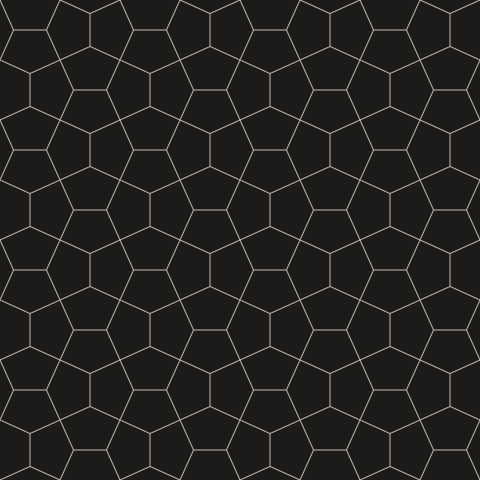
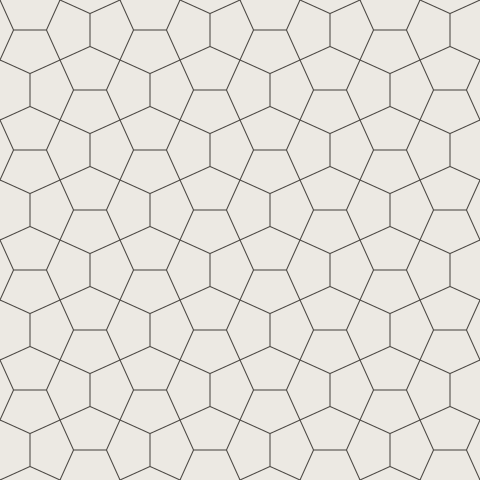
Cairo street paving · Casey Mann and others, 2015
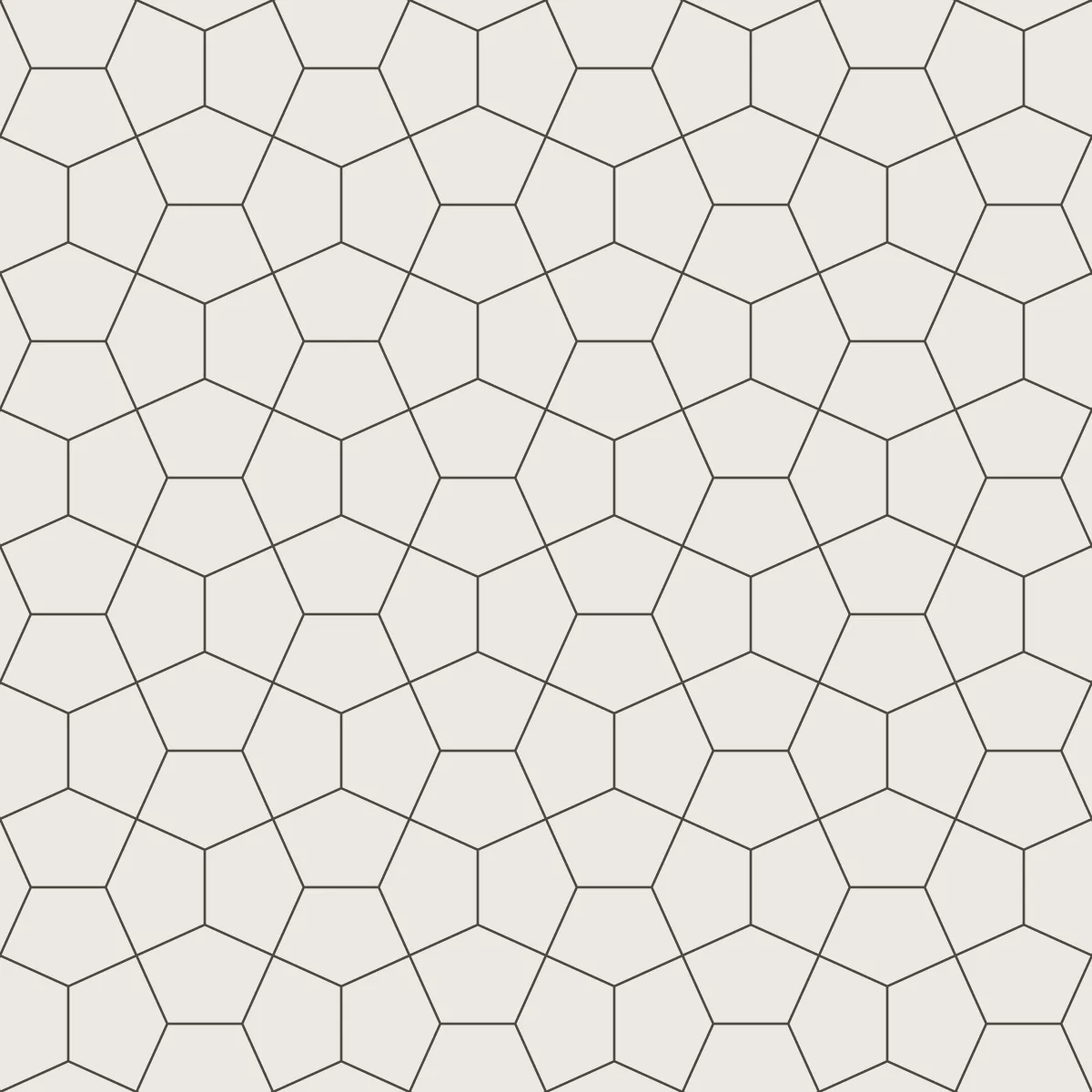
A regular pentagon cannot tile a floor: its corners are 108°, and no number of them makes 360°. Bend it a little and it can, in at least fifteen different ways, the last found by computer in 2015 and proved complete in 2017. The best loved is named after Cairo, where it paves streets and is said to be laid in the pavements of the old city.
Two pentagons back to back make a hexagon, and the hexagons lie in two directions, upright and across, crossing like a woven mat. It hides a square grid: draw a short bar through the middle of every square, across and upright in turn like a chequerboard, join each end to the two nearest corners and rub out the squares.
Every corner where three pentagons meet is the end of a bar; every corner where four meet was a corner of the grid. The bar is the one thing you can change. At nothing the pentagons collapse into squares turned on end; at the full width of the square they flatten into the grid itself; and at (√7 − 1)/3, a little over half, all five sides of every pentagon are equal.
In motion the bar breathes in and out about the length you chose. Drawn in tones, each of the four ways a pentagon lies has its own shade, and the woven hexagons come forward.
Behind the mathematics
Found the fifteenth kind of pentagon that tiles, 2015
American mathematician who found a shape that can be surrounded five times and no more, a record for Heesch’s problem that stood for nearly two decades until 2021.