
Archimedesc. 287–c. 212 BCE
The dissection
Greek mathematician whose study of the spiral established a curve whose radius grows at a constant rate with its angle.
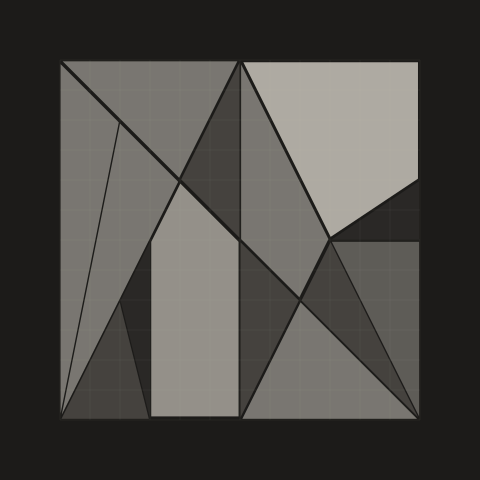
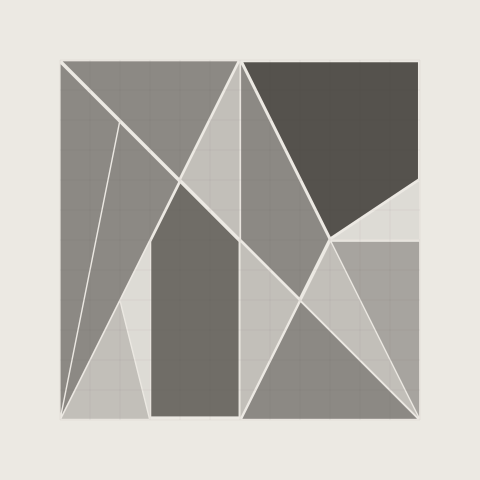
Archimedes' square of fourteen pieces, every corner on a 12 × 12 grid. In motion it comes apart, turns, and closes up again.
Archimedes, 3rd century BCE · Bill Cutler, 2003
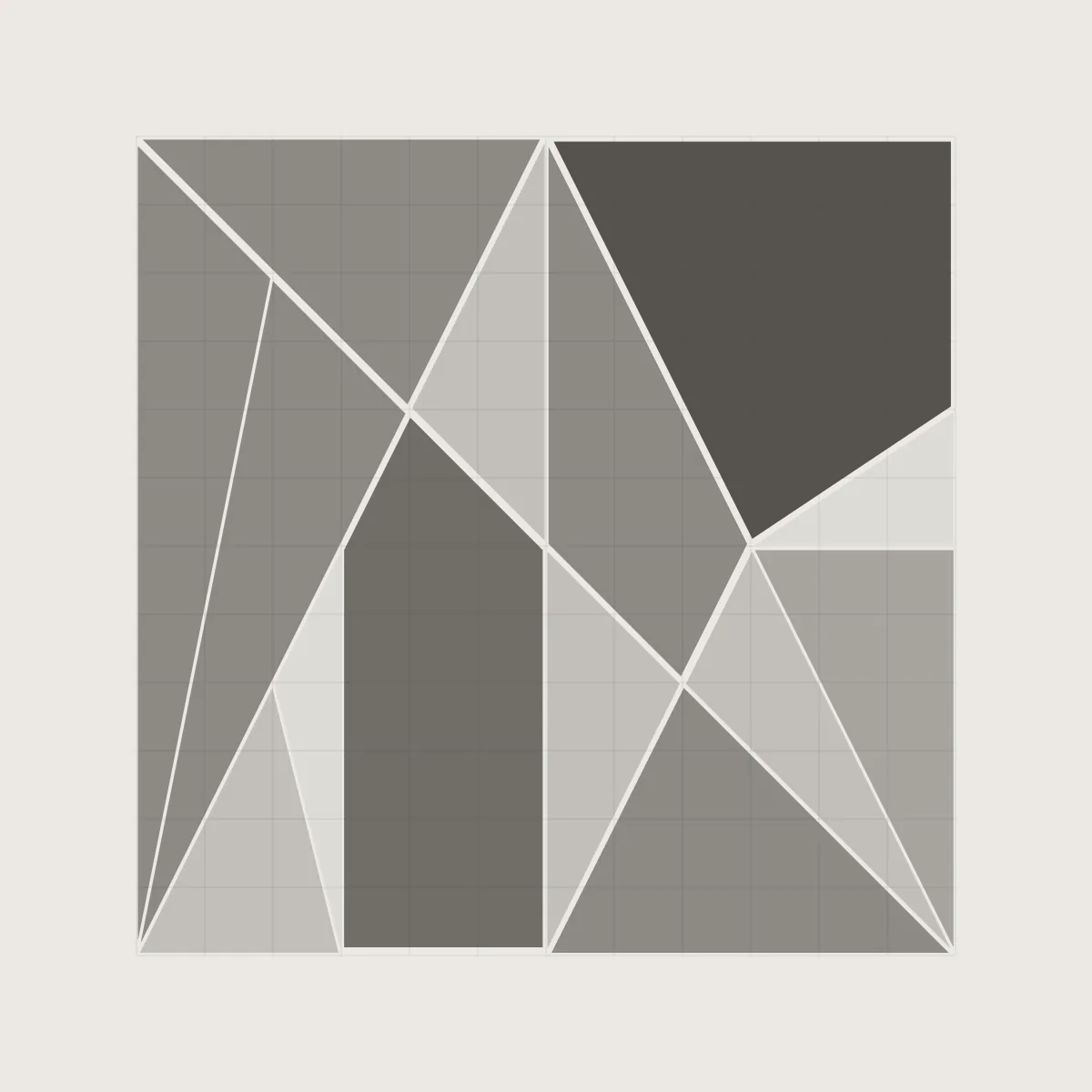
The Stomachion survives in a palimpsest, an Archimedes manuscript scraped and written over as a prayer book, and in a few Arabic and Latin fragments. It cuts a square into fourteen pieces whose corners all fall on a 12 × 12 grid, so every piece's area is a whole number of grid squares, from 3 to 24.
What Archimedes asked of it is not certain, but one reading is a counting question: in how many ways can the pieces be put back together as a square? In 2003 Bill Cutler found by computer that there are 536 ways, not counting turns and flips of the whole square. The drawing is the canonical arrangement, its pieces shaded by area; in motion they drift apart, each turning a little, and fit back together.
Behind the mathematics
The dissection
Greek mathematician whose study of the spiral established a curve whose radius grows at a constant rate with its angle.
Counted its 536 squares, 2003
American puzzle designer who in 2003 counted the ways to assemble Archimedes’ Stomachion into a square: 536, setting aside rotations and reflections.