
Archimedesc. 287–c. 212 BCE
The solids made by truncation
Greek mathematician whose study of the spiral established a curve whose radius grows at a constant rate with its angle.
A Platonic seed, truncated toward rectification, then truncated again. Amount is how far each cut goes; rounds is how many times the solid eats itself.
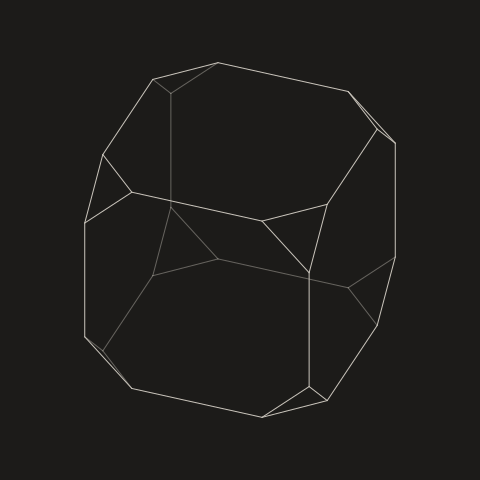
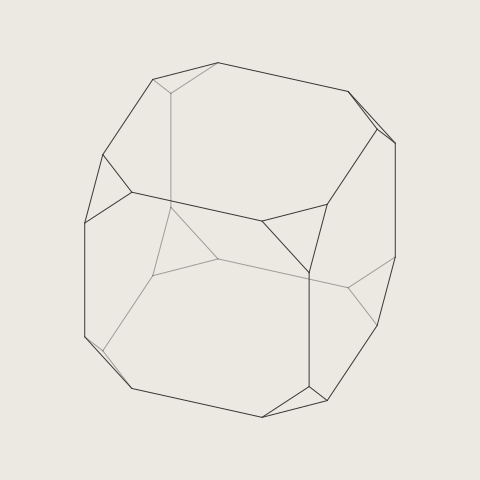
Truncating the Platonic solids · after Archimedes

A Platonic seed, cut toward rectification, then cut again. Amount is how far each vertex is eaten; rounds is how many times the solid applies the same bite to itself. Drawn as the same isometric line art as Geodesic.
Behind the mathematics
The solids made by truncation
Greek mathematician whose study of the spiral established a curve whose radius grows at a constant rate with its angle.