Solid · Detail · Turn
Polyhedra drawn in line: Kepler's nested Platonic solids, geodesic spheres, Jessen's icosahedron, deltahedra built only from equilateral triangles, and a solid that cuts itself down by truncation.
Solid · Detail · Turn
Solid · Amount · Rounds
Vertices · Jitter · Turn
Fold · Turn · Tilt
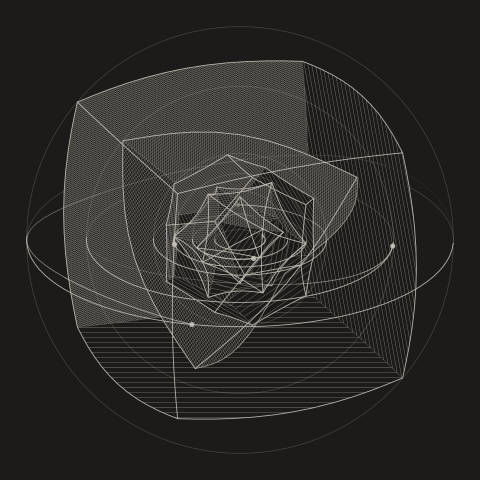
Solids, from the Sun out · Evened out · Drawn as
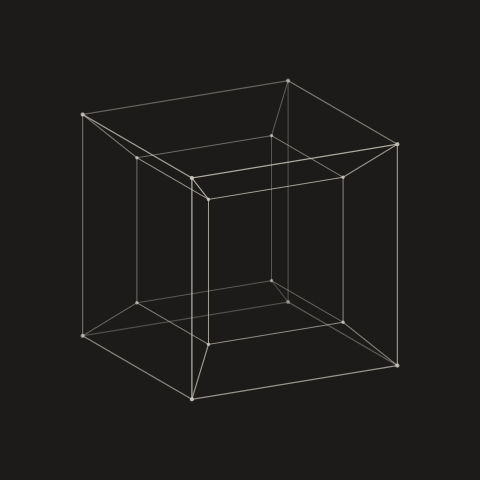
Polytope · Turning · Fourth-axis turn
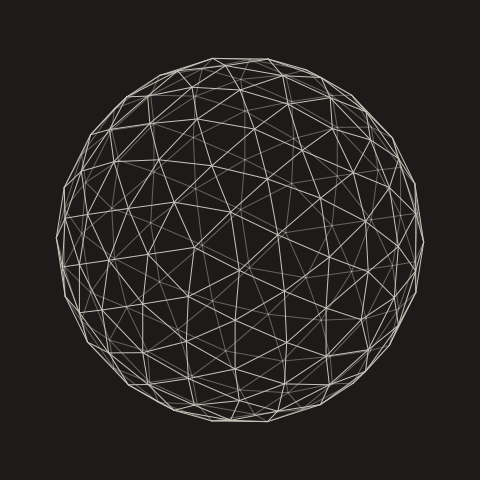
A Platonic solid, geodesically subdivided, drawn as 2D line art. Detail is subdivision; turn and tilt choose the view. Far side fades the hidden hemisphere so the solid reads in depth.
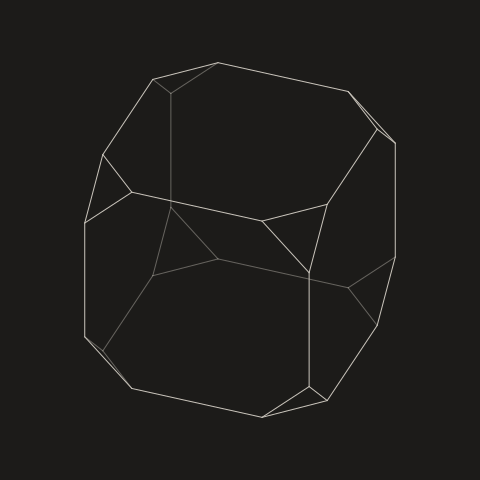
A Platonic seed, truncated toward rectification, then truncated again. Amount is how far each cut goes; rounds is how many times the solid eats itself.
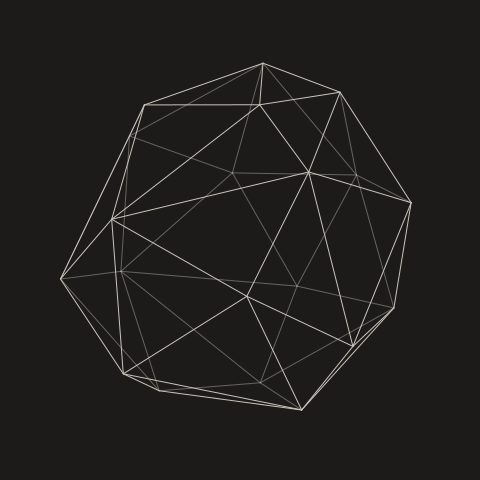
A convex hull of seeded points on a sphere. Every face is a triangle, none of them regular. Count is how many vertices; jitter breaks the even packing.
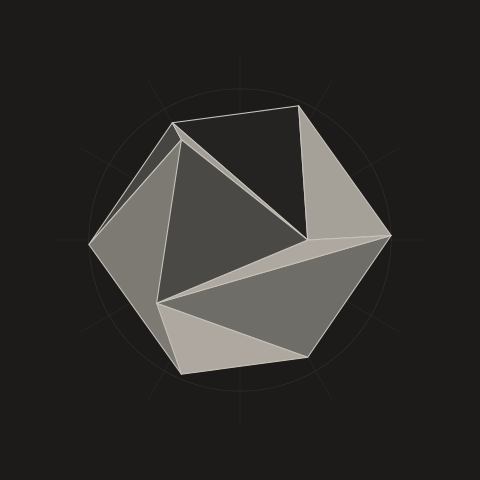
Twenty triangles whose every pair of neighbours meets at a right angle. Six pairs fold into deep notches, so a regular icosahedron turns star-like.
The five Platonic solids nested one inside another, with a sphere between each pair: Kepler's 1596 model of why there were six planets, and why they sat where they did.
A four-dimensional cube turning through a direction we cannot point to. Its far cube swells, passes through the near one and turns inside out, edges never bending.