Tesseract

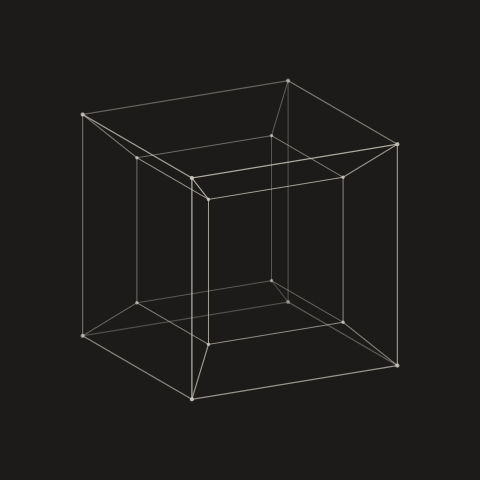
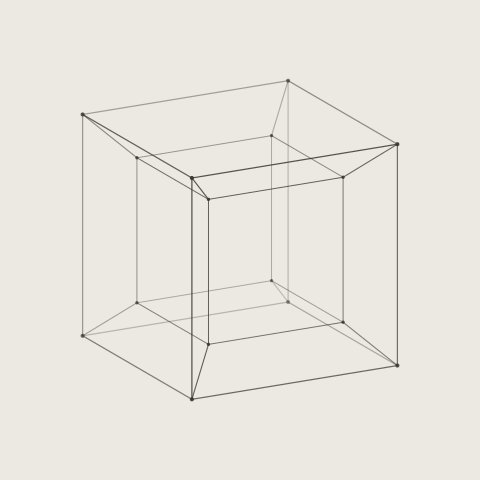
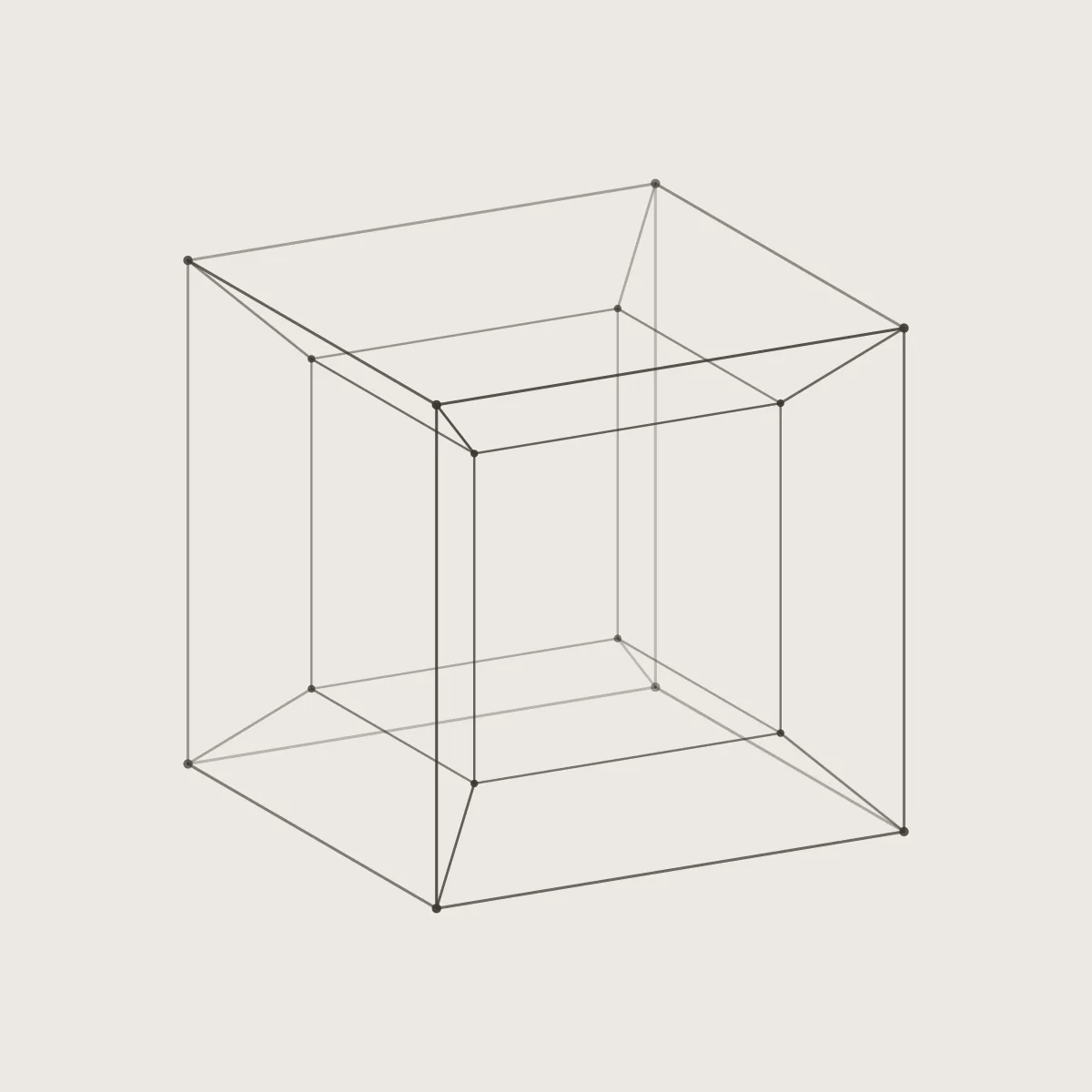
A four-dimensional cube turning through a direction we cannot point to. Its far cube swells, passes through the near one and turns inside out, edges never bending.

Tesseract: A four-dimensional cube turning through a direction we cannot point to. Its far cube swells, passes through the near one and turns inside out, edges never bending.Tesseract: A four-dimensional cube turning through a direction we cannot point to. Its far cube swells, passes through the near one and turns inside out, edges never bending.

About this shape

Ludwig Schläfli, 1852 · Charles Howard Hinton, 1888

Tesseract, regular 4-polytope, drawn by GART: A four-dimensional cube turning through a direction we cannot point to. Its far cube swells, passes through the near one and turns inside out, edges never bending.
Tesseract · CC BY 4.0

A square drawn in perspective is a small square inside a big one, joined at the corners; that is a cube seen down one axis. Do the same one dimension up and you get the tesseract: a small cube inside a big one, joined corner to corner, eight cubes in all, the same as a cube has six squares. Charles Howard Hinton coined the name in 1888 and spent years teaching people, with coloured blocks, to picture it.

Behind the mathematics

Charles Howard Hinton1853–1907

Named the tesseract, A New Era of Thought, 1888

British mathematician and writer who spent years teaching people to picture the fourth dimension, with coloured cubes, and who coined the word tesseract in A New Era of Thought, 1888.

Ludwig Schläfli1814–1895

Found the six regular polytopes of four dimensions, 1852

Swiss mathematician who worked out the geometry of many dimensions decades before others took it up, and found that four dimensions have six regular polytopes.